Satan Divides, Christ Unites — Which Way Will We Choose?
COMMENTARY: The Church stands between the two ways — communion and division, life and death, light and darkness. Our age must choose which path to follow.
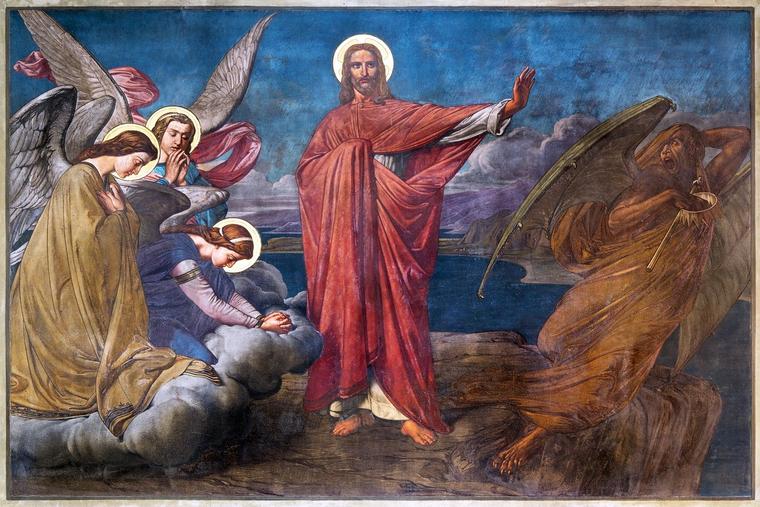
The Didache — one of the earliest Christian texts besides the New Testament — begins with this: “There are two Ways, one of Life and one of Death, and there is a great difference between the two Ways.”
This line is deeply rooted in Scripture. Think of the words of Moses in Deuteronomy: “I have set before you life and death, blessings and curses” (30:19). Or think of Matthew 25, where Christ speaks of the separation of the sheep and the goats — one blessed, the other cursed — at the end of time.
There are two ways. This idea has always shaped the lives of Christians. Are we children of light or children of darkness? Will we walk the road to salvation or the road to perdition? Do we belong to the City of God or the City of Man?
This question remains fundamentally the same today, but the Church needs a new language for pronouncing it, as much to itself as to the world. Why? First, our age has its own distinctive and disquieting contours. Trump, TikTok, COVID and the AI boom, whatever else they’ve done, have utterly redrawn our map of reality, and we find ourselves in a strange new landscape — a bedlam of fragmentation and polarization.
Second, we have a new Pope with a new style of leadership. Before the conclave that would elect Leo XIV, The New York Times published a piece arguing that unity was a “divisive” motto for the Catholic Church. Whether the cardinals saw that headline or not, clearly they came to the very opposite conclusion: Leo, drawing on his Augustinian spirituality, has made unity a central — if not the central — theme of his pontificate thus far.
We need a new point of departure for the two ways: the way of communion or the way of division.
What Is the Way of Division?
What’s the way of division? We see it in our country, in our communities, maybe even in our own families. It’s a path marked by mutually exclusive principles, polarized extremes and noxious hostility. Human division isn’t exactly news — just flip to any page of any history book — but the digital age has amplified its intensity a hundredfold. All of our ideas now crash into each other online — all around the world, all the time, with just the click of a button. And the more interconnected we become, the more we descend, in a bitter irony, into a brutish tribalism. The end result — vividly illustrated by the headlines of the past few weeks — is paroxysms of violence.
Our political and cultural discourse has fallen headlong into the way of division, but division isn’t a mere political or cultural problem. It runs far deeper, down into the human soul, where a fundamental perversion reigns. Christianity traditionally speaks of this perversion in terms of both sin and Satan, but both are of a piece with division.
“Where there are sins,” Origen writes, “there are schisms” — that is, divisions (see Jude 19; Titus 3:10-11; 1 Corinthians 11:17-22). And the very word “diabolic” signals dividedness: dia-ballein, “to scatter” or “to throw apart.”
The devil is sin’s father (1 John 3:8); the wages of sin is death (Romans 6:23), and the upshot of death is “the second death” of hell (Revelation 21:8) — and this whole trajectory is shot through by division. Left to our own devices, we’re divided from God, divided from each other, divided even from our very selves (Matthew 16:26).
What Is the Way of Communion?
What’s the way of communion? We see it in Christ and his Body, the Church — the Totus Christus, in St. Augustine’s formula: the “whole Christ.” On this path, the things that divide us — and thus, the groups divided along those lines — are brought together and harmonized as one.
St. Paul, in his letters, repeatedly stresses this communion quality of the faith first called “the Way.” He writes that God has “gathered” and “reconciled” all things in heaven and earth through Christ (Ephesians 1:10; Colossians 1:20); that Christ is the “peace” between Jews and Gentiles, breaking down “the dividing wall” between them and making them “one” (Ephesians 2:14). He says that, in fact, there is no longer Jew or Greek, slave or free, or male or female — “for all of you are one in Christ Jesus” (Galatians 3:28). In short, there are to be “no divisions” in the Church, which is “united in the same mind and the same purpose”: the undivided Christ (1 Corinthians 1:10-13).
And Paul and the other New Testament writers exhort the early Christians again and again to guard this “unity of the Spirit in the bond of peace” (Ephesians 4:3), this oneness in and through Christ, through a spirit of love, peace, gentleness and patience with one another.
How exactly does this communion happen? The deepest answer to that question is hidden in the hills of Bethlehem and Calvary. But, as I’ve argued in The Way of Heaven and Earth, we can recognize a certain pattern of paradox in both the life of Christ and the Christian life — a convergence of heavenly and earthly reality. In this convergence, heaven and earth remain contrasted (they are distinct) yet deeply connected (they are one). This pattern explains us to ourselves. If we turn down the way of division, we find heaven and earth in opposition, choosing one at the expense of the other; if we turn down the way of communion, we find the two integrated in the sacramental Church and drawn toward the fullness of God “all in all” (Ephesians 1:23; 1 Corinthians 15:28).
The practical upshot of this communion should be clear: What unites the Church is far deeper and stronger than what could ever divide it. People of varying social and political backgrounds, with a diversity of spiritual gifts and personal perspectives, all come together to worship at the same altar and live in the same community, learning from and appreciating one another. The Church then becomes, to borrow Leo’s phrase, a “leaven of unity, communion and fraternity” to the world through its own life and witness.
Which Way Will We Choose?
The reality, though, is that the Catholic Church — and Christians generally — are stumbling down the way of division, which is the way of the world: the way of sin and death and hell. We’ve politicized absolute matters and absolutized political matters, taking potshots online and fomenting discord for personal gain. We’ve taken our cues not from the in-gathering of the divine but from the scattering of the diabolical — not from the harmony of Christ but from the chaos of Satan. And the degree to which the Church fails to live up to and protect its own light is precisely the same degree to which the world, lacking any meaningful countersign, will succumb to its own darkness.
Pope Leo has called on the Church to commemorate the opening of the Second Vatican Council, which began on Oct. 11, 1962. On that day, his predecessor, Pope St. John XXIII perfectly summarized the ways of communion and division:
Either men anchor themselves on [Christ] and his Church, and thus enjoy the blessings of light and joy, right order and peace; or they live their lives apart from him; many positively oppose him, and deliberately exclude themselves from the Church. The result can only be confusion in their lives, bitterness in their relations with one another, and the savage threat of war.
This is where we stand today: poised between the way of communion and the way of division — between peace and war, light and darkness, joy and bitterness, right order and utter chaos.
Which way will we choose?
- Keywords:
- communion
- catholic unity
- division
- schism
- scandal of division