America 250 Years Later: A Conversation With Robert George
One of the country’s foremost Catholic intellectuals weighs in on political polarization, the role of Catholic life in the U.S., and the state of the great ‘American experiment’ as the nation approaches this landmark anniversary.
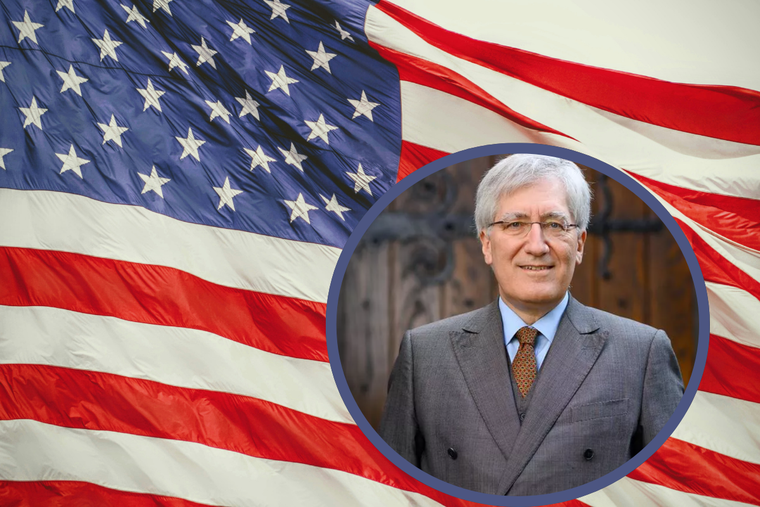
As the United States approaches the 250th anniversary of the Declaration of Independence, the occasion provides an opportunity not only to celebrate the nation’s founding but also to reflect on the health of the American republic two and a half centuries later.
To consider this question, the Register turned to Robert George, McCormick Professor of Jurisprudence at Princeton University and founder of the James Madison Program in American Ideals and Institutions. Widely recognized as one of the nation’s foremost Catholic intellectuals, George offered his assessment of American democracy and the duties of citizenship at a pivotal moment in the country’s history.
In an emailed exchange, George reflected on the strengths and challenges facing American democracy, the responsibilities of citizenship, the role of Catholics in public life, and the enduring promise of the American experiment as the nation turns 250.
As we mark the 250th anniversary of the Declaration of Independence, how do you think the American experiment is going?
“Experiment” is the right word. Our founders knew that the constitutional republic they proposed to establish would be an experiment — and that experiments can fail. Indeed, over the course of history, attempt after attempt to establish systems of self-government had failed. And when republics failed, they often collapsed into the worst forms of tyranny. By the time of the American founding, many people had concluded that the failure of republics was inevitable: Human beings are simply incapable of governing themselves.
We Americans can be grateful that ours is a republic that has, to borrow a phrase from Abraham Lincoln, “long endured.” Although it was almost lost in a bloody civil war, it survived that conflict and the underlying moral dispute over slavery that, as Lincoln finally acknowledged, caused it.
The maintenance of a republican form of government for two and a half centuries is certainly something worth celebrating. And it is something for which we should all be grateful to those men who, pledging their “lives, fortunes, and sacred honor,” launched the American experiment. But it is also an occasion to remind ourselves that the experiment is ongoing, and could yet be lost, and to rededicate ourselves to fulfilling the promise contained in our founders’ declaration that “all men are created equal, that they are endowed by their Creator with certain unalienable rights.”
Do you see the polarization of our country as an existential threat to the nation?
Yes, I’m afraid I do. We as a nation are not — yet — being tested as we were in 1861. But our current measure of polarization is not far from where things were in 1800, when bitter ideological partisanship between Federalists and Democratic-Republicans (also known as “Jeffersonians”) raised a real question of whether our unity as a nation could be maintained.
For republican government to survive, civic friendship must be sustained. Citizens whose opinions about important matters differ, as is inevitable in circumstances of freedom, must be willing to treat each other not as enemies to be defeated or destroyed, but as friends who disagree — that is to say, as fellow citizens. Civic friends resolve their disagreements, at least in terms of public policy, via agreed-upon constitutionally prescribed mechanisms and procedures.
Our problem today is not that people have deep disagreements. It is that the bonds of civic friendship have dangerously frayed. We need to remind ourselves that our fellow citizens with whom we disagree — even deeply disagree about fundamental matters of justice and the common good — are not our enemies. That’s the message of my book with Cornel West, Truth Matters: A Dialogue on Fruitful Disagreement in an Age of Division. Cornel and I have deep disagreements on what we both regard as profoundly important moral and political questions, yet we regard and treat each other as friends — and indeed brothers — and we engage each other in a spirit that enables us to learn from each other despite our differences.
How has the Catholic Church lived up to or failed to meet expectations of a “Catholic moment” in which it would serve as the primary moral conscience of the nation?
Well, for these purposes, the Catholic Church is the Catholic people — bishops and clergy, yes, but above all the laity who, according to the Church’s teaching, have primary responsibility for the sanctification of the world. Regrettably, to a very large extent, Catholics are part of the problem rather than part of the solution. Too many Catholics are driven more by ideological fervor and partisanship than by the teachings of the Church. We Catholics will become part of the solution when, and only when, our political actions are genuinely shaped by the Church’s wisdom — the wisdom of Christ — regarding questions of justice and the common good. If we were to do that, we would wear our partisan political allegiances very lightly.
Some Catholics today are questioning the idea of winning hearts and minds of the public and arguing for a more institutional, even statist, approach to advancing Catholic ideals. What do you make of this development?
Let me begin my response to this question by saying that we Catholics should not be tribal. We need to be prepared to join hands and hearts with men and women of goodwill of every faith and shade of belief in working for justice and the common good.
We should certainly be vigorous in the effort to win hearts and minds — making the case for what we believe to be right as intelligently and persuasively as possible. But we also need to work for policies that genuinely serve the cause of justice and secure the common good. This is not an “either-or” but is rather a “both-and” matter.
While some observers believe that political correctness and “woke” have peaked, others argue we are now seeing speech restrictions driven by different political factions. Can we ever fully return to a culture of true intellectual freedom?
Of course, we can — but the problem will not take care of itself. There is no “pendulum” that is bound to swing back. So, it’s up to us. We need to defend the right to free speech, and we need to do it in two important ways: 1) by exercising that right ourselves, even in the face of people who would resort to intimidation to silence us, and 2) by defending it not only for ourselves and people who disagree with us, but for those whose views we oppose. It cannot be “free speech for me, but not for thee.”
As America turns 250, do you see full legal protection for the unborn as the necessary culmination of our founding ideals?
We are, as a nation, committed to the principle of the profound, inherent and equal dignity of each and every member of the human family. That is the meaning of the proposition that “all men are created equal, that they are endowed by their Creator with certain unalienable rights.” We have struggled throughout our history to be faithful to that principle. The struggle continues as we work to accord to unborn human beings the full and equal protection of the laws. Just as we struggled over the issue of slavery and then segregation and Jim Crow, we struggle today over abortion and other violations of the rights of our fellow human beings in the embryonic and fetal stages of development. It is today the most glaring violation of the principle to which we committed ourselves as a nation.
How can lay Catholics contribute to the flourishing of our nation today?
By being engaged citizens who bring the profound intellectual and spiritual resources of our tradition to bear in fulfilling our civic duties. We Catholics must, by precept and example, show what it means to honor the profound, inherent and equal dignity of each and every member of the human family. We must, for example, stand up and speak out for the sanctity of human life in all stages and conditions; for the marriage-based family; and for religious freedom and the rights of conscience. We must not permit ourselves to be purchased or suborned by any political party or ideological movement. We must not yield to bullying and intimidation. We need to be willing to join hands with anyone of any tradition or shade of belief who is willing to join with us in working for justice and the common good.
Why did you decide to champion “Fidelity Month” during the annual June observance of LGBTQ+ “pride” celebrations?
Fidelity Month is not an identitarian observance. Nor is it a sectarian one. Its purpose is not to assert or affirm a particular ideology, identity or creed. Rather, Fidelity Month unites people of very different racial and ethnic backgrounds, religious traditions, cultural heritages and partisan political allegiances in a movement to restore the values that have traditionally been principles of our unity and strength as Americans: fidelity to God, to our spouses and families, and to our country and communities. Whether we are black or white, Asian or Latino, Catholic or Protestant, Christian or Jewish, male or female, old or young, we can affirm and work to restore these values.