How Plato Turned Socrates’ Death Into a Blueprint for True Learning
The Academy became the model for what a real university should be: a place of honest inquiry, moral formation, and resistance to every ideology, as thinkers from antiquity to Newman have affirmed.

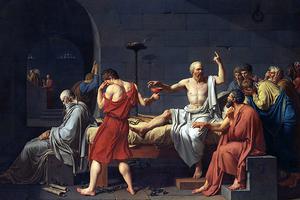
I begin my Introduction to Philosophy course by reading Socrates’ defense of the philosophical way of life. Democratic Athens had found him guilty of corrupting the youth, of making the weaker argument defeat the stronger, of not believing in the gods of the city. These are serious charges, but as Plato later argued, they were sham charges designed to hide the shame of all those whose errors were revealed by the Socratic art of question and answer.
In our own day, Charlie Kirk inspired the wrath against him because, like Socrates, he challenged conventional wisdom through the power of public debate. (A wise person welcomes correction, but most of us resent it.)
Now at his trial, Socrates foretells that should the powers set against him succeed in killing him, they would only unleash dozens more Socrates. Go ahead and sentence me to death, he said, but in doing so, you won’t silence the philosophical voice of conscience: It will only grow louder and more persuasive.
What happened, however, was even more powerful than Socrates guessed. Whereas Socrates wandered about the marketplace and questioned people, Plato set down roots and established a school, called the “Academy,” which worked out answers — a move that was so significant for Western culture that to this day the name of his school has been equated with the highest enterprise of learning.
Charlie Kirk rightly questioned the value of much of what passes for higher learning in our day. He was genuinely Socratic in this respect. Some will want to honor his memory by continuing to do what he did, and it will be good for them to do so.
Yet still others might wish to follow Plato’s method of honoring his teacher, for the problem is not the Platonic ideal of higher learning; it is not a problem with the idea of a university. The problem is that many universities today are not Platonic; they are not really universities.
After the example of Plato and one of his many, much later students, St. John Henry Newman, we can say that a university is a place of truth and of formation in virtue.
The university is indeed a place of radical inquiry into the truth. In The Idea of a University, Newman says:
It is the education which gives a man a clear conscious view of his own opinions and judgments, a truth in developing them, an eloquence in expressing them, and a force in urging them. It teaches him to see things as they are, to go right to the point, to disentangle a skein of thought, to detect what is sophistical, and to discard what is irrelevant.
As such, the university is in principle opposed to every ideology.
The university is also a place of formation, which provides an education for true freedom by underscoring requisite virtues such as diligence and discipline, not to mention fortitude and moderation. In this respect, such an education is premised on the dignity of each and every one of its students, while moderating the passions of the age.
A university, Newman writes, “aims at raising the intellectual tone of society, at cultivating the public mind, at purifying the national taste, at supplying true principles to popular enthusiasm and fixed aims to popular aspiration, at giving enlargement and sobriety to the ideas of the age, at facilitating the exercise of political power, and refining the intercourse of private life.”
In developing skills of perceptive thinking, which grasps the truths of things up to and including the human good, the university also prepares students for excellence in their chosen field, making them eventual leaders in the workplace. As Newman says, “It prepares him to fill any post with credit, and to master any subject with facility.” Such flexibility, indeed, is especially needed today in a work world upended by technology.
Plato honored Socrates by doing something Socrates never did: founding the Academy as a place for transformative discovery. And in doing so, as Newman suggests, he changed culture more profoundly and lastingly than had he merely imitated his teacher.
- Keywords:
- socrates
- plato
- st. john henry newman
- universities
- education