A Castel Gandolfo Encounter With St. John Paul II
COMMENTARY: Thirty years ago, a seminar and papal Mass helped shape a priestly vocation.
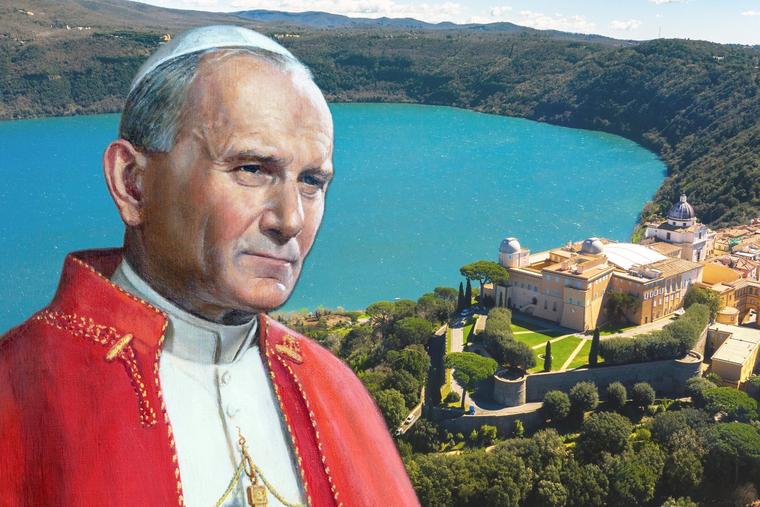
The return of Pope Leo XIV to Castel Gandolfo was widely welcomed, even if only for a few weeks. The previous custom was that the popes would go there soon after the feast of Sts. Peter and Paul (June 29) and remain well into September. Leo may well return to that custom in future years.
It was in that context that, 30 years ago, on July 26, 1995, I had one of the more memorable papal encounters of my life.
It was the feast of Sts. Joachim and Anne, the parents of the Blessed Virgin Mary, and we were going to Holy Mass with the Holy Father.
We were a group of students who had participated in a summer seminar organized by Michael Novak, Father Richard John Neuhaus, George Weigel and Polish Dominican Father Maciej Zięba. Then titled Centesimus Annus and the Free Society (now called Tertio Millennio Seminar on the Free Society), the three-week seminar explored the vision of Catholic social teaching as articulated by St. John Paul the Great on what a free and virtuous society should be.
The seminar brought together students from North America, Poland and Eastern Europe, the latter two cohorts rediscovering in the early 1990s what it meant to live in a free society after the defeat of communism.
The seminar, linked in its 1992 origins with the Italian philosopher and statesman Rocco Buttiglione, met for two years at an academy of philosophy in Liechtenstein. Then John Paul, who knew of the seminar and encouraged it, asked that it be transferred to Kraków, where it has been annually ever since, including this year for its 33rd edition. I was in that first Cracovian group in 1994 and it was a decisive moment in my priestly vocation. We encountered, not just in our studies but on the very streets of Kraków, the compelling figure of John Paul II.
During my studies of economics and politics, it was reading the works of Novak, Father Neuhaus and Weigel that opened new horizons for me. I saw that studying the mundane affairs of men required knowledge of his transcendent identity and mission, which leads more or less directly to the question of the Incarnation and, in my case, more or less directly to the question of the priesthood.
A year after that decisive experience, in 1995, the organizers held a small reunion in Rome for seminar alumni. Having freshly decided to ask for admission to the seminary, to rejoin members of the same Cracovian group who were influential in my decision, and with the chance to meet John Paul himself, was a blessed opportunity for thanksgiving.
We did not know whether we would meet the Holy Father, but while in Rome, the invitation came for his morning Mass at the summer residence. We were ushered into the private chapel at Castel Gandolfo and noted immediately the two frescoes on either side — the first depicting the miraculous Polish resistance to the siege of Częstochowa in 1655 against the Swedish army, and the other the “Miracle of the Vistula” when Poland defeated the invading Bolsheviks on Aug. 15, 1920.
Recognizing the episodes from my study of Polish history the year before, I assumed that the Polish Pope had had them installed. I learned later that it was Pope Pius XI who commissioned them. Archbishop Achille Ratti had served in Poland as the nuncio during the advance of the Red Army on the capital and, alone among the diplomatic corps, had the courage not to flee. Eighteen months later, he was elected Pope Pius XI. The frescoes he commissioned for Castel Gandolfo were a kind of remote preparation for the papacy of a baby born during his time in Poland, Karol Wojtyła.
Whether Pope Leo XIV used that chapel during his recent sojourn is not publicly known. Under Pope Francis, the buildings at Castel Gandolfo were turned into a museum open to the public, so this summer the Holy Father used another residence on the property.
There is a notable link between Pius XI and Leo XIV. Usually, a man is a cardinal for some time before election as pope. Leo XIV was created a cardinal in September 2023 and elected pope less than two years later. Pius XI became a cardinal in June 1921 and, less than a year later, was elected in February 1922.
The gospel for the feast of Sts. Joachim and Anne is very brief, just two verses from Matthew 13:
Jesus said to his disciples: ‘Blessed are your eyes, because they see, and your ears, because they hear. Amen, I say to you, many prophets and righteous people longed to see what you see but did not see it, and to hear what you hear but did not hear it.’
Jesus was speaking of himself, but that morning I applied those words to his Vicar, thinking of all the generations of my family who had prayed for the Roman pontiff, never imagining that one day a son of theirs would be in his chapel for Mass! It was a moment of great emotion.
After Holy Communion, the Holy Father remained in a prolonged silence. He then raised his head and looked at his secretary, Msgr. Stanisław Dziwisz, who slightly shook his head negatively. The Pope was asking whether our group had prepared anything to sing as a meditation after Holy Communion. We hadn’t.
So he began to sing. By himself. It was the Ave verum corpus natum — Hail the true Body, born of the Virgin Mary…
He sang without accompaniment, using the Mozart setting. He continued alone, his voice strong, and I thought that no one would be bold enough to join the Pope. For my part, I didn’t know the hymn then, and I can’t sing.
Then I heard Michael Novak, sitting beside me and only an arm’s length from the Pope, join him. He knew the Ave verum and he could sing. The two Slavs, the saint and the scholar, sang the Eucharistic and Marian song together. It was simple and deeply beautiful. I remember it to this day every time I hear the Ave verum, which is now my favorite Eucharistic hymn.
The saint, the scholar, the song. Economics, politics, history, the Eucharist, the Blessed Mother, the priesthood, John Paul — all of it linked together to shape my life. It remains, 30 years later, a powerful memory. And I acquired a new devotion to the holy parents of the Virgin Mary.
Pope Leo XIV sings as John Paul once did, with a strong voice. I don’t know who attends his private Masses, and whether he sings, and if he does, if anyone has the boldness of Michael Novak to make it a duet. But I hope he does.
Many desire to hear what you hear!
- Keywords:
- pope john paul ii
- castel gandolfo
- michael novak