Ann Widdecombe, British Politician and Catholic Convert Who Vigorously Defended Church Teaching, Dies at 78
Former Member of Parliament became a prominent voice for life, conscience, and moral truth in Britain’s public square.
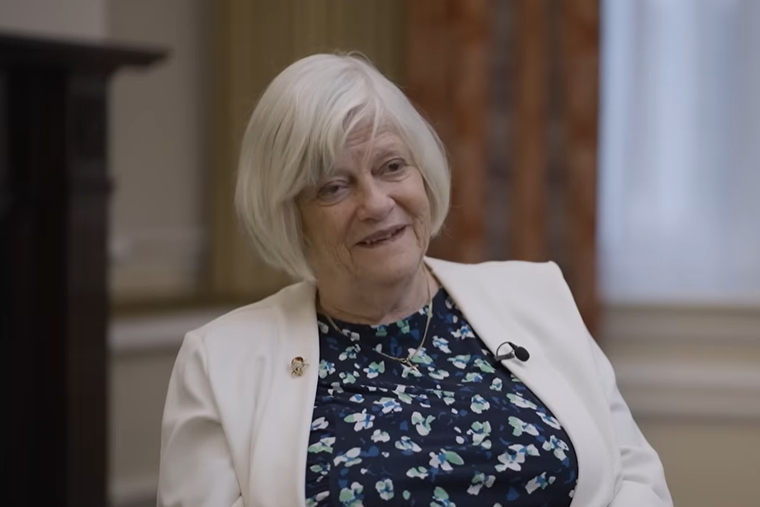
LONDON — Ann Widdecombe, who has died aged 78, was a prominent and combative former British politician who consistently defended the Catholic faith and the Church’s moral teaching in public life.
She is believed to have died on Wednesday as a result of a fall at her home on Dartmoor, southwest England, but a postmortem examination will likely be conducted to establish the precise nature of her death.
Her management agents announced the news “with great sadness” and sent their “deepest condolences to Ann’s family and friends.”
Widdecombe became one of the best-known Conservative politicians of her generation, holding ministerial positions in the 1990s, and briefly returning to elected office in 2019 as a member of the Brexit Party.
Already renowned for her outspoken conservative views, she gained further public recognition when she left the Church of England following its vote to ordain women as priests and was received into the Catholic Church in 1993.
In one of her last interviews, given to EWTN’s Colm Flynn last September, Widdecombe said although the Anglican vote was, for her, the final straw of a “very large bundle,” it was not the theology behind it so much as the attempts by the Church of England to make itself relevant to the modern world that convinced her.
“I thought, ‘Hang on, the duty of the Church is to lead, not to follow its lead,’” she said. “The great thing about Catholicism is it doesn’t compromise — something is either true or it’s false. It’s right or it’s wrong. It’s a sin or it’s not. There’s none of this endless fudging that you get with the Anglican church.”
The Church of England, she recalled, was “sacrificing faith to fashion, creed to compromise, and the numbers in the pews fell. They didn't grow. They weren’t going to grow because they were being asked to follow a fog.” She therefore naturally gravitated to the Catholic faith, telling EWTN that “if I didn’t think it was the one, true Church, I wouldn’t be Catholic.”
Her reception into the Church was, she said, the best decision she had ever taken. As a Catholic, she became an outspoken apologist for the faith, defending the Church’s moral teaching, especially in upholding the sanctity of life, marriage between a man and a woman, and opposing abortion and drug use.
She frequently appeared on television, where she was unafraid to explain why and what she believed, and memorably took part in a 2009 televised public debate in London where she and Nigerian Cardinal John Onaiyekan debated celebrities Stephen Fry and Christopher Hitchens on whether the Church is a force for good in the world. She and the cardinal lost the debate, but not before putting up a spirited fight.
Asked by Colm Flynn if she was concerned about the sometimes-vicious opposition she would receive on account of her moral, political and religious positions, she replied: “St. Paul said: We believe and therefore speak,” and added: “If you believe something, say it. I mean, what is the point of believing it if you won’t say it.” She also recalled Jesus’ blessing from the Beatitudes: “Blessed are you when men revile you and persecute you.”
She frequently faced further opposition and bewilderment from her own parliamentary colleagues, unable to understand her voting record based on her Catholic convictions. “I believe in things that are unfashionable,” she said, “so on whole they just thought I was a bit odd.”
A recurring theme in her public comments was the primacy of conscience informed by faith, particularly where state law conflicted with religious conviction. She criticized equality legislation that forced Christians to act against conscience — for example, compelling bed‑and‑breakfast owners to offer double rooms to homosexual couples. She saw this as an “erosion of the Christian conscience,” arguing that people should not be obliged to facilitate acts they consider morally wrong, even if those acts are legal.
She stressed that she wanted to see “a free Britain” where her citizens can express themselves freely as long as they do not incite violence. “I don’t want a Britain where children are taught that there are 72 different genders and they can just pick one and, you know, live the rest of their life that way,” she said. “I want a Britain which respects unborn life; there are lots of things that I would like to see — therefore, I work towards those things.”
But she always distinguished between respecting persons and approving particular behaviors, insisting that moral disapproval of acts did not equate to hatred of individuals.
Her forthrightness and the courage of her convictions, years of public service and a sense of fun and good humor made her one of Britain’s most cherished and recognizable public figures.
Born on Oct. 4, 1947, in Bath, Somerset, Ann Noreen Widdecombe was the daughter of James Murray Widdecombe, a senior Ministry of Defence official, and his wife Rita. Her childhood followed her father’s naval postings around the country and abroad, including the Royal Naval School in Singapore, before she went on to study Latin at Birmingham University. She then majored in philosophy, politics and economics at Lady Margaret Hall, Oxford, where she became secretary and treasurer of the Oxford Union and served on the university Conservative association.
After Oxford University, she built an early career outside Westminster in marketing, administration and local government, before repeated attempts to win a parliamentary seat. Her persistence was rewarded in 1987, when she was elected Conservative MP for Maidstone in Kent, which she represented for 23 years until standing down in 2010.
During John Major’s government, Widdecombe rose through the ministerial ranks, serving in the Ministry for Employment and then at the Home Office with responsibilities that included prisons and immigration, roles that cemented her reputation as a tough, outspoken conservative voice. Around 1999, while serving as a Home Office minister, she was granted an unexpected 20‑minute private audience with Pope St. John Paul II at the Vatican — a privilege she believed was awarded on the grounds of her very public conversion six years earlier.
After leaving the House of Commons, Widdecombe pursued a public career as an author, broadcaster and media personality. She had a successful appearance on BBC’s Strictly Come Dancing in 2010 (the U.K. equivalent of Dancing With the Stars) and appeared on a reality television program in 2018. She returned to elected politics in 2019 as a Brexit Party MEP for South West England, serving until the U.K.’s withdrawal from the European Union, and wrote several well-received books, including her autobiography, Strictly Ann.
In 2010 she was briefly considered as Britain’s next ambassador to the Holy See, but a health issue prevented her candidacy from proceeding further. She was a close friend of David Amess, also a Catholic Conservative MP, who was violently killed by an Islamist attacker in his constituency in 2021. A godmother to one of Amess’ children, she paid tribute to him as a “faithful servant of the Lord and a huge source of inspiration to so many colleagues.”
Asked by Colm Flynn what she thought of Pope Leo XIV’s pontificate, Widdecombe said it was “going well so far.” She took solace in the fact that he appeared on the loggia after his election wearing the traditional mozzetta, which she saw as welcome reassurance to traditionalists that they were “not going to be marginalized.” She said she never had a longing to meet Pope Francis, saying that, like many British parliamentarians, especially on the political right, she had strong reservations over his China policy.
Widdecombe never married, partly, she said, out of choice — “because it was never a big enough priority to go out looking for him” — and partly because “Mr. Right never came along,” but she added that she had no regrets about that at all.
Questioned about her mortality, she said throughout her 60s she never thought about it, but by the mid-70s, “things start to happen: You develop twinges where you never had them before; you start to forget names that you’ve known all your life — little signs are there, and they are intimations of mortality, and you realize it’s not going to be any different for you. You’re going to pop your clogs at some stage, and you’re going to go.”
But she told EWTN she was not frightened of death, hopeful she would be reunited in heaven with her father; her mother, whom she cared for into her 90s; and her late brother, Malcolm, who was an Anglican canon.
As an animal lover, she added: “I always hope I might be with my past cats as well, but I don’t think that’s theologically sound.”
- Keywords:
- british catholics
- catholic politicians
- in memoriam

Edward Pentin Edward Pentin is the Register’s Senior Contributor and EWTN News Vatican Analyst. He began reporting on the Pope and the Vatican with Vatican Radio before moving on to become the Rome correspondent for EWTN's National Catholic Register. He has also reported on the Holy See and the Catholic Church for a number of other publications including Newsweek, Newsmax, Zenit, The Catholic Herald, and The Holy Land Review, a Franciscan publication specializing in the Church and the Middle East. Edward is the author of The Next Pope: The Leading Cardinal Candidates (Sophia Institute Press, 2020) and The Rigging of a Vatican Synod? An Investigation into Alleged Manipulation at the Extraordinary Synod on the Family (Ignatius Press, 2015). Follow him on Twitter at @edwardpentin.