Wyszyński, Paul VI and the Polish Millennium
COMMENTARY: The consecutive feast days of Blessed Stefan Wyszyński and Pope St. Paul VI recall their pivotal roles in Poland’s millennium celebration and a turning point in modern Catholic history.
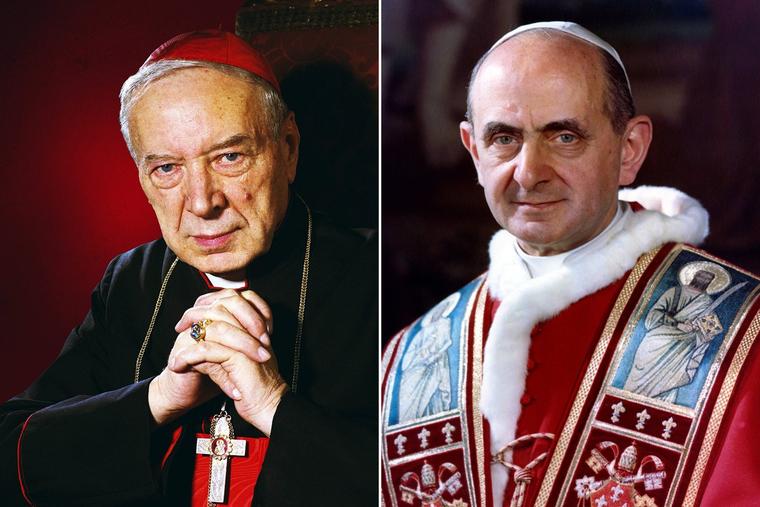
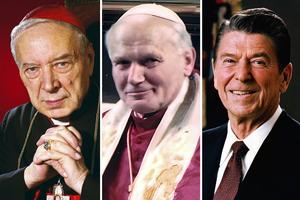
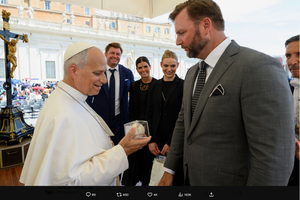
Relics of Blessed Stefan Wyszyński, primate of Poland (1948-1981), were placed in the Roman basilica of Santa Maria in Trastevere on May 28, his feast day assigned when he was beatified in 2021.
May 29 is the feast of Pope St. Paul VI, and their back-to-back feast days are a reminder of the great drama of the Polish Millennium 60 years ago this month, one of the most significant moments in Catholic history.
Cardinal Wyszyński died on May 28, 1981, just weeks after the assassination attempt on Pope St. John Paul II. The two most outstanding churchmen of the 20th century had their last phone conversation from their respective hospital beds in Warsaw and Rome.
Santa Maria in Trastevere was Cardinal Wyszyński’s titular church. When cardinals are created, the Holy Father assigns to them a “titular church” in Rome. They symbolically become part of the Roman clergy and so the bishop of Rome is elected by the clergy of Rome in the conclave.
Students of American Catholic history have a particular affection for Santa Maria in Trastevere, as it was the titular church of Cardinal James Gibbons, archbishop of Baltimore for more than 40 years (1877-1921).
Cardinal Gibbons was assigned Santa Maria in Trastevere, perhaps the oldest Marian church in Rome, in March 1887, and took possession of his new “parish” on the feast of the Annunciation some days later. On that occasion, he delivered one of the more important addresses in American Catholic history, defending the American constitutional settlement as being advantageous for Catholic flourishing.
“Without closing my eyes to our shortcomings as a nation,” Cardinal Gibbons preached, “I say, with a deep sense of pride and gratitude, that I belong to a country where the civil government holds over us the aegis of its protection, without interfering with us in the legitimate exercise of our sublime mission as ministers of the Gospel of Christ. Our country has liberty without license, and authority without despotism.”
Despotism marked the entirety of Cardinal Wyszyński’s tenure as the head of the Catholic Church in Poland. As archbishop of Warsaw and primate of Poland since 1948, he led the Polish Church under Stalinist communism. Cardinal Wyszyński was installed as titular priest of Santa Maria in Trastevere in 1957 on May 18 (incidentally, John Paul’s birthday).
By that time, he was one of the best-known bishops in the world. He had been arrested by the regime in 1953 and kept under house arrest until 1956, cut off from the proper governance of his flock. Upon release in 1956, Cardinal Wyszyński was a hero of global anti-communism; in Poland, he had become a unifying figure of religious, cultural and national resistance.
Cardinal Wyszyński’s heart beat to the ancient rhythms of Poland’s history, and upon release in 1956, he announced the “Great Novena” — nine years in which Poland would prepare to “renew the vows of her baptism” at the millennium of Polish Christianity in 1966. Poland dates its Christian faith to 966, with the baptism of Mieszko, duke of Poland.
In preparation for the Polish Millennium, Cardinal Wyszyński sent an image of Our Lady of Częstochowa to all the parishes of Poland. When the communists “arrested” the image, clumsily hoping to prevent massive processions in every place where it went, Cardinal Wyszyński sent an empty frame in its place. The crowds only grew larger, and Cardinal Wyszyński showed himself the master of popular piety — the empty frame was a more potent symbol than the Black Madonna herself.
So decisive was the Great Novena that Cardinal Wyszyński came to be known as the “Primate of the Millennium.” At the crowning celebration of the millennium, Cardinal Wyszyński invited Pope Paul VI to the main celebration in Częstochowa on May 3, 1966. Paul VI accepted but the communists refused to allow the Holy Father to come, handing Cardinal Wyszyński another victory.
During the Mass for the millennium — a half-million Poles were present despite government obstacles — Cardinal Wyszyński had an empty throne placed in the sanctuary, with a portrait of Pope Paul VI and a bouquet of white and yellow roses. The crude propagandists of the regime were no match for the pastoral brilliance of the primate. The empty throne was a more potent symbol than the Pope might have been himself.
When Paul VI was beatified, the Vatican chose not to assign his death day as his feast day, as he died on the feast of the Transfiguration and thus his feast would never be celebrated on Aug. 6. Initially, Sept. 26 — his birthday — was chosen, but was later changed to May 29, the date of his priestly ordination.
Thus, the two feasts of Cardinal Wyszyński and Paul VI now fall on consecutive days, bringing to mind the invitation — issued and accepted but blocked — of 1966. The memory of that day, 60 years ago this month, remained vivid in the Polish Catholic imagination.
In 1978, St. Paul VI would die. Within a year, a pope would indeed be in Poland. This time the communists could do nothing to prevent it. Karol Wojtyła, Pope John Paul II, was coming home.
Upon arrival, John Paul began his first address to the Polish state authorities with a quotation from Paul VI. With that rhetorical slap, repeated later in the same address, the Polish regime was reminded of why they feared a papal visit so much.
The climax of that history-changing first day was the Holy Father’s heroic homily in Warsaw’s Victory Square. In the presence of Cardinal Wyszyński, John Paul began by reminding everyone about Paul VI and 1966.
“We know that the recently deceased Paul VI, the first pilgrim Pope after so many centuries, ardently desired to set foot on the soil of Poland, especially at Częstochowa. To the end of his life he kept this desire in his heart, and with it he went to the grave,” he said. “And we feel that this desire — a desire so potent and so deeply rooted that it goes beyond the span of a pontificate — is being realized today in a way that it would have been difficult to foresee. And so we thank Divine Providence for having given Paul VI so strong a desire.”
“Today it is granted to me to fulfil this desire of the deceased Pope Paul VI in the midst of you, beloved sons and daughters of my motherland,” he added. “When I was … called by the votes of the Cardinals from the chair of Saint Stanislaus in Kraków to that of Saint Peter in Rome, I immediately understood that it was for me to fulfil that desire, the desire that Paul VI had been unable to carry out at the Millennium of the Baptism of Poland.”
Sixty years ago, the communist regime thought it had frustrated the will of Wyszyński. Perhaps, but not Providence. The papal visit of 1966 was simply delayed, and when it took place in 1979, it finished off the regime entirely.
Paul VI was not permitted to accept Cardinal Wyszyński’s invitation in 1966. Now Poland’s Primate of the Millennium is coming to Rome in 2026, his relics deposited in his titular church. On Friday morning, Masses for the feast of Paul VI will be celebrated in their presence, the Pope and Primate united in heaven — and on the liturgical calendar.