Why I Love the ‘Ugly’ Resurrection Sculpture in the Paul VI Hall
COMMENTARY: The much-maligned resurrection sculpture in the Paul VI Hall reveals a deeper truth about Christ’s wounds, glory and the enduring meaning of the Cross.
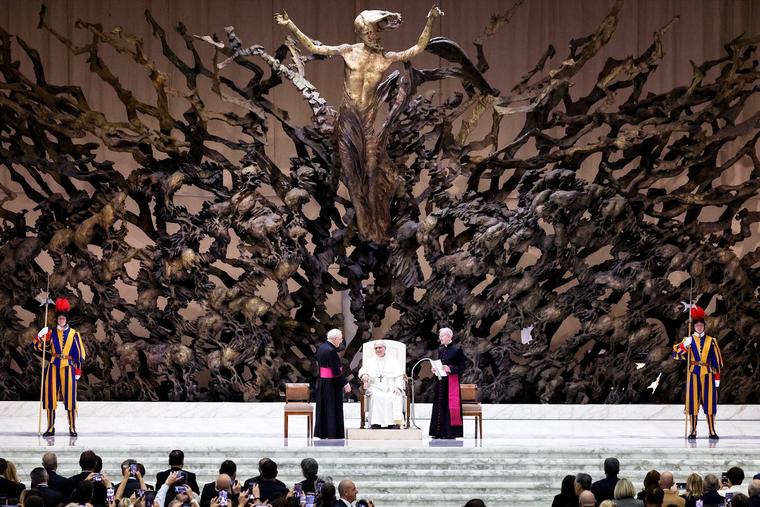
It seems to be the universally held view in some Catholic circles that the sculpture by Pericle Fazzini of the resurrection of Christ that hangs in the Paul VI Audience Hall in Rome is ugly to the point of being weird. But I disagree — which probably makes me an outlier among my friends — as I find the sculpture both inspiring and strangely haunting.
But why do I choose to focus on the Fazzini sculpture at this hour? Are there better works of art to which I could have appealed?
I think so, and I will mention a few of them below. But we in the Northern Hemisphere are locked at the moment in winter, and Pope Leo’s Wednesday audiences are often indoors. As I have watched his audiences via the magic of the internet, I have seen the Fazzini sculpture over and over, and I cannot unsee it. I have seen it in person on only two occasions and was impressed by it, but seeing it now so often, and in conjunction with the current convulsions of our world, I am moved to reflect upon it.
Called, simply, La Resurrezione, Fazzini’s sculpture was officially commissioned in 1977 on the 80th birthday of Pope St. Paul VI. It depicts the resurrected Christ rising out of the cratering blast of a nuclear explosion in the Garden of Gethsemane. As such, it reflects the tensions and fears of a nuclear holocaust from the Cold War era.
Some folks I have spoken to say that the nuclear horror theme only adds fuel to their criticisms of the piece, since the atomic-holocaust imagery renders the sculpture “dated” and therefore lacking the transcendent and timeless quality that art in the Vatican should have. This is no place, they say, for a “political” commentary on the evils of the nuclear arms race.
I once again disagree, since this sets up a false either-or between an artwork’s immediate historical context and the timeless themes it also portrays.
For example, I love Michelangelo’s frescoes in the Sistine Chapel. I try to see them every time I am in Rome. They are both beautiful and deeply awe-inspiring. Nevertheless, his depiction of Divine Judgment reflects the specific imagery of heaven and hell from the Renaissance era. It also reflects the artistic quirks of the time, with the typical Renaissance fixation on depicting the human form as semi-nude to nude, evoking resonances with ancient Greco-Roman themes of bodily symmetry and beauty. But none of that “time-boundness” detracts in the slightest from the artistic and religious genius of the work as a whole.
And do I even need to mention Dante, whose majestic Divina Commedia is riddled with images and overtones from the politics of his day?
Art never arises from a cultural vacuum. We are incarnated beings. We are enfleshed spirits and spiritualized flesh. The hypostatic union in Christ forever embeds the Christian vocation in the real world of time and place. We are not Gnostic esoterics seeking escape from time and matter. We are Christians who see the whole in the part — which is why Christianity is the greatest religion for poetry. Everything we encounter is a sacrament of the spiritual, and we find the spiritual not “beyond” or “around” the material, but precisely in and through it. Everything we see is a condensed symbol of the whole.
There are others I have engaged with who go on to say that the sculpture is hideous and of a piece with the awful ugliness of the entire Paul VI Audience Hall. They view the entirety of it as a typical example of modernist grotesquery so common to the post-Vatican II era.
And while I agree that the Paul VI Hall is ugly and architecturally uninspiring — not to mention out of place with the rest of Vatican City — I still maintain that the Fazzini sculpture is a profoundly moving work of art that transcends the mundane architecture in which it is housed. In fact, I think it is the only uplifting and redeeming feature of the hall.
I know that is not an opinion shared by many of my friends. But I stand by that claim. Christ is depicted as risen and victorious, yet with a look of anguished pain on his face. This reminds me of the depiction of Christ in the Book of Revelation as the Lamb who was slain from all eternity, who even now resides in Heaven as the one who has transformed his sufferings into glory without effacing or eliding them. This image of the Lamb eternally slain rejects the idea that Christ’s sufferings served only a soteriologically utilitarian purpose — that now being complete, they are no longer relevant.
Think of the resurrection appearance of Christ to the doubting Thomas, whose doubts are assuaged only by placing his hands in the still-present wounds of the risen Lord. But why his wounds in particular? Why does the Gospel emphasize the touching of his wounds as the most evidentiary element of the appearance’s veracity? Would not touching his face or hair or fingernail have sufficed?
Perhaps it was to emphasize continuity — that he who now appears is indeed the same Jesus who was crucified and not a mere ghostly avatar. But that only makes the point stronger. What is in continuity is the full incarnational reality of the historical Jesus — a reality that reaches its climax in his crucifixion. His wounds, therefore, are not simply identity markers; they are constitutive of the deepest truth of what the Incarnation was about.
Christ took into himself the sufferings of us all — the pain of the world, the misery of God’s wayward creation, locked in violence, despair, anguish and dysfunctional madness. He took these things into himself, suffered them through in a true mystical “marvelous exchange” (admirabile commercium), and transformed them from within, giving them an eternal soteriological meaning and significance.
The torturers do not have the last word. Christ is the great healer of every tear, every suffering child, every victim of war, every slave, every terminally ill person, and every groaning sigh of those who have given up on the joy of life. He has conquered. But he has conquered at great cost —a cost underwritten by a divine, eternal furnace of love that is the only true crucible for judgment day.
I think of Matthias Grünewald’s Crucifixion, with its grotesque distortion of Christ’s limbs, and the poverty of Mary and John in their rags. I think, too, of the Adoration of the Mystic Lamb by Hubert and Jan van Eyck, with their famous altarpiece in Ghent, Belgium.
The Fazzini sculpture may or may not rise to their level artistically. I am no judge of such things. I am not an art connoisseur any more than I am a wine sommelier. But I do appreciate good wine, and I do think Fazzini’s sculpture is a profound depiction of how, in Christ, kenosis and resurrection glory coincide and are coextensive.
And in so doing, Fazzini elevates us all, insofar as it reminds us that as Christians, we are not exempt from that same dynamic. There is no glory that does not pass through the cross. Furthermore, it reminds us that our imitation of Christ implicates us in his mission to enter into the sufferings of the world and, in a priestly fashion, to intercede for them by empathetically suffering into them.
I find myself convicted of spiritual laziness as I look upon the sculpture. Therefore, I am unconcerned by those who find it ugly. Because in some ways it is ugly — just as Grünewald’s Crucifixion is ugly — as ugly as the brutalized body of Christ, now transformed into glory, yet still bearing the signature traces of the human cruelty that such glory has conquered.