From Plato to Pop Culture, Art Teaches Us How to Live
Rooted in beauty and imitation, the arts — from music to story — form our affections and shape how we seek what is good, true and beautiful.
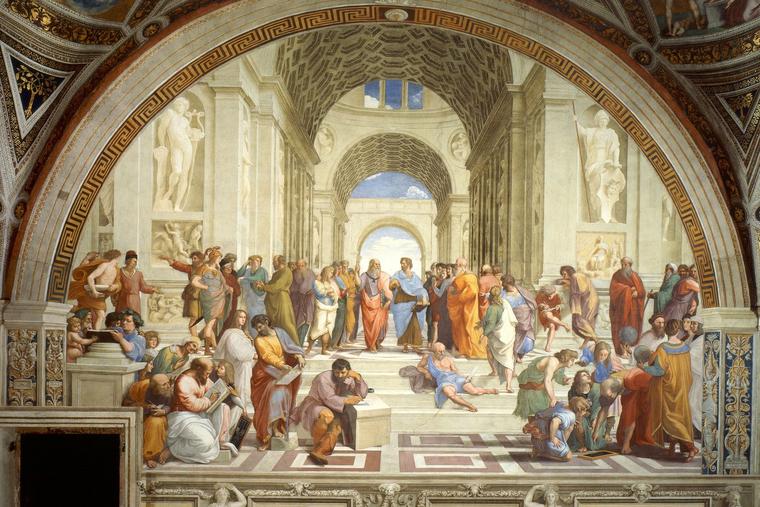
“What is the meaning of music?” This was the question I threw out to my unsuspecting wife and kids at dinner one night. The assembled children consisted of a few high schoolers, a middle schooler and a couple of upper elementary-aged children. The 3- and 5-year-olds may have been at the table, maybe not, but they were not expected to take part in the conversation.
Someone suggested that the meaning of music is different for each listener. Did that mean, I asked, that the writer’s intended meaning was irrelevant? And that response was dropped.
Then it was hazarded that the meaning depends on the artist’s intention. I responded by asking if, then, it is unjust to find meaning in a song that the artist did not intend, and that solution was dropped as well.
Before we could get much further, the conversation was cut off, probably by the 3- and 5-year-olds, and we never came to a satisfactory conclusion. I did not feel bad about this outcome because I know Plato thought it worthwhile to publish such “unfinished” dialogues and that such dialogues form the foundation of Western philosophy. It is not bad at all to let deep questions linger.
But try the question for yourself. Try it on some friends and family. What is the meaning of music?
Even broader than that, my ultimate goal in the conversation is the question, “What is the nature and meaning of art in general?” In the mind of the common “man on the street,” a sweeping subjectivism reigns supreme and generally unchallenged: Art is whatever we make of it, and anything can be art. However, even a bit of pointed questioning and reasoning can begin to break down those assumptions, but it is still quite challenging to build back to some solid answers. It is easier to figure out what it is not than to figure out what it is.
When it comes to these kinds of challenging questions, books of wisdom and clarity can cut through the confusion like the bright morning sun dispelling the fog. Beauty and Contemplation, by Daniel McInerny, is such a book. Rooted in the Thomist-Aristotelian tradition, and drawing from his experience as a professor and writer, McInerny explains that true art, in a word, is about imitation (mimesis), a truth we all recognize once it is well articulated and explained.
Allow me to give a brief clarification, much briefer and less clear than McInerny’s, in order to fend off a common misunderstanding. Imitation does not mean copy, as if every story and painting had to be true in every visual and realistic detail. No, imitation means essentially the making present, through some medium like music, painting, novel or film, some common human experience and reality like courage, fatherhood, joy — or, ultimately, the quest for fulfillment and happiness. A work of art is another way of seeking truth, but it does so through experiences and encounters rather than deductive and abstract reasoning, as in philosophy.
Of course, McInerny goes chapter by chapter and step by step to explain his meaning and why this perspective on art makes sense. He primarily focuses on stories, like novels, as a mimetic art, but what he has to say about story is then extended to all of the mimetic arts because even music and paintings tell a story, though not in the same way as novels and films. All stories are about a protagonist making choices that will lead to fulfillment or disappointment, to happiness or sadness. Each story has some controlling idea, some argument, about human happiness, and it is communicated through the events of the story so that the reader, viewer or listener is impacted with a kind of experiential knowledge about how to live. The Catholic imagination roots the contemplation of art within the Catholic worldview regarding our place in the universe, God as the main protagonist, vice, virtue and man’s ultimate end.
However, quoting from Flannery O’Connor, McInerny is adamant about the fact that no analysis of a work of art or exposition of the argument it makes is a substitute for the work itself. The reason the artist creates is the encounter of the art and the experience of the story it tells. Even if the viewer cannot articulate the meaning, one is nevertheless impacted and formed by the experience of the work of art.
We are surrounded by art; it is everywhere. Many of my students stream it constantly into their ears. Many of us spend hours a week in a state of “being entertained” with shows and movies. Some people today still read books (or listen to them on audiobook). And yet so few of us have ever asked ourselves what all this art is really all about, what we are getting from it, and what it is doing to us. The world of art provides for us, you might say, another life, and maybe many lives. It is a world that helps shape our affections and order our loves by showing us in novel ways the deepest parts of being human.
The art of modern pop culture is not an exception, and McInerny points out that most of it deals with imitating for the viewer the artist’s own path of self-expression and the formation of identity. Art in our world, and especially music, is used like candy or a toy and develops the taste for an ever-expanding palate of desire, and those are the experiences we live out and the view of the world that we cultivate through the enjoyment of the art of that culture.
This does not mean, of course, that we ought to shun entertainment. On the contrary, McInerny’s analysis of the meaning, impact and nature of art should encourage us to consider deeply the kind of art we allow into our minds and homes. His final chapter is an analysis of entertainment in light of the whole preceding philosophical discussion. One need not be a philosopher to get the point; art should be pleasing, and it should also teach and inspire.
“We all need stories, and paintings, and music, and mimetic art generally, that excite, amuse, and stir the mind but also the senses, the imagination, and the blood.” Even some brief moments of reflection on this point will be enough to start thinking critically about the nature of the art we contemplate and the decisions we can make to intentionally place before ourselves works that will cultivate a love of what is true and good and beautiful.
So, what is the meaning of music? As an educator and student of philosophy, I am not comfortable with just “giving the answer” because it short-circuits the learning process, but I will say this: Music is about human happiness. How exactly does that make sense, and what, exactly, does that mean? You’ll have to read the book for yourself, but it will be worth it.