Transfiguration Reimagined: A Flat Canvas That Reaches Heaven
Alexander Ivanov’s 19th-century vision of the Transfiguration flattens the scene yet draws heaven and earth together in a single moment of divine glory.
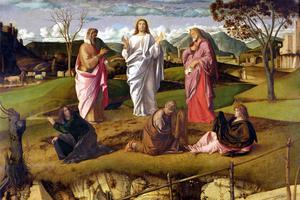
The Feast of the Transfiguration of the Lord on Aug. 6 is a major feast of both the Catholic and Orthodox Churches and has often been depicted by both in art. In the West, the Transfiguration has been shown in various artistic styles. In the East, it has primarily been represented by icons.
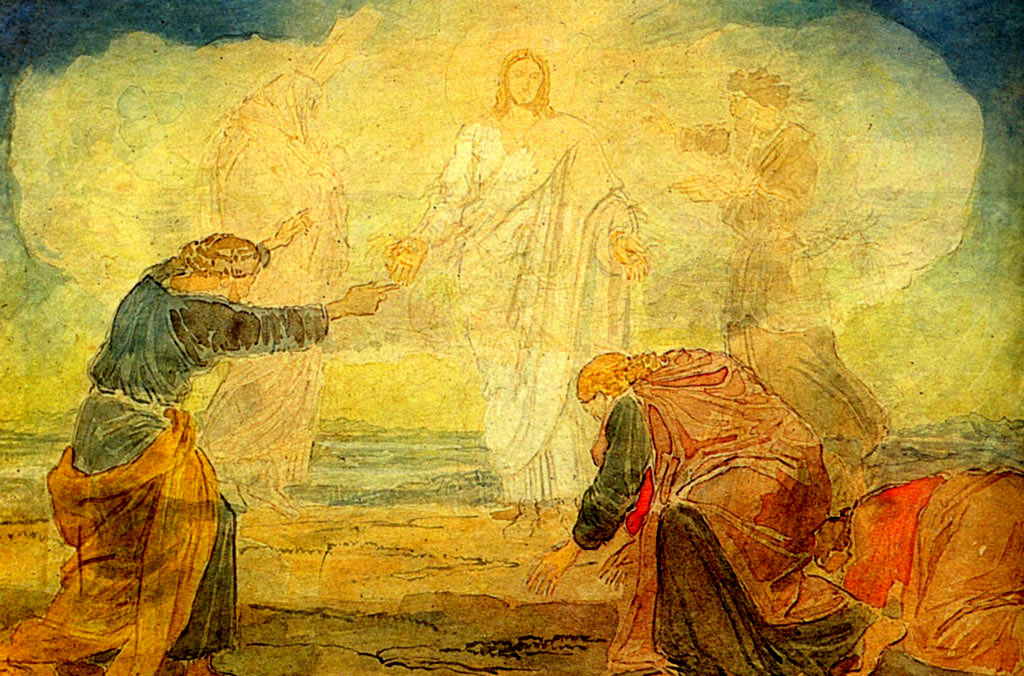
One exception is the 19th-century Russian neoclassicist painter, Alexander Andreyevich Ivanov (1806-1858). He appears to have returned to the theme of the Transfiguration (Преображение) several times. (Don’t confuse him with Andrey Ivanovich Ivanov, who also painted the Transfiguration but lived about a half-century earlier than Alexander Andreyevich Ivanov.)
The key distinguishing feature of Ivanov’s sketch is the painting’s single horizontal axis: Everybody is more or less on one horizontal level. Compare that to traditional Western renditions, where the Apostles (Peter, James, John) are usually horizontally below the event involving Jesus, Moses and Elijah that is taking place above them. A Russian commentator claims Ivanov did this to emphasize the synchronous nature of the event: Everybody — Jesus, his Apostles and his heavenly guests — are all participating in this same event at the same time. Although the Gospels speak of Jesus taking his Apostles up a high mountain (traditionally Tabor), Ivanov’s landscape does not suggest that. It is rather flat.
Still, Ivanov draws distinctions between them. The three apostles appear more substantial; Jesus, Moses and Elijah are more ethereal and transparent. Still, we would not want to impugn their true humanity: As we learn from the Gospels after Jesus’ Resurrection, the transfigured/resurrected body is the same, yet different.
The earthly/heavenly distinction is also suggested by the fact that the three apostles are sitting on the ground while Jesus and his guests are raised above the earth. They, too, are surrounded by a cloud — the Shekinah, which shields yet manifests the Divine glory. It also suggests the manifestation of the Blessed Trinity since, while I can be mistaken, I believe the text in the cloud here is “This is my beloved Son, listen to him.”
I cannot decide which figure is Moses and which is Elijah. I would prefer to call the outer figure in darker brown Elijah, given his association with religious community (though in the West — the Carmelites — perhaps not the East). The rays emanating from his eyes, however, seem to allude to the traditional “horns” that mark Moses.
Jesus clearly occupies center stage, as is appropriate. Ivanov makes that clear not just by his pure white garments, but because he is the focus of action within the divine cloud of glory. He is the one to whom one of the Apostles points, and the foreground is split by a large rock that shifts our visual attention toward Jesus.
I hypothesize that the Apostle pointing out Jesus is Peter. In Western iconography (which may be inapplicable here), Peter usually wears yellow or gold; here, his lower garment is gold. He has a gray beard, suggesting he’s the oldest. One apostle is beardless, indicative of youth, suggesting John. That he may be clinging to his brother, James, seems appropriate. They appear closer in age.
Likewise appropriate is Peter pointing out the Christ, confirming our faith in him — although, again, such a focus on Peter seems somewhat out of place in an Orthodox painting. That all the Apostles have their eyes averted reinforces the tradition, from Moses forward, that man should not look directly on the face of God and live but by divine permission.
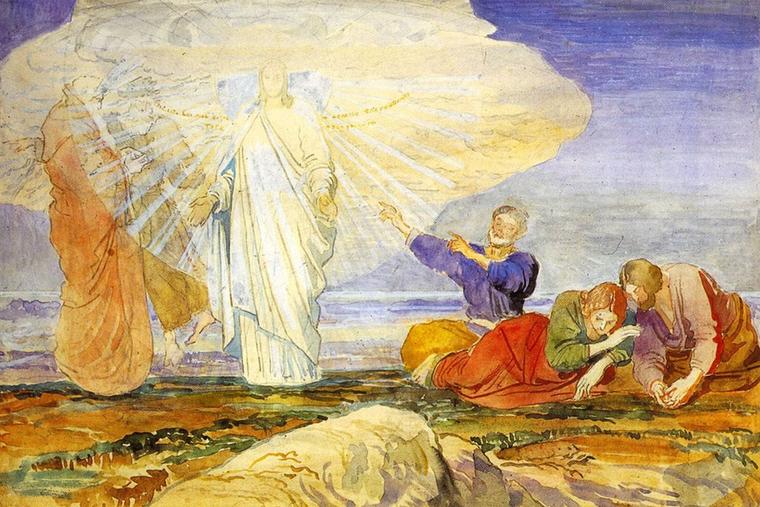
A variation on this sketch, but from an unknown date, appears here. While Jesus and his visitors appear more ethereal as in the sketch we just discussed (though Moses and Elijah are so transparent as almost to disappear), the distinguishing feature of this rendition is a return to the “layering” more traditional in Western art, i.e., the Apostles in the foreground form one horizontal axis separated from Jesus, Moses and Elijah by a small but still significant step.
Ivanov’s sketch inspired others to build on it. Alexander Golovin’s 1894 oil painting shows its inspiration from Ivanov while making Jesus stand out more distinctly by reducing the “ethereal” nature of the original work. It also demonstrates the impact of media: Ivanov’s painting is most likely watercolor, while Golovin’s is oil.
- Keywords:
- transfiguration
- art
- painting