Holy Thursday: A Moment to Reflect on Pope Leo XIV’s Vision for Priests
COMMENTARY: The Holy Father has offered to the Church a powerful teaching on the meaning of the priestly ministry in today’s world.

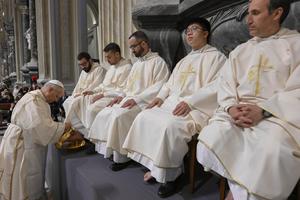
On Holy Thursday, the Church commemorates the moment in which Christ instituted some essential elements of her life: the sacrament of the Holy Eucharist, the ministerial priesthood, and the New Commandment of love.
During the Chrism Mass, usually held on this day or earlier in Holy Week, priests together with their bishop renew the priestly promises they pronounced at the moment of their ordination.
Hence, this solemn day provides us with a special opportunity to reflect on the unique identity of the priest. In considering this vital ministry for the People of God, this year we are enriched by the teaching of Pope Leo XIV.
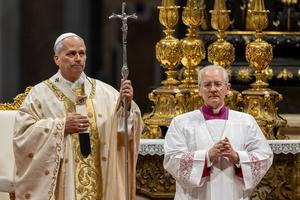
In the first year of his pontificate, the Holy Father has given significant attention to the topic of priests. In doing so, in continuity with his predecessors, Leo has articulated in vivid detail the rich mystery of priestly identity and offered numerous practical suggestions aimed at renewing the life of these ordained ministers today.
This body of teaching cannot fail to have decisive importance for the entire Church, which by baptism shares in a certain manner in priestly dignity, receives essential spiritual nourishment from these ministers of Christ, and bears responsibility to support priests in their divine mission.
In his apostolic letter entitled “A Fidelity That Generates the Future,” issued on the occasion of the 60th anniversary of the two Vatican II decrees related to priestly life, Pope Leo echoes the last council’s teaching that “the desired renewal of the whole Church depends to a great extent on a priestly ministry animated by the spirit of Christ.”
Vatican II’s decree on priestly training, Optatam Totius, and its decree on the ministry and life of priests, Presbyterorum Ordinis, thus remain essential reference points for today.
By means of these texts, the Church, rooted in her doctrinal tradition, boldly professed her faith in the exalted reality brought about by priestly ordination. Priests, as the latter text affirms, “by the anointing of the Holy Spirit, are signed with a special character and are conformed to Christ the Priest in such a way that they can act in the person of Christ the Head.”
Amid the various cultural changes and increased secularization that have taken place in many areas in recent decades, the Holy Father has urged priests to realize that their ministerial identity remains ever relevant and even appealing to their contemporaries.
In his recent letter to the priests of Madrid, Leo acknowledges that common reference points in society have gradually disappeared, and that the Christian message has become ever more difficult for many to understand.
At the same time, the Pope notes the new horizons that are opening up for priests today.
He expresses the conviction that “in the heart of not a few persons, especially of young people, a new restlessness arises.” The pursuit of well-being, the vision of a freedom detached from the truth, and material progress alone “have not succeeded in satisfying the profound desire of the human heart.”
In the face of such circumstances, Leo goes on to describe the kind of priests needed by the Church at this moment. Instead of “new models” or an effort to redefine priestly identity, the Pope asserts a need to repropose, “with renewed intensity, the priesthood in its most authentic nucleus — to be alter Christus [‘another Christ’] …”
Such an identity, as Leo indicates, calls for priests to be sustained by “a living relationship” with Christ, “nourished by the Eucharist and expressed in a pastoral charity marked by a sincere gift of self.”
Priests are thus called to live out a contemplative life, in the midst of their various activities in a world which, as the Pope notes in his apostolic letter on priestly life, “often makes us feel rushed and inclines us to activism.” These ministers should be compelling witnesses of that standard of holiness to which all Christians are called.
To live out such an ideal, Leo recognizes the need for abundant grace and support. In the same apostolic letter, he recalls Vatican II’s wish that priestly formation continue beyond the seminary years, in a “continuous, permanent formation, which will create a dynamic of constant human, spiritual, intellectual and pastoral renewal.”
Therefore, while the priest has been granted a most sublime identity through his sacramental identification with Christ, he can never see himself independently from the rest of the Church.
In “A Fidelity That Generates the Future,” Leo warns priests against the “temptation to individualism,” a temptation that can be strong for priests today in light of their multiple ministerial demands and the solitude many of them experience.
In this context, the Holy Father has wanted to situate the priestly ministry ever more firmly within a broad perspective of the Church in her mystery, a vision that was a key theme of Vatican II. The last ecumenical council enhanced our understanding of the priesthood by reaffirming the traditional doctrine about the priest’s identity, while also situating this identity within that wider communion, which marks the Church as a whole.
In line with this vision, in his apostolic letter Leo highlights the importance of manifesting the “relational and communal dimension of ordained ministry,” especially in a world in which conflict and division are so often present.
The priest’s special identity, as the current Holy Father emphasizes, should not isolate him but rather lead him to a special closeness to those around him. As the Pope stated in his first meeting with the clergy of the diocese of Rome, the priest is “called to be the man of communion, because he is the first to live it, and continually nurtures it.”
This capacity for relation is not an add-on to the priest’s ministry, but rather a fruit of the sacramental grace he has received, a grace that unites him to Christ and also to the entire Church. In this regard, in “A Fidelity That Generates the Future,” Leo has desired once more to return to the teaching of Presbyterorum Ordinis. This decree on priestly life describes the fraternity priests share with all the baptized, as well as the special fraternity among priests that arises from the sacrament of holy orders.
Pope Leo has furthermore encouraged priests to practice a style of life in keeping with this attitude of communion: by spending time in prayer, study and fellowship with their fellow priests; by finding a spiritual guide — “a person of great spiritual wisdom,” who “can accompany you,” as he commented recently to the priests of Rome; and by fostering an attitude of closeness to others, especially the young and those experiencing particular difficulty.
In continuity with the Church’s Tradition, Pope Leo XIV has sketched out with new splendor the beauty of priestly identity and the deep relevance of this ministry for today’s world.
We can hope that all priests and the entire People of God might take the Holy Father’s words to heart, and so experience authentic renewal in the Church’s mission of presenting Christ to the men and women of our time.
- Keywords:
- holy thursday
- priesthood
- priests

Father Joseph Thomas Opus Dei Father Joseph Thomas, based in Princeton, New Jersey, is dedicated to ministry that focuses on college students. He writes regularly on theological topics and is the author of The Theology of Divine Grace (Scepter, 2023). He also serves as the U.S. representative for the Pontifical University of the Holy Cross in Rome.