Two Augustinians, Two Chairs, One Body in Christ
Formed by the same Augustinian community, Pope Leo XIV and Servant of God Father Bill Atkinson show how sanctity is forged in both hidden suffering and visible leadership.
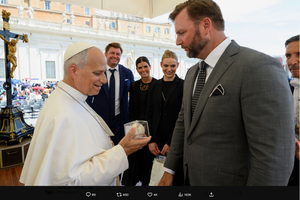
When Pope Leo XIV emerged on the balcony of St. Peter’s Basilica, much was made of his nationality, age and pastoral record. However, one detail stood out for those of us who live, teach and pray within the Augustinian family: he was one of us. An Augustinian friar had been elected pope. For the first time in the Church’s long history, an heir of St. Augustine now wears the white cassock.
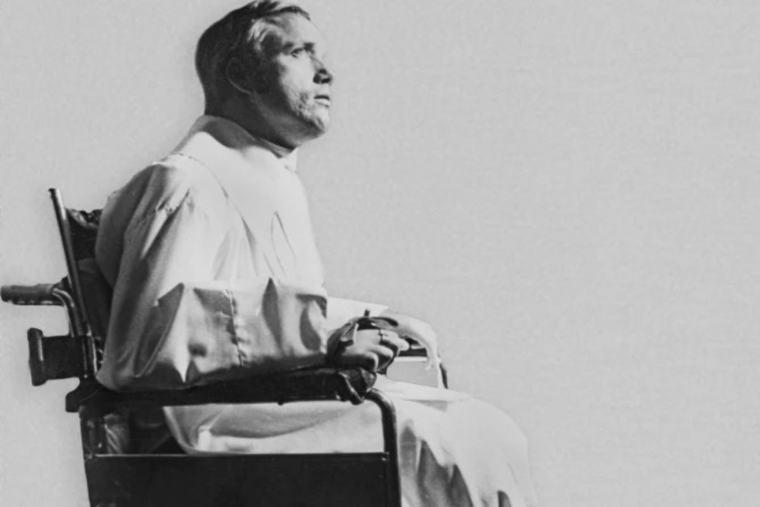
It’s a striking image — a humble missionary priest is seated upon the Chair of St. Peter, charged with shepherding the universal Church. Yet, in my memory, that image brings to mind another seat: a wheelchair. Not in the eternal city, but the suburbs of Philadelphia. Not surrounded by cardinals, but by high-school students. It belonged to another friar, Augustinian Father Bill Atkinson — the first quadriplegic priest in the history of the Catholic Church, and a man Pope Leo knew personally. On one chair sits the holder of the keys to the kingdom, while on the other sat a hidden saint.
A Third-Period Friendship
I really “met” Father Atkinson (some called him “Father Bill”) in the Fall of 2003, during my senior year at Monsignor Bonner High School in Delaware County (Delco), Pennsylvania. My mom insisted I use my third-period free time to do something productive, so I worked in one of the school offices. What seemed like a forced chore turned out to be a defining grace: I met my future wife (who was running attendance from the girls’ school next door), and I got to know Father Atkinson.
Much to my surprise, Father graded his own assessments using a bold red felt-tip pen held in between his teeth, but because of his physical limitations, he needed help inputting the results into the gradebook. That’s where I came in. At first, I was nervous. But a natural bond formed when the office secretary, Mrs. Sally Scaggs (a name straight out of Dickens!), told Father I was from St. Alice Parish, the same parish where he had been raised and ordained. Like many Delco conversations, ours often centered on the neighborhood, who lived where, and Father telling me stories of the “old days.” That shared background allowed our time together to fly by easily.
We Are One Body
I remember one afternoon when Father Atkinson asked me to grab a brush from the back of his wheelchair and scratch an itch on his head. I also remember holding the phone to his ear as he spoke to his doctor — and even his barber. His vulnerability never diminished his dignity. If anything, it elevated it. He bore his condition with both humor and holiness. He didn’t try to be inspiring. He just was.
In all four years I spent at Bonner, I can recall only one time when Father Atkinson served as the main celebrant at a school Mass. It was just before Thanksgiving break and I remember it vividly, precisely because it was so rare in those years. I later learned that presiding at the altar had become increasingly difficult for him around this time. If that was the case, I don’t remember seeing any signs of it. What was jarring, though, was seeing how he needed help. Another Augustinian stood beside him, hands ready to raise the host and the chalice on his behalf.
That image of the two priests together was one of the most impressive acts of Augustinian brotherhood and Christian unity I’ve ever witnessed. The sacrament was celebrated not alone, but together — one voice, two bodies; a shared priesthood. In that moment, I saw love incarnate. It called to mind the words popularly attributed to St. Augustine:
What does love look like? It has the hands to help others. It has the feet to hasten to the poor and needy. It has eyes to see misery and want. It has the ears to hear the sighs and sorrows of men. That is what love looks like.
At that Mass, we sang the most beloved hymns of our high school years: We Are One Body. I still remember the lyrics echoing through the auditorium: “We are one body, one body in Christ, and we do not stand alone.” Watching Father Bill at the altar, assisted by the hands of his brother priest, I was seeing those lyrics come to life in real time. St. Paul’s words on the unity of the Church in 1 Corinthians 12:26 also ring true here: “If one part suffers, all the parts suffer with it; if one part is honored, all the parts share its joy.”
That liturgy was a living icon of the Church St. Paul describes: diverse in function, united in purpose. Father Atkinson offered the sacrifice while another raised the elements. Together, Christ was made present. This was love. This was the priesthood. This was the body of Christ, visibly united in its frailty and strength. I feel honored to have been there.
As I watch Pope Leo XIV lead the universal Church, I see another Augustinian friar not standing alone; I see the same refrain continuing in a different key. Just as Father Atkinson could not celebrate the Mass without the help of others, Pope Leo cannot shepherd the Church without the help of us all. We must be his hands, his feet, his eyes, his ears and his support. This is not the work of one man in Rome, but of one body, bound in love, sustained by prayer, grace and frequent reception of the sacraments. Father Atkinson knew this better than anyone, and in one of his poems published after his death, we see this beautifully stated:
How’d I do it? Let me confide:
Always with others right by my side …
On those who helped me, I totally relied.
They taught me to live, not just to cope;
With their love, they gave me hope.
That same wisdom applies now. Pope Leo needs the love, fidelity, hope and faithfulness of the whole Church beside him. Like Father Atkinson, he leads not in isolation, but through communion. And like Father Atkinson, he reminds us that the strength of the Church lies not in individual might, but in the grace we share.
From Yearbook Photos to Saints
As my senior year went on, our conversations became even more natural. Father correctly sensed I was discerning a vocation, which I later pursued with the Augustinians after my undergraduate studies at Merrimack College.
One day in the spring, he asked me what I wanted to do with my life. I told him I wanted to be a history teacher, because I had great history teachers and wanted to be remembered by my students just like they were by theirs. He smiled and gave me advice I’ve never forgotten: “Don’t worry about being remembered. Most of us (teachers) end up as yearbook photos. And that’s okay. It’s not about you. It’s about the students — and the journey you share with them on the way to God.”
Those lines have followed me throughout my career as a Catholic educator, and I have shared them with many of my peers. Every time our school hangs up a new set of school portraits or when I flip through an old yearbook, I remember his advice, and I smile.
After Father Atkinson died in 2006, I returned home to attend his funeral. A mutual friend, Augustinian Father Frank Horn, delivered a beautiful homily, and the grief in the church was pierced by something more profound than sorrow — reverence. No one needed to preach that Father Atkinson was a saint because we already knew. Sanctus simply means holy, and holy he was. However, where his story would lead the Church, we didn’t know then. Those whose life he had touched knew we had witnessed something rare: a quiet faithfulness that didn’t ask to be seen, only to serve.
That quiet sense of holiness found a more public voice in 2015, when then-Archbishop Charles Chaput officially opened the cause for Father Atkinson’s canonization. I was blessed to be present for that moment, accompanied by one of my uncles, a fellow Bonner graduate. Now recognized as a “Servant of God” (the Church’s way of saying, gently but firmly, that we should pay attention), Father Atkinson’s case was off to Rome for further investigation. None of this was a change in who he was, but a recognition of who he had always been.
A Legacy Still Speaking
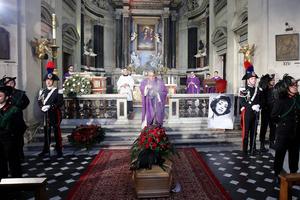
Today, on the campus where I now teach, we have a table set up year-round in one of our main buildings featuring Father Atkinson’s story, photos and information about his cause for canonization. Students pause, ask questions. Guests read quietly. His life still speaks. Augustinian Father Rob Hagan, current Prior Provincial of the Province of St. Thomas of Villanova, reflected during the reinternment of Father Atkinson’s remains at St. Thomas of Villanova Church in June 2024:
May others for generations come here and be inspired by the way God’s grace enabled Father Bill to rise from his cross and to persevere. He would be quick to remind us that his story is not so much what he achieved nor what he overcame himself, but what he overcame through Christ as a member of the broken body of Christ with all the sisters and brothers that God gave him.
In this Augustinian pontificate, the time has come to lift up his witness, especially now. The same community that formed Father Bill Atkinson also formed Pope Leo XIV, and this moment in Church history would be a fitting time for a humble priest from Delaware County, Pennsylvania, to rise from Servant of God to Blessed. The world could use a patron saint of fortitude, disability, perseverance and unglamorous holiness.
A Teacher, A Priest, A Brother
I have been blessed to know both of these Augustinian men (albeit briefly) — one who now shepherds the universal Church and one who once needed help scratching his own head. I am grateful to stand in the tradition that formed them both, and I invite the whole Church to acquaint itself with St. Augustine of Hippo, the Augustinian Friars and Augustinian Father Bill Atkinson, Servant of God.
St. Augustine taught us that we are pilgrims on a journey, bound together not by achievement, but by grace. Father Atkinson lived that truth with every breath he drew, even through the ventilator at the end of his life. As Pope Leo XIV leads that pilgrim Church into a new era, Father Atkinson is already interceding (quietly, humbly and faithfully) just as he lived.
I am in the final year of my graduate theology studies at Villanova University. I teach high school theology at St. Augustine Prep in Richland, New Jersey. I do my best (imperfectly) to live the lesson Father Atkinson left me: It’s not about being remembered; it’s about helping others remember Christ.
To learn more about the life and cause of Servant of God Father Bill Atkinson, visit FatherBillAtkinson.org.
Brendan Towell Brendan Towell is the Director of Spirituality and Mission for Secondary Schools and Schools of Special Education in the Archdiocese of Philadelphia, where he lives with his family. His interests include Augustinian Studies, Ressourcement Theology and the theological legacy of Pope Benedict XVI. His website is BrendanTowell.com.