When Fulton Sheen Was Out of Season
The famous preacher, author, and radio and television host embraced the relative obscurity of the latter years of his life.
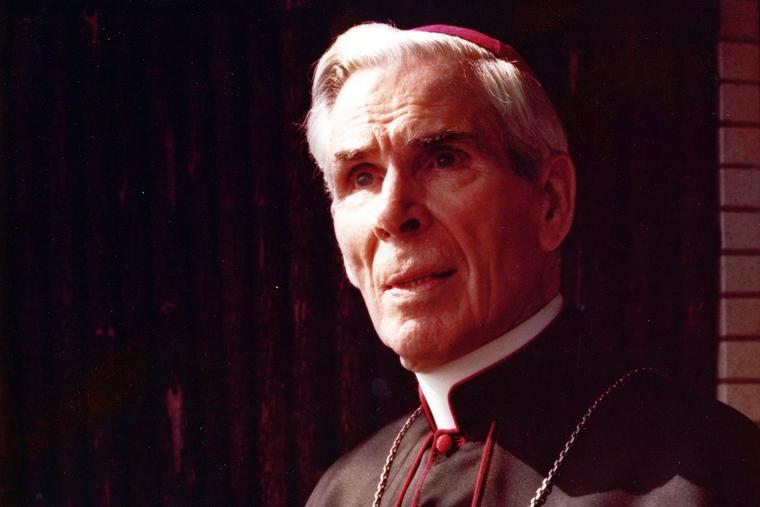
In December 1956, Bishop Fulton J. Sheen ranked third among Americans for most admired man in the world, according to Gallup.
At 61, he was the host of a popular national television show and a celebrated radio personality, author, speaker and convert-maker. When he appeared as a surprise guest on a game show a couple of months before, the audience erupted in thunderous applause, the likes of which one panelist said he hadn’t heard in a long time.
Yet though it wasn’t clear at the time, Sheen’s fame was peaking and beginning a slow decline.
Within a year, Sheen’s weekly TV show ended, amid circumstances that are still murky but possibly stemming from a bitter falling-out he had with Cardinal Francis Spellman, the archbishop of New York.
Sheen’s sermons at St. Patrick’s Cathedral in Manhattan — which routinely drew so many people on Good Friday that streets in the area had to be blocked off by police — ended, apparently on Spellman’s orders.
Sheen wasn’t as prominent at the Second Vatican Council during the 1960s as many Americans thought he would be. When he later got a diocese of his own, it didn’t go well and ended early.
Sheen was still well known through these years. But he never again commanded high television ratings. He never again appeared in the Gallup poll. And a clerical career that once seemed limitless — head of a famous diocese? a Rome appointment? cardinal? — stalled.
Today, 46 years after he died, Sheen’s Church title is Venerable. On Monday the Vatican approved his beatification, which, if it occurs later this year as expected, would make his title Blessed, one step below Saint.
Yet while many remember Sheen for his television appearances, books and speeches, which brought adulation and fame, some close observers of his life say his reaction to rejection and physical pain in his post-limelight years deserve more attention.
Msgr. Jason Gray, executive director of the Archbishop Fulton J. Sheen Foundation in Peoria, Illinois, sees the last decade of Sheen’s life as a vital part of his story.
“I think that those 10 years were kind of a purification for him,” Msgr. Gray told the Register. “For him, that suffering brought him in close relationship to Christ.”
Fall From Eminence
Many (though not all) of Sheen’s struggles in his later years stem from the conflict with his one-time backer, Cardinal Spellman, who influenced Church and secular leaders for 28 years as head of the most prominent see in America.
While some details about the dispute between the two remain unclear, it began in the mid-1950s over Sheen’s unwillingness to allow Spellman to use funds raised by the national Society for the Propagation of the Faith, which Sheen ran, for purposes Spellman had in mind, according to Thomas C. Reeves’ major biography, America’s Bishop: The Life and Times of Fulton J. Sheen (2001).
Spellman thought Sheen owed him use of the money because Spellman as archbishop of New York was the superior of Sheen, an auxiliary bishop of the archdiocese. (Spellman had also gotten Sheen the job.) Sheen thought that as director of the organization he was the rightful decision-maker over funds raised for worldwide missions, and he disagreed with Spellman’s plans for the money. (Why isn’t always clear because of a gap in the historical record; correspondence between the two has never been made available to historians by Church authorities, who have the letters.)
What began as a disagreement turned ugly, although mostly outside the public eye. Spellman’s animosity extended beyond mere unpleasantness. Some fellow bishops and priests avoided Sheen for fear of running afoul of Spellman.
Spellman at one point told New York seminarians that Sheen was “the most disobedient priest in the country,” according to a 1972 book by a former Sheen aide, Father Daniel P. Noonan, The Passion of Fulton Sheen.
While Spellman lived — until 1967 — Sheen was an outlier among clerics in the Archdiocese of New York and in certain places beyond. “He lived daily with Spellman’s wrath hovering over him,” Reeves writes in his biography of Sheen.
Yet when Sheen was writing his autobiography about a decade later, he omitted all details of the conflict, making only vague allusions to it.
Around that time, Sheen sent a personal letter mentioning the autobiography to a former priest secretary, Msgr. Hilary Franco, the priest recently told the Register.
“Then he adds something so important: ‘Nothing about Spellman,’” Msgr. Franco said. (The 1980 book, Treasure in Clay: The Autobiography of Fulton J. Sheen, actually mentions Spellman eight times, but in a positive vein, with nothing negative.)
“That goes to show you the humility of the guy,” said Msgr. Franco, author of Bishop Sheen: Mentor and Friend (2014). “And the sanctity of this wonderful man.”
Exile
In 1966, Sheen was moved to a far less prominent place than New York City, as bishop of the Diocese of Rochester, an appointment widely thought to have been engineered by Spellman to try to make sure that Sheen wouldn’t succeed him as archbishop.
Sheen’s three years in Rochester were difficult.
Sheen devotes a section of his autobiography to what he calls “things I would like to have done but failed to do.” One idea — offering a lightly attended inner-city parish church and its land for a federal public housing project for poor people — drew so much opposition that parishioners threw pebbles at his car when he visited.
Sheen had been used to drawing thousands all over the world to his speeches. But when he gave a series of retreat talks in the largest auditorium in Rochester, few people came, according to Reeves’ biography of Sheen, America’s Bishop.
“The whole world comes to hear Fulton Sheen, except his own diocese,” Sheen told a priest, according to the book.
Sheen approved of the Second Vatican Council and he enthusiastically tried to implement it — to the dismay of many local Catholics who didn’t like his changes. He also drew fire when he defended Pope Paul VI’s anti-contraception encyclical Humanae Vitae, which was widely criticized and rejected by Catholics in the United States, including in Rochester, as Reeves describes in his biography of Sheen.
Sheen found the diocese frustrating and, eventually, untenable.
When he resigned as bishop of Rochester in 1969, at 74, he was a year away from the mandatory retirement age, and he was still in good health.
“It wounded him, because he was rejected by those people,” Reeves told the Register.
Come Down
Sheen’s retirement, which lasted 10 years, was active, but largely out of the spotlight.
“He poured himself into priestly formation. This is the period of his life where he’s going basically to a lot of retreats for clergy,” said historian Derek Rotty, author of Prophet of Hope: Fulton Sheen Responds to the Modern World (2025).
While Sheen found his new status an adjustment, he also saw it as necessary.
“You realize that your sanctity comes more from quiet suffering than it does from being in the limelight,” Rotty said.
In July 1977, Sheen, then 82, became the oldest person ever at that time to undergo open-heart surgery, according to Reeves’ biography.
He experienced intense physical pain after the surgery, plus the indignity of an unwanted interrogation from a psychiatrist, instigated by a nurse because of “what she thought was a depression but was really only agony,” Sheen wrote in his autobiography, published months after his death.
He later described the surgery and its aftermath as a blessing, “because when the Lord comes to take us all, He will look to see if we have any physical marks of the Cross upon ourselves.”
“Maybe He will recognize me from that scar and receive me into His Kingdom,” Sheen wrote.
Holy Hour
Admirers of Sheen see marks of holiness throughout his life, including his charity (he gave away millions in royalties, salary and gifts); his concern for troubled souls (he would drop everything to help a single person in need); and his Holy Hour, a 60-minute time in prayer before the Blessed Sacrament that he performed every day starting a year before he was ordained a priest, even when he was traveling or had little sleep.
"I think the main source of Sheen’s holiness is his daily holy hour, to which he was faithful all 60 years of his priesthood. That’s what made his extensive knowledge of Jesus Christ personal and life-changing,” said Msgr. Roger Landry, national director of The Pontifical Mission Societies USA, which includes The Society for the Propagation of the Faith, which Sheen ran.
“His meditation on the Lord’s passion, among the best of all time, did come alive, however, during his sufferings, whether moral sufferings like he experienced in his conflicts with Cardinal Spellman, or the producers of The Catholic Hour, or some priests and faithful in Rochester, or seeing the infidelities and defections in the Church in the late 60s and 70s; as well as his physical sufferings due to heart issues at the end of his life,” Msgr. Landry told the Register by email. “That’s when he truly became a priest and victim in configuration to Christ."
In later years Sheen lamented what he considered the defects of his past life, including vanity and luxury. He acknowledged in his autobiography a taste for recognition, applause, titles, fine clothes and Cadillacs, and he considered his mortifications slight and unimpressive.
He was a famous emissary of Christ, he noted.
“But … but …” he wrote, with ellipses in the original, “how close was I to the Cross?”
“I was the priest; was I the victim?”
The public examination of conscience doesn't come across as obligatory modesty.
“I wonder if Sheen was questioning, ‘What exactly have I done for the Church?’” Msgr. Gray told the Register.
When exactly Sheen finished writing his autobiography isn’t known. But he was likely still working on it when Pope John Paul II visited New York City in early October 1979 during his first visit to the United States as pope. Amid suffering and self-doubt, Sheen received a consolation.
At a packed St. Patrick’s Cathedral in Manhattan, Sheen (whom an aide described as “feeble”) greeted the Pope and knelt before him, but John Paul grabbed him by both arms and quickly helped him to his feet. As a video of the encounter shows, they had a brief though emphatic conversation, with the Pope putting both hands on Sheen’s shoulders three times as the two men spoke face to face just inches apart, while the congregants applauded loudly.
Sheen, when later asked what the Pope said to him, replied: “He told me that I had written and spoken well of the Lord Jesus, and that I was a loyal son of the Church.”
Sixty-eight days later, on the morning of Sunday, Dec. 9, 1979, Sheen celebrated Mass and practiced part of a Christmas sermon he was planning to give at St. Patrick’s Cathedral, according to Reeves’ book.
Early that evening, he died — “in his chapel,” Reeves writes, “before the Blessed Sacrament.”