In Holy Week, Life’s Indignities Reveal Our Eternal Dignity
COMMENTARY: In the frailty of old age and the reversals of family life, the cross of Jesus Christ comes into focus as the true measure of human dignity.
I am just back home from an unexpected trip to my hometown of Lincoln, Nebraska, where I was needed by my siblings to aid in getting my 90-year-old mother, who has advanced Alzheimer’s, into a nursing home. She had fallen at home in the bathroom and cracked five ribs and punctured a lung, which, beyond her major injuries, indicated that my father, who is 92, could no longer care for her. My father also needed major help since he was an emotional wreck after watching his wife of 70 years leave their home for what is most certainly the last time before she enters her eternal home.
To make matters worse, the very day I arrived at my father’s home, he informed me that his beloved dog, Bandit, was sick and asked me with tears in his eyes if I could take him and Bandit to the vet. Sadly, Bandit was beyond help and had to be put down that very afternoon, which left my poor father in agony as his entire life was collapsing beneath his feet within a matter of two days.
This has caused me to reflect on the arc of our existence from birth to old age and death. And as we approach the end of this Lent, I have been given an object lesson in these past months on the Ash Wednesday beginnings of the season: “Remember that you are dust and unto dust you shall return.” Dust indeed is what we are, and that dust is both fungible and fragile. The dust is not even ours to keep, as once we are gone it will be recycled and taken up again by another entity, be it living or nonliving. This is probably why God created matter in the first place, since to live as a body-soul unity requires from us an embracing of the kenotic divestment of our earthly bodies before we can inherit our spiritual body in the Kingdom.
I remember visiting my parents in January of this year, and one morning I had to help clean her up due to her Alzheimer’s causing severe incontinence. She was agitated and resistant, but I got it done. And it struck me that our life as mother and son had come full circle. The woman who brought me into the world 67 years ago and who changed my baby diapers was now utterly dependent upon me, as I was on her then.
Some readers might be a bit taken aback by the indignity of my blunt description of my mother’s condition, but the indignity of it all is precisely the point.
The young woman who had cared for me was still inside my mother somewhere, her soul intact, but she is now hidden beneath the indignity of a malfunctioning brain and a withered body incapable of even the most basic of functions. I who was dependent upon her as a baby was now someone upon whom she was utterly dependent. The commandment to “honor your mother and your father” is easy when you are in good times or when simple obedience to their will when you are young is usually straightforward and clear. But what we do not expect is that honoring them means cleaning them, feeding them, wiping their chins of food and drool, and patiently enduring their mental inability to communicate with you.
Life is therefore a series of dependencies, and not one of us is truly, in any meaningful way, an independent being in charge of his or her ultimate destiny. In the prime of our lives, Satan’s seductions can easily deceive us into the belief that we are not dependent on others as we build our own personal towers of Babel. But it is a lie and an illusion of the most destructive sort. We are made by God for others, and this means not only that we are to live a life of charity devoted to the Golden Rule, but also that we must be willing to acknowledge that we need the charity of others as well. We are dependent beings whose completion and fulfillment can only happen if we are willing to allow others to help us.
It seems at times as if all of secular modernity is built upon the lie that we are most ourselves when we are “independent” of needing others. It is a scathing untruth that torches the reality of who God is and who we are. It is the source of our deepest miseries as we desperately desire to evade such dependence as somehow “beneath us.”
The greatest deception is therefore the demonic belligerence displayed against human dignity by instilling in people the execrable idea that we must never “be a burden upon others.” Of course we are a burden on others. And they on us.
We lay moral and spiritual claims upon one another, and rightly so. Such is our dignity. Such is our joy. Such is our destiny in the love of the trinitarian life of God, who is nothing other than, if I may press the metaphor, an eternal circumincession of burdening and unburdening as the deepest joy of all.
God could have incarnated himself into a human being already an adult. But in order to share in the full cycle of a human life, he submitted to having a mother. He submitted to being dependent upon her.
Jessie Buckley, who recently won an Academy Award for Best Actress for her role in Hamnet, dedicated her Oscar to the “wild chaos of a mother’s heart.” Christ submitted himself, dependently, to the wild chaos of Mary’s heart. Indeed, I am certain that never was there a “wilder” and more “chaotic” heart than that of Mary. However, in this case, “chaos” is a verbal cipher, not for the incoherent entropies of our life, but for the spending spree of a freedom profligately and exuberantly launching itself from the precipice of a false independence and into the true independence that happens only when we submit to radical dependence.
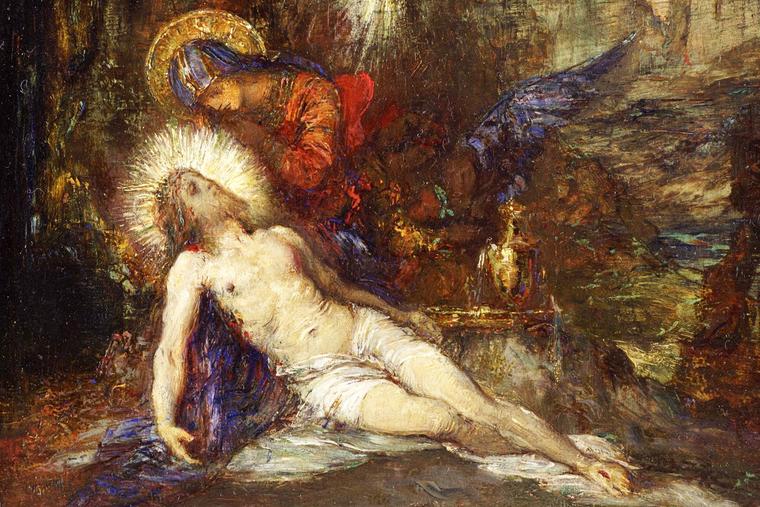
We are now approaching Holy Week. And every year I immerse myself in its various liturgies and prayers with my eyes firmly focused on the humility of Christ. The Son of God, the second person of the Holy Trinity, not only became “a” man, but in so doing “became man” as such, recreating our fallen nature by elevating it into its true divine calling. But this “elevation” is in direct relation to the humble “descent” of Christ into the indignity of being judged in a rigged trial by thoroughly mediocre men, spat upon, struck in the face, stripped naked in public, flogged, mocked as a false king with a crown of thorns from a common thistle bush, and finally judicially murdered on a cross before being interred in someone else’s tomb.
All of this was a gross indignity, and yet our Lord humbly submitted to it, because it is precisely our frailty, both spiritual and physical, that Christ came to share precisely in order to heal.
Therefore, cleaning and feeding my mother like I would a child, and helping her drink some water, has nothing undignified about it in this bigger picture. Likewise, I was also reminded of this truth as I was helping my father walk without his walker, grabbing him by the arm, supporting him and holding his hand. I have been told that it was this now physically broken man, my father, who helped me take my first steps as a toddler. And that toddler, now grown, is aiding him to take some of his last steps.
Yesterday, my sister and I located a new dog for him, which she delivered to my father to great joy. And once again I was struck by the fact that this act mirrored the joy I had when my father brought home to me my first dog, a Basset Hound puppy bought from a neighbor, and presented it to me. Parents have been giving their children pets like this from time immemorial. And here now was my 92-year-old father, grinning from ear to ear like an innocent young boy with his first dog, and unselfconscious about his unalloyed tears of joy. It was, once again, as if my father was now the child and his children were the parent.
Do we ever really grow up? Are we not instead really, and in a spiritual sense, children forever? Is this not why, no matter where we end up living in life, the town we were raised in will forever be “home?” And is this not the hidden pedagogy gifted to us by God in our post-lapsarian condition? The deterioration of our bodies, the reality of which returns us to the dependence of childhood, unveils the truth that we are really never anything other than adult children.
There is, as Chesterton noted in Orthodoxy, a theological truth in all of this. He notes that one of the annoying things about children is their incessant plea for us to “do it again” when we have engaged in some action that pleases them. But as we age we get jaded and cynical. We submit to the lie that the goal of life is “independence,” and we devote ourselves to the alleged sobriety of a “serious life devoted to adult things.” But, as Chesterton notes, it is not automatic necessity that makes every daisy look alike, but rather it is that God sees one daisy and, being eternally young, says, “Do it again.” Only jaded adults get bored.
My parents will most likely return to dust very soon and to a dependence upon God’s redemptive economy. I too will turn to dust soon and to the same childlike hope in God’s tireless daisy-making. And so will we all. As the young Curé of Ambricourt in Bernanos’ Diary of a Country Priest says as he lays dying: “Tout est grâce” (“Everything is grace”).
That grace, which is all, and beyond which there is nothing but decay and darkness, is not some generic “spiritual power” that we can tap into like a faucet that we control. It is the grace of the humbled, crucified and risen Christ. And it is only communicated to us if we too accept the indignity of being dependent upon others, if we accept the frailty of our condition, and embrace our crucified and risen Lord as Thomas did: “My Lord and my God!”