Heaven Spoke — and St. Joan of Arc Took Up Her Sword
SAINTS & ART: The Church honors Jeanne d’Arc as a virgin martyr and national patroness, whose courage, purity and fortitude continue to inspire Catholics and converts in a secular age.

St. Jeanne d’Arc (Joan of Arc) is celebrated on the French liturgical calendar on May 30 as co-patroness of France. Seeking her intercession, there is currently an ongoing nine-year national novena in France, culminating in the 600th anniversary of her death in 2031.
Born around 1412, Jeanne lived during the Hundred Years War (1337-1453) between England and France, a conflict between those nations would result in her being killed. Northern France (including Paris and Reims and regions like Normandy and the Duchy of Brittany) were controlled by the English. The Burgundians, allies of England, ruled two noncontiguous regions adjacent to English-controlled French territory: what we today call “Burgundy” in east-central France and Flanders, today’s northern France and Belgium. “Germany” did not exist — it was then the assorted patchwork of the “Holy Roman Empire.”
Jeanne claimed to have received visions from St. Michael to help effect France’s victory (the French cause had been going badly). Faced with little risk from sending a 17-year-old girl to try, Jeanne broke the English siege of Orléans, continued pursuing the English through the Loire River valley in western France, and finally retook the city of Reims. In its great cathedral, where Clovis had been baptized in the fifth century and which by tradition had become the coronation site of French kings Charles VII (“the Dauphin”) was at last anointed and crowned.
Jeanne fought for that event and ecclesiastical legitimation and stood by his side when it happened in July 1429. Eventually, some 30 years later, the recovery of French fortunes begun under Jeanne would lead to their winning the Hundred Years War. But let’s not get ahead of ourselves.
Jeanne continued fighting for the French cause, leading the battle of Compiègne against the Burgundians, English allies. There she was captured and handed over to the English who put her on a show trial in Rouen for “heresy” (a judgment subsequently posthumously annulled), condemned her, and burned her at the stake in 1431, aged 19. In 1456, another church court vacated the previous finding of guilt. Pope Benedict XV canonized her 105 years ago, on May 16, 1920.
The English trying Jeanne for “heresy?” In 1429, England would still remain Catholic for about another century. But losing the Hundred Years War with France led to political dislocations in that sceptered isle (generally called the “Wars of the Roses”) during which two rival English dynastic houses — the Lancasters and Yorks — exhausted and eliminated themselves, allowing an upstart family called the “Tudors” to take the throne. Henry VIII’s wanting to avoid rekindling a succession crisis for lack of a male heir (as well as his uncontrolled libido) led to serial wife abuse/murder and the ecclesiastical schism/heresy of “Anglicanism.” But that’s also a separate story.
St. Jeanne d’Arc combines a variety of symbolic purposes. As a Catholic, she combined love of God and country, convinced she had received a heavenly mission to rescue France and to legitimize her king (who had been exercising royal powers) through ecclesial coronation. She was canonized for her obedience to God’s call, allowing herself to serve as an instrument of his Will, not because she fought for France or beat the English.
That doesn’t mean others don’t accentuate other aspects of her life. For Frenchmen who subsequently threw in their lot with various anti-clerical “republics” and “empires,” Jeanne is an expression of patriotic commitment to France. For feminists, she is a symbol of what women can achieve if freed of gender role expectations. Even for gender ideologues, because she wore military armor, Jeanne is taken as a symbol of cross-dressing.
From what we know of this daughter of a peasant farmer, Jeanne had a pious Catholic upbringing, not unusual for the France of the late Middle Ages. She claimed, around age 13, clearly to hear voices and later had visions of Sts. Michael, Margaret and Catherine (the latter two from the Patristic era), which by May 1428 called her to put herself at royal disposal and help the king. The call grew more insistent by the following January. In March, she was presented to the king, who at first tested her as a delusional visionary. Convinced of her bona fides, he allowed her to act and, by May 8, Orléans was free.
The following May, she would be taken prisoner at Compiègne, a staged heresy trial allowing the English to eliminate she who had defeated him. Jeanne said her “voices” had also told her she would be taken prisoner. She maintained the authenticity of those “voices” until her death. She was burned May 30, 1431, and her ashes were cast into the Seine. Theological nuance aside, I’d venture to say many Englishmen probably considered St. Jeanne a witch. U.S. history tells us how the English were about that.
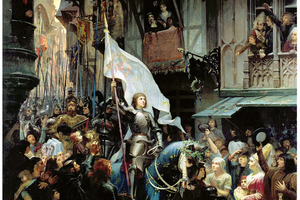
The saint’s life is depicted in art by French watercolorist Louis-Maurice Boutet de Monvel (1850-1913). Boutet de Monvel, from Orléans, was an artist living in a time of French artistic ferment with a practical problem: having to put bread on the family table. In that period, one way of making money was by illustrating books, especially children’s books. In America, N.C. Wyeth made his reputation with Treasure Island. Boutet de Monvel made it with local-girl-made-good, the 1896 book, Jeanne d’Arc. It was a hit.
“The Trial of Joan of Arc” was subsequently repainted by the artist for William Clark as part of the Corcoran Gallery and is now in the Boutet de Monvel collection at the National Gallery of Art in Washington. The work is large: 2-1/2 feet high and almost 6 feet wide, though the painting is oil. The principal protagonists are opposite each other: Pierre Cauchon, Bishop of Beauvais and partisan of English interests, the presiding judge on the left, and St. Jeanne on the right.
Most of the 20-some other judges — including the two Dominicans adjacent to Cauchon, pale indescriptly into the dimly lit room: Cauchon, Jeanne and a tablecloth add the brightest colors to the painting. Jeanne, her shackles hanging from her waist, boldly and confidently defends her case (as we know from the extant court records). Blue and white are colors usually associated with fidelity and purity, both characteristics of Jeanne’s that were impugned. The bishop sits haughtily in white and gold (yellow perhaps indicative of his moral cowardice).
Cauchon’s face, like that of many jurors, clearly betrays partiality and hostility towards the defendant. Some officials are asleep: why bother with evidence? A group of soldiers with halberds keeps order: this was a point of dispute, as Jeanne — being tried in a church court — should have been held in a women’s jail by women guards, not a men’s prison by male guards. Take a look through the whole Boutet de Monvel collection, here.
When the French Revolutionaries overthrew the monarchy in 1789, they launched an aggressive secularization campaign that persists until today in its celebration of laïcité as an ideological pillar of French “patriotism.” That said, the numbers of people entering the Church at the 2025 Easter Vigil — often from secular homes — astounded many people. France was once called “the Church’s Eldest Daughter.” Organizers of “Neuvaine d’intercession à Sainte Jeanne d’Arc” (the Novena of Prayer to St. Joan of Arc) have launched this multiyear effort so that, under her patronage, France rediscover her vocation and spiritual identity as daughter.
Each year highlights a particular virtue or practice: this year’s is fortitude. There can hardly be a better model than a woman, not out of her teens, who led men into battle and faced fire at a stake alone.
- Keywords:
- st. joan of arc
- saints & art