Golden Words, Eternal Truth: St. Peter Chrysologus Preached with Power
SAINTS & ART: The fifth-century bishop of Ravenna, famed for his brief but brilliant sermons, is honored as a Doctor of the Church.
St. Peter Chrysologus was born in 406 in Imola, a town of north-central Italy. The local bishop apparently took him under his wing, educating and ordaining him. Peter became bishop of Ravenna in 433.
Ravenna, on Italy’s eastern coast south of Venice, was an important city. In Peter’s day, it was the capital of the Western Roman Empire. It was also on that fault line where east and west met, which meant there were many Byzantine influences in the city. In the century after Peter, Ravenna also came under strong Arian influences and would be an Ostrogothic capital. For today’s Christian tourist, Ravenna is most renowned for its superb mosaic artwork in many churches throughout the city; it was (and remains) a center of mosaic craft.
“Chrysologus” is actually a title, meaning “golden worded,” referring to Peter’s renown as a preacher. He left behind 176 extant sermons. They have been collected by various people, starting with Felix, his eighth-century successor as bishop of Ravenna. Father William Palardy, a priest of the Archdiocese of Boston, has most recently published them in a new English, two-volume collection (supplementing an earlier volume from 1953) by The Catholic University of America Press.
Chrysologus’ homilies are succinct but pithy: he makes his points eloquently but quickly, yet with depth. Apart from dealing with particular biblical texts, Peter’s sermons address both Christological questions (including Jesus’ Incarnation) and moral questions. He is regarded as a Doctor of the Church.
In Ravenna, Peter preached moral reform and Christian theology. He combatted Monophysitism, one of the variations of Christological heresies that plagued the early Church. Those heresies found it impossible to reconcile Jesus being completely true God and true man, so they often compromised one side or another. Monophysitism, for example, claimed that Jesus had only one nature: divine. If that were true, however, Jesus would not be a real human person. His anti-Monophysite treatise is his “Letter to Eutyches,” its major proponent.
Peter died in 450 in his native Imola, having returned with the expectation of dying.
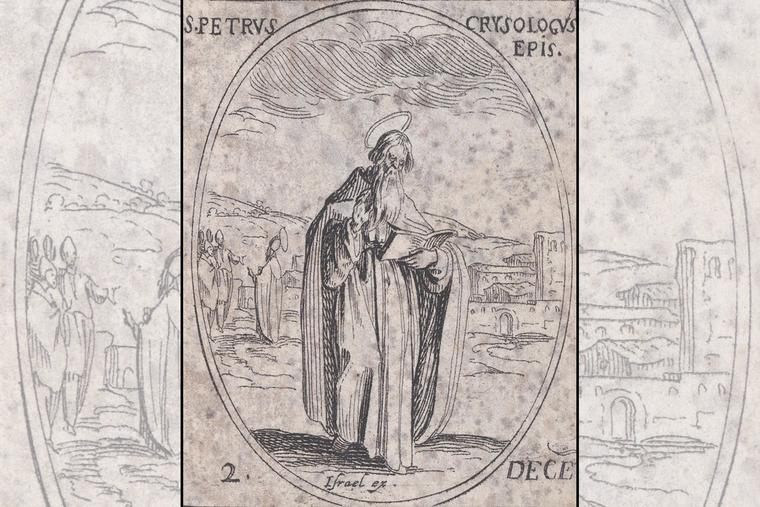
The saint is depicted in art by the French engraver Jacques Callot (c. 1592-1635). The depiction comes from a book published the year after Callot’s death, Les Images De Tous Les Saincts et Saintes de L’Année [Images of All the Saints of the Year], which illustrated the saints for each of their feast days. The book contains 122 illustrations. The illustration is rather small, about 2-1/2 by 2 inches. It depicts the saint, book in hand, apparently ready to speak.
The inscription in Latin is “Saint Peter Chrysologus, Bishop” according to his feast in the old (i.e., pre-1969) Roman Calendar, Dec. 2. His feast has since been transferred to July 30, closer to his death (which may have been July 31, which was already preempted by St. Ignatius Loyola). The book is held by New York’s Metropolitan Museum of Art but is not on public view.
- Keywords:
- saints & art
- St. Peter Chrysologus