How St. Joseph Calasanz Taught the Forgotten Children of Rome
SAINTS & ART: Long before America’s education reformers, St. Joseph Calasanz taught that every child, rich or poor, deserved to learn.
St. Joseph Calasanz (in older works, St. Joseph Calasanctius) was a Spanish priest, born in 1556, who founded the Piarist order. He was well educated in the classical fashion, obtaining a doctorate in law and completing the course in theology. His father wanted him to marry to perpetuate the family line, but Joseph’s near-death experience led to his becoming a priest in 1583.
Noted as a theologian, different bishops gave him various responsibilities, even taking him to different dioceses and roles as they were transferred. Finally, in 1592, he went to Rome, where Cardinal Colonna made him his theologian and instructor for his nephew. During Calasanz’s Roman stay, he began works of charity with neglected and abandoned street urchins. He heard Christ’s call to “give yourself to the poor. Teach these children and care about them,” organizing a free public school for them in 1597.
Pope Clement VIII’s benefactions led quickly to almost a thousand children in Calasanz’s care. He multiplied his educational endeavors; he and his associates coalesced in 1597 into the Piarist order. Paul V approved the Piarists in 1617 — an order primarily committed to basic education. (The Jesuits de facto may be heavily into schooling, especially secondary and post-secondary education, but their formal charism is disposition to whatever mission the pope gives them.) The Piarists take the traditional three vows (poverty, chastity, obedience) plus a fourth: commitment to the education of youth.
Calasanz died in 1648, was beatified in 1748, and canonized in 1767. His feast is observed in his order’s schools on Nov. 27 — the day he opened his first school — because August usually fell in the middle of students’ summer vacation.
Calasanz’s charitable activities extended beyond schools. When the Tiber flooded in 1598, displacing thousands of poor, especially in the Trastevere district, Calasanz helped organize relief.
Afford attention to the fact that Calasanz’s school was free and public. A certain bias would like to present “public” education as secular or at least Protestant. Americans proclaim that the first public school was either Boston Latin School of 1635 or Horace Mann’s vision of public schools from the late 1830s. Neither is true. Calasanz preceded Boston Latin School by 38 years (and no school in 1635 Puritan Boston would have been non-religious) and Mann by more than two centuries. Calasanz was committed to education irrespective of class. Education — and not just higher education — is very much a Catholic product.
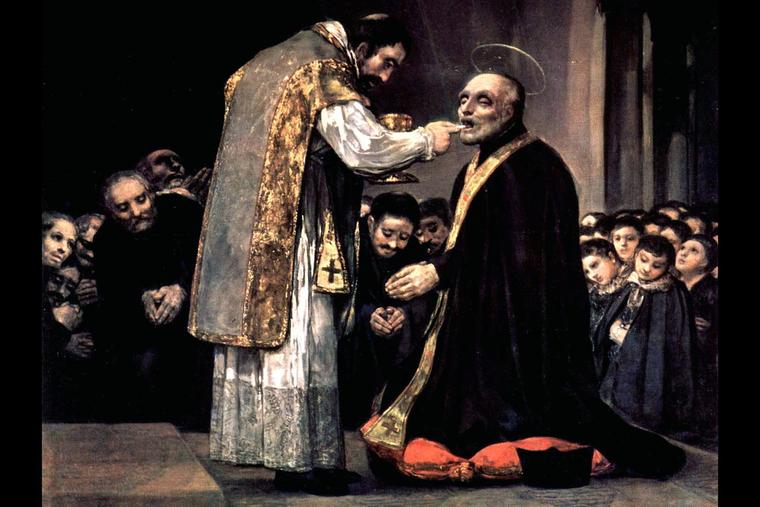
One of the most famous artistic depictions of our saint is Francisco Goya’s “The Last Communion of St. Joseph Calasanz.” Goya (1746-1828) is regarded as the premier representative of the Spanish Romantic school of painting.
Done in chiaroscuro style, the play on light and darkness allows two figures to step out of the darkness: the saint and the priest giving him Holy Communion. The saint kneels to receive Communion, dressed in cassock (without surplice) and a stole crossed at the breast (signifying his priestly rank). The one human marker distinguishing the saint is the red pillow on which he kneels. He is already an old man (he died at 92), as is evident from his face and grey beard, though both radiate an inner peace. The priest, vested for Mass, communicates the saint.
The divine markers in the picture are the saint’s halo and the rays of light from above that primarily illumine the important sacramental moment and secondarily some of the congregation in the church gathered around Calasanz. Unlike the Baroque era, none of the figures are disproportionately large or highlighted in that respect.
The Piarists Fathers Province of the United States and Puerto Rico is based in Washington, D.C., near The Catholic University of America.