Modern Martyrs of Poland, Pray for Us
Beatified by Pope St. John Paul II in 1999, these 108 martyrs bore witness to Christ under Nazi and Communist persecution

Two reasons Pope St. John Paul II accelerated the canonization process were to highlight two truths: that sanctity is “always in season” and not just something from times long ago, and that there are martyrs for the faith today, not just in the Colosseum and Roman Empire. The choice to live according to God’s will — or not — is one in every time and season.
The 108 Martyrs of Poland show us just that. They were all killed out of hatred for the faith during World War II. The 108 Martyrs include three bishops, 76 priests (51 diocesan, 26 religious), three seminarians, seven religious brothers, eight nuns and 10 laypersons. They were beatified by Pope St. John Paul II in 1999. They are collectively honored on the Polish liturgical calendar on June 12, though many dioceses parcel them up, specifically honoring those who came from what is now the area of that diocese.
Few people realize just how persecuted the Catholic Church was in Poland during World War II. There are many reasons for that.
First, Poland is, as Pope John Paul II commented when he was elected, a “faraway country,” not just in distance or culture but, in his day, by the artificial division imposed by the Iron Curtain. Perhaps Neville Chamberlin’s description of Czechoslovakia as he was selling it down the river to Hitler at Munich is more apt: “a faraway country [involving] people of whom we know nothing.” Let’s be honest: most Americans’ knowledge of Europe gets very fuzzy beyond France, Italy and Germany.
Second, there is a caricature in America that somehow the Nazis were in some weird way “Christians” because Hitler was baptized. The truth is that Nazism promoted a pseudo-religion that had more in common with Nordic mythology than Christianity.
Third, the Russian factor. While Americans generally know that “Hitler invaded Poland,” most don’t know that 17 days later (and by prearranged agreement) Stalin also invaded Poland. Two ideologically anti-Christian powers divided the country between them and each, in turn, intended to destroy the Church as a threat to their rule. Because the USSR was later an “ally” (having been burned by Hitler), FDR et al. downplayed its past.
Polish Church history during World War II is extraordinarily complex. In 1939 Poland was split into three parts. Westernmost Poland was incorporated directly into Germany and subjected to ecclesiastical repression, especially of ethnically Polish priests now directly part of the Third Reich.
Easternmost Poland was incorporated into the USSR, where immediate atheization began. (When Hitler invaded in 1941, Stalinist Church repression was replaced by German tyranny until, with the end of World War II, Soviet suppression of the Church returned permanently after the “Big Three” said Stalin could keep what he invaded.)
Central Poland was turned into an entity called the “General Government” — not a country but not part of Germany either. It was a dumping ground for the killing of Jews and Poles. Jews more often were murdered immediately, while Poles were first used as slave labor, though it is clear there were ultimate extermination plans for them, too.
Let’s look at some of the martyrs:
Bishop Władysław Góral — the auxiliary bishop of Lublin (where Poland’s famous Catholic University of Lublin exists) — was arrested two months after the German invasion and, along with 13 priests, sentenced to death. They were detained in the Gestapo prison in Lublin Castle before their sentences were “commuted” to life in a concentration camp. Sent to Sachsenhausen camp, he was kept from 1940 until about 1945 in solitary confinement in a cement cell, denied contact with others, the sacraments, and any reading material other than Nazi newspapers. The circumstances of his death are unclear: some think the sick bishop was taken to Berlin in December 1944 and killed by injection.
Father Mieczysław Bohatkiewicz — a diocesan priest from eastern Poland — before the War worked in a seminary and then in a high school. During the War, he took over a parish (now in Belarus) that had been deprived of a priest for years. The Gestapo arrested him, detained him in two prisons, then took him out into a forest and shot him, along with two other priests. An eyewitness reported that his fellow priest, Father Stanisław Pyrtek, declared “Long live Christ, our Ruler!” as he was shot.
Father Michał Czartoryski — a Dominican from a noble Polish family — as an architect built the new Dominican cloister in Warsaw’s Służew district (which I attended). Having gone to the eye doctor the day the Warsaw Uprising broke out, he volunteered to be a chaplain to the fighters and was serving as chaplain in a makeshift basement hospital for wounded soldiers and civilians. Afforded the opportunity to escape, he declared that a priest stays with the dying. The Germans came and shot the sick and their chaplain.
Father Symforian Ducki — a Capuchin in his mid-60s — was arrested along with other Capuchins at their Warsaw house, interned by the Gestapo in their infamous Pawiak prison, then sent to Auschwitz where he was put to work in a gravel mine. Seven months later, in the adjacent Birkenau camp, he died.
Sister Celestyn Faron — a Little Servant Sister of the Immaculate Conception — was a teacher. She was arrested by the Gestapo in February 1942 and sent to Auschwitz where she was put to work digging trenches. She established an underground school to teach girls arithmetic and enough German to obey commands barked at them. Ill with typhus and tuberculosis, she prayed on a rosary made from bread crumbs. She died on Easter 1944.
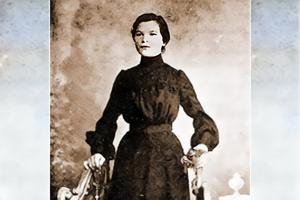
Sister Bogumiła Noiszewska — a Sisters of the Immaculate Conception nun — had medical studies in St. Petersburg before World War I, then worked as an infirmarian. She hid Jews in her convent. Arrested by the Gestapo, she was summarily shot.
Stanisław Kostka Starowieyski — a member of the landed gentry — before the war was active in Catholic intellectual circles, worked with Catholic action, and organized a local Eucharistic congress. In 1934, Pope Pius XI named him a “papal chamberlain.” During the War, he provided assistance to the diocesan curia of Lublin, particularly for charitable activities. Arrested by the Gestapo, he was sent to Dachau concentration camp, outside Munich, where his reputation for Catholic activism resulted in his regular beatings. He died on Holy Saturday night/Easter Sunday morning 1941.
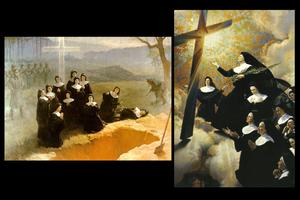
The art depicting our saints is a modern painting by Zbigniew Kotyłło, adorning the Capuchin church in Nowe Miasto nad Pilicą, about 60 miles southwest of Warsaw. Brown dominates the painting, both as the color of the Capuchin habit and as a darker color of mourning.
The figures are, in the top row, left to right: Father Henryk Krzystofik (Dachau, killed through exhaustion, dying in the camp hospital weighing 77 pounds; Father Anicet Kopliński, an ethnic German killed in Auschwitz as “unproductive” (he was bitten by an SS-man’s dog during selection); and Father Fidelis Chojnacki (Sachsenhausen, died of exhaustion after 2.5 years internment). Bottom row, left to right: Father Ducki; and Father Fidelis Stępniak (Dachau, gassed as an “invalid”).
Given the martyrs’ beatification took place in 1999, i.e., when Poland was finally free, artistic commemoration of the martyrs is going on very much at the local level. Their cult was somewhat circumscribed under communism, which was divided between celebrating resistance to Nazism and not wanting to celebrate the Church’s role in it. On the other hand, relics are uneven: many beati were just killed and cremated by the Germans.
- Keywords:
- saints & art
- poland
- martyrs
- world war ii
- nazis
- communism