Exodus Begins: Moses and Pharaoh Face Off
OLD TESTAMENT & ART: The Hebrews’ first request is for freedom to worship — and Pharaoh’s refusal reveals the clash between God’s claim and man’s pride.
(Reading: Exodus 4:29-6:30)
Moses takes leave of Jethro and Midian and, accompanied by Aaron, makes his way to Egypt, where he first legitimates himself by the signs God has entrusted to him with the Hebrews. He then makes his first appearance before Pharaoh.
As we noted earlier, God at first wants Moses to ask Pharaoh to allow the Hebrews to make a three-day journey “into the wilderness to offer sacrifices to the Lord” (Exodus 3:18). At the same time, God already declares that the request will go nowhere and that Pharaoh’s hand will have to be forced.
The Hebrews are slaves in Egypt, compelled to forced labor on grand public projects. The initial request for their freedom is for freedom of worship, for the opportunity to give right and just thanks to the Lord. That first request reaffirms the primacy of the spiritual: the right and duty of people to worship God and to have the opportunity to do it.
Those lessons need to be remembered today. Man does not live by bread alone — nor by work (cf. Exodus 5:4). A person’s value is neither measured nor determined by his productivity. And religion is not simply a matter of human discretion: it is a duty in justice towards God (which God stimulates us by grace to fulfill). Justice is, after all, giving someone what is due him, and there is no one we owe more to than I AM, who is the very giver and sustainer of our being.
It wasn’t just Pharaoh who forgot those lessons. Many moderns do, too. Treating the Lord’s Day as just another “work day,” another day in a fixed cycle, is one example. That goes two ways: employees willing to level the Lord’s Day with others and employers forcing workers into that position. Thinking we do God a “favor” by giving time to worship, prayer and religious duties is a similar error.
So, Moses and Aaron go to Pharaoh to lodge the request and, as God foretold, are turned down (Exodus 5:1). The request is denied because, just as one Pharaoh reduced the Hebrews to slavery because he “did not know Joseph” (Exodus 1:8), now Pharaoh does “not know the Lord and will not let Israel go” (5:2). Implicit in his refusal is a raising of himself to God’s level: “Who is the Lord that I should obey him?” This is the temptation of every Caesar when it comes to dividing up his things and the things of God: a refusal to recognize God’s claims or to make his equal to God’s. That happens whether Pharaoh thinks himself a god or when modern-day Caesars, invoking “separation of church and state,” decide they need not reckon with the possibility there are things not theirs to apportion.
But Pharaoh’s problems are not simply ignorance of God or even puffed-up pride. His is also a hardness of heart coupled with a malice of soul: the request to worship incites Pharaoh to intensify the subjugation of the Hebrews while branding them as “lazy” (5:8, 17). They are to maintain the same production levels but also take on the task of acquiring by themselves instead of receiving allotments of required raw materials. They are to make the same number of bricks without receiving the straw they need to do it (5:10-19).
Hebrew recourse to Pharaoh gets nowhere, so we have a preview (5:21) of the kind of discontent that will mark the next forty years: when things go well, the Hebrews rejoice. But when they don’t, a perverse kind of sentimental grumbling for the “bad old days” of Egyptian fleshpots and straw supplies is thrown in Moses’ — and, by extension, God’s — faces.
Moses seems somewhat to join those sentiments, asking God, “Why have you brought trouble on this people?” Feeling some responsibility himself, he also tries to shift it onto God: “Is this why you sent me?” (4:22-23). They all need to learn that deliverance does not come from human action or reason, but from God, in whom they are challenged in faith to put their trust.
God responds (6:2-8) by assuring the Hebrews through Moses that he will now deliver them, not just for a temporary leave but for permanent liberation from Egypt in a promised land. But receiving that assurance requires trusting faith and, as Scripture makes clear, the Hebrews don’t have it (6:9) while even Moses continues to point out his limitations to God (v. 12).
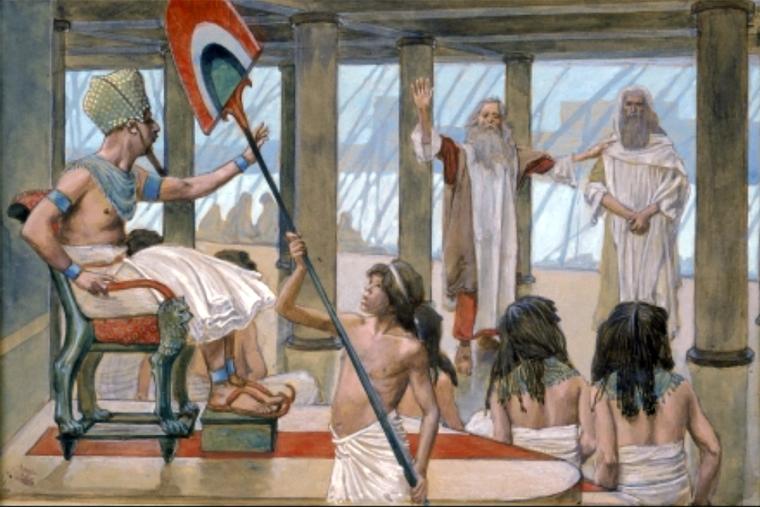
Frenchman James Tissot illustrated “Moses Speaks to Pharaoh” sometime between 1896-1902. Tissot, who was a leader in the effort that gathered strength in the 19th century to paint Biblical scenes as if they occurred in the Holy Land and Middle East, not as if they were transplanted to medieval or Renaissance Europe. This small painting (about 7 x 11 inches) appeals to me for two reasons: the limitation on the protagonists and the fidelity to a Mideast (if perhaps stereotypical?) vision of what ancient Egypt might have looked like.
Let’s note the small number of people. We have eight figures in the painting: three decisive, five for “decoration.” The three decisive figures are Pharaoh on his throne (left foreground), Moses and Aaron speaking to him (right background, in white). Pharaoh wears a variant of the traditional double crown pschent and a false beard, which was intended to make him distinctive and associate him with divinity. Moses and Aaron are primarily/exclusively in white, a dress color convention Tissot uses in his New Testament art for Jesus.
The five decorative figures are servants of court: the man whose face we see, cooling Pharaoh with an ostrich feather fan, two others with backs turned on us, facing Moses and Aaron, and two almost wholly concealed by Pharaoh’s throne. Other people are suggested outside the room, where we also see in the background Egypt’s lifeline, the Nile.
Pharaoh is, in our terms, the head of state. He obviously is not going to meet anybody alone; there will be a court. At the same time, this is the first of many meetings between Moses, Aaron and Pharaoh: Even if Pharaoh had not hardened his heart, the disgorgement of a large, alien slave population of utilitarian value to Egypt was not going to happen in one meeting overnight. As tensions ramp up with each subsequent encounter of the protagonists, we’d expect a swell of attendees, so it’s good that Tissot starts us off small.
Why is Pharaoh’s throne in the foreground? An obvious answer is that he is the ruler of Egypt. But, spiritually, we also recognize that genuine power here belongs to God and his representatives, Moses and Aaron. So, Pharaoh’s prominence may also suggest the decisive moral position he occupies — he’s heard what God wants of him and the ball is in his court. Will he hear what the Lord says? Or will he harden his heart? We know from the whole Book of Exodus that the latter is the case.
Exodus reports multiple meetings between Moses, Aaron and Pharaoh. Many “Moses and Pharaoh” paintings include a snake, to allude to the sign Moses and Aaron perform before the Egyptian ruler. That happened in the next meeting, after Pharaoh had aggravated the lot of the Hebrews — it does not belong here, and Tissot does not include it.
- Keywords:
- old testament & art
- exodus
- moses
- james tissot