10th Plague of Egypt: ‘There Was Not a House Without the Dead’
OLD TESTAMENT & ART: Exodus’ most devastating plague exposes the price of resistance to God — and why the loss of the firstborn struck at the very heart of Egypt.
Reading: Exodus 11; 12:12-13, 29-42.
The tenth and final plague is the death of all the firstborn of Egypt, man and beast.
Whatever origins or causality one might try to attribute to the prior plagues, the supernatural direction of the final one is unquestionable. The firstborn of Egypt, man and beast, dies; the firstborn of Israel live.
Man can decide to harden his heart to God and his commands, but man cannot avoid the ineluctable consequence that turning against him who gives life can only mean death. And since man is not self-sustaining, when God removes his protecting hand, they “return to dust, ye sons of men” (Psalm 90:3).
God has shown nine signs to Egypt. The Egyptian reaction each time is to persist in its will and put God off. It is fair to say that the tenth plague is not so much inflicted by God as brought upon themselves by the Egyptians.
Pharaoh is forewarned, but he refuses to relent. On a purely human level, despite the signs he has already seen, he no doubt was convinced both that Moses could not do that nor would dare. But, of course, it was not Moses’ doing.
Because we live in a society that has diminished the value of children, we perhaps do not fully appreciate the impact of this plague, particularly of the firstborn. After all, didn’t families have other kids? No doubt, but in most cultures throughout most of history the firstborn – the son that carries on the family name and heritage, the one who first opened the womb, the one who will be the one who incarnates your blessed memory but in himself and before others – is unique. Thanks to the firstborn, one becomes what one has never been and will then never cease to be: a parent, and the parent of a son who will perpetuate one’s family line. And the universal loss of that child is a unique and painful blow. “There was loud wailing in Egypt, for there was not a house without someone dead” (Exodus 12:30).
As much as Pharaoh had hitherto refused to let the Hebrews go, so now he “summoned” Moses and Aaron to tell them to get out, to leave with their flocks. He even asks them to “bless me” (v. 32). That urgent request was seconded by Egyptians at large, not out of conviction to obey the Lord but because “’otherwise … we will all die!’” (v. 33) And, almost laconically, Exodus observes that, after “430 years” since Joseph brought them there, Israel departed Egypt (vv. 40-41).
Exodus blends the plague of the death of the firstborn with the Passover, because both are indivisible. Given the importance of the Passover to Jewish theology and identity, I will treat it separately (which is why I have suggested a broken-up reading of Chapter 12). Passover also has Christological implications: the Passover as foreshadowing the Eucharist.
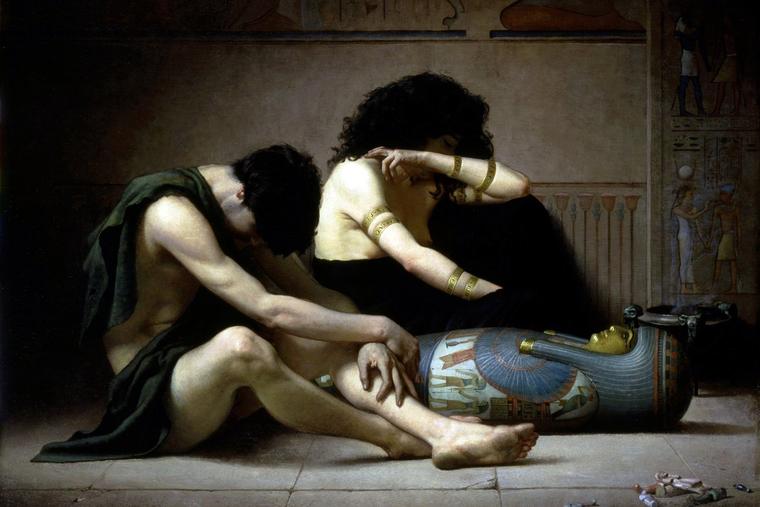
“Lamentations over the Deaths of the Firstborn of Egypt” by American painter Charles Sprague Pearce (1851-1914) is a classical painting associated with the tenth plague. Pearce spent many of his later years in France and was caught up in the “Orientalist” movement, a movement in 19th-century art that took an interest in showcasing Mid- and Far Eastern themes in painting and decorative arts. He also painted religious subjects besides this tenth plague scene, e.g., the “Decapitation of John the Baptist.”
The overall darkness of Pearce’s painting mirrors the mournful grief of the Egyptians, all of whom have just lost someone. And while the loss was multi-generational (the father of a firstborn may also have been his father’s firstborn, and so on), Pearce focuses on children. We see two parents, faces covered in grief, heads bowed, sitting on the floor. Their bodies and black mourning clothes are illuminated by a light from above, also suggestive of the supernatural origin of this event.
An ushabti (also called schwabti) is on the floor between them. These funerary figurines, usually of clay, were buried with the deceased. They were intended to do manual work in the afterlife for the person with whom they were buried. (It is amazing how this pagan culture managed to develop a sophisticated idea of the afterlife and the relevance of the body to it: see my comments here.) The wall behind them, with hieroglyphics and lower half decorative elements, reinforces the Egyptian venue.
One commentary noted that Pearce was painting in the Victorian Age, when infant mortality was still high and, therefore, the feelings about the loss of a child were not unknown to his contemporaries. The painting is in the Smithsonian in Washington.