Pharaoh’s Hardened Heart Meets God’s First Sign
OLD TESTAMENT & ART: Aaron’s staff becomes a serpent, the magicians answer in kind, and the drama of the plagues begins with a warning Pharaoh refuses to hear.
Moses’ and Aaron’s first encounter with Pharaoh turned out, on a human scale, to be a disaster: The conditions of Hebrew slavery worsened. They now faced the same brick quota without the necessary straw. The Hebrew response to Moses was a sarcastic “thanks a lot” — Moses’ to God slightly less so.
I say the outcome “on a human scale” was disastrous because, of course, Exodus does not measure the outcome by human indices. What happened is exactly what God said would happen: Pharaoh would be stubborn and reject the plea. But God would raise the stakes and improve the outcome.
Which is why Moses and Aaron again appear before Pharaoh.
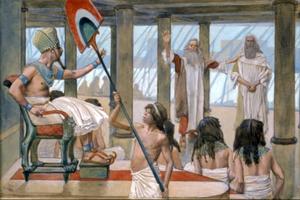
This time (as many artistic renditions of the event depict), there are more people and greater interest because the stakes are higher. From a human (Pharaoh’s) perspective, why are these two dolts back? Who’s dumber: them or the Hebrews who, having been appropriately punished, didn’t stop them?
This next encounter with Pharaoh will set a whole range of events in motion. God also tells Moses that Pharaoh’s obstinacy would continue, as well as how he and Aaron should conduct themselves.
Moses and Aaron return to Pharaoh. He obviously wonders why these two think they can persist. They respond by performing a sign God commanded of them: Aaron casts down his staff, which becomes a snake. But Pharaoh’s “magicians” and “sorcerers” do the same, so Pharaoh undoubtedly thinks it’s all a trick — even though Aaron’s snake fights and consumes all the others. “Yet Pharaoh’s heart was hard and he would not listen to them.” Moses and Aaron go home. (We might also reflect on the “black magic” of sorcerers and magicians being diabolical competition against Moses and Aaron.)
Now begins the cycle of what we often call the “ten plagues.” Exodus does use the word “plague,” but it also speaks of them as “signs and wonders.” They do augur evil. But they are signs of God’s power and dominion, which the unhardened heart should recognize and be moved.
Yet, as St. Paul would say centuries later, the “mystery of evil” (2 Thessalonians 2:7) is such that — as John observes — men “loved darkness instead of light because their deeds were evil” (John 3:19). The mystery of sin is that men can accommodate themselves to, even become comfortable in its servitude. We see that throughout Exodus, where the Hebrews themselves grumble, even though they are being freed of slavery, because without faith, all they see is a further deterioration of a lousy status quo to which they have grown accustomed.
So, one man’s “plagues” are his just punishments for refusing to see the “signs and wonders” God does in order to confirm his commands. But we’ll consider the “plagues” separately.
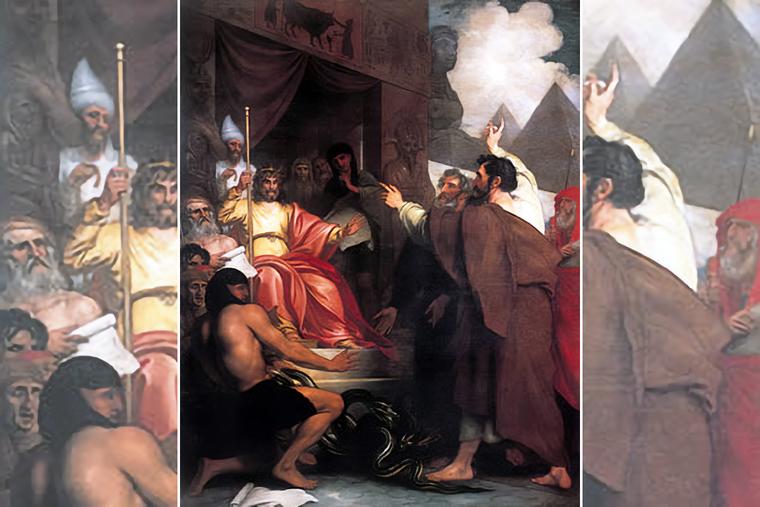
This second, important confrontation between Moses/Aaron and Pharaoh is depicted by the American painter, Benjamin West (1738-1820). West was born in Pennsylvania and died in London after a distinguished career on both sides of the Atlantic.
West’s illustration of Moses and Aaron before Pharaoh has the two former making agitated protests before Pharaoh. Their agitation is depicted by their upraised hands. There’s some measure of cultural confusion in the picture: Pharaoh is dressed more like a Greek king than an Egyptian Pharaoh. Indeed, the man behind Pharaoh in the blue pschent-like head covering looks more Pharaoh than the staff-bearing Pharaoh. We know it’s Egypt because West kindly inserts the Sphinx and two pyramids in the background behind Moses and Aaron.
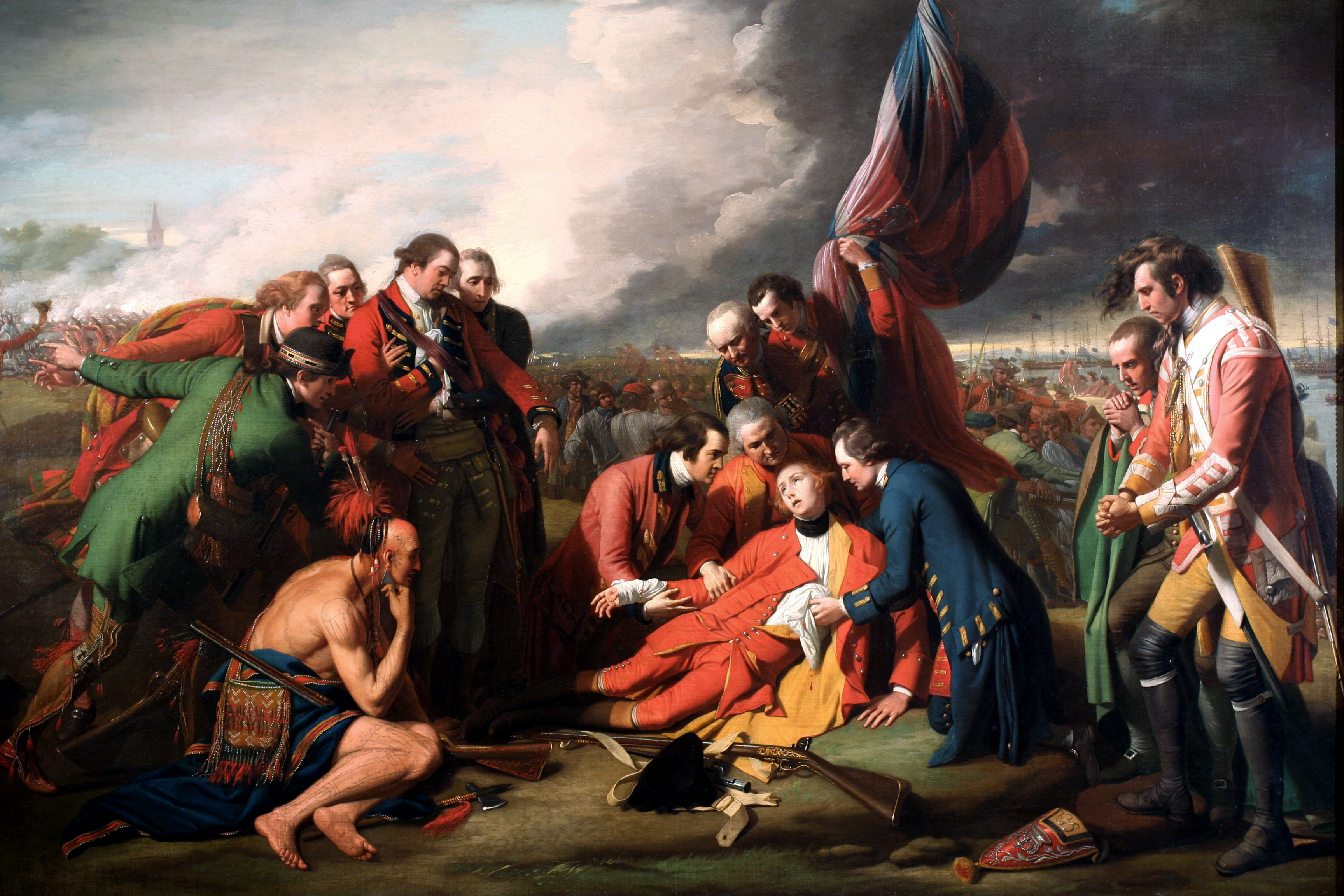
Is this confusion part of West’s allegiance to neoclassicism — a return to simple ancient forms in art, in contrast to the preceding Baroque? Perhaps: as one commentator noted, important figures were often cast as classical Greek heroes, and one mark of West’s break with that tradition is his famous painting of the death of British General Wolfe on the Plains of Abraham, where the great military victor is shown in clothing of his era. That battle sealed British control of Canada.
West’s “Moses and Aaron Before Pharaoh” is a somewhat bizarre depiction, because it seems to suggest that Moses and Aaron accosted Pharaoh at his door. Since Pharaoh appears to be aboard a platform, presumably he was going somewhere: Pharaohs don’t normally get carried to open the door for unwanted visitors. But, in the dark background of the passageway, we can see a numerous court — far more than we saw in Tissot’s painting earlier.
What clearly connects this painting to this encounter with Moses and Aaron is the presence at the foot of Pharaoh’s platform of Aaron’s snake that is consuming the snakes of Pharaoh’s court magicians. When we see snakes in the picture (which is most common), we know we are referring to this meeting between Moses and Aaron and Pharaoh.
- Keywords:
- old testament & art