What Does a ‘Synodal Parish’ Look Like? This Missouri Parish Is Trying to Figure That Out
At St. James in Kansas City, a “synodal parish director” manages day-to-daily operations and parishioners meet regularly to make collective decisions.
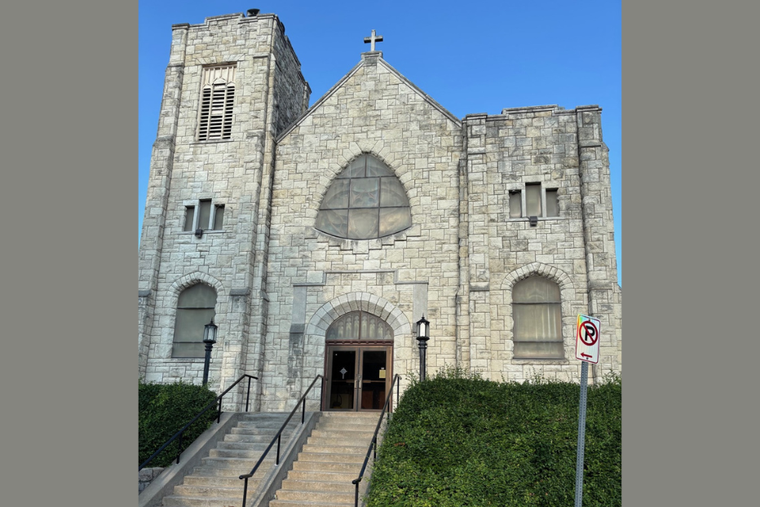
With the Synod on Synodality moving into its “implementation” stage, one Missouri parish — prompted by a priest shortage — isn’t waiting for the details to be worked out.
St. James Catholic Church, an urban parish in an economically disadvantaged neighborhood in Kansas City, is going full-throttle to put the principles of synodality into regular practice by emphasizing collective decision-making, dialogue and social justice activism.
Even as it works out what it means to be a “synodal” parish, St. James is blazing a trail that other Catholic parishes around the country and throughout the world may have to tread, eventually, if Pope Leo XIV makes good on his pledge to press forward with his predecessor’s signature initiative, which seeks to make the Church more welcoming and give the laity a bigger say over its administration.
St. James is no stranger to lay involvement. The church shares a pastor with two other parishes and has for years delegated day-to-day responsibilities of the church to a lay parish administrator.
But when the administrator, who supported the pastor by overseeing the operations of the church, stepped down from his position which he had held for the last 10 years, members of the parish leadership team saw an opportunity.
Why not become a synodal parish and help realize Pope Francis’ vision of a Church that “walks together?” Instead of simply hiring another administrator, they decided to engage the entire parish in making decisions together.
The move comes in response to the Synod on Synodality, a four-year process initiated by Pope Francis aimed at making the Church more inclusive and participatory.
In the early days of his pontificate, Pope Leo has moved forward with the Vatican’s push for synodal reforms, issuing a guide for the implementation stage of the initiative that invites each parish to “practice synodality within its ordinary pastoral ministry, improving the way it carries out its mission through the ecclesial discernment that the Holy Spirit asks of us today.”
Today, four years into the process, many Catholics might still be hard-pressed to define what synodality or a “synodal Church” means.
The final document published at the conclusion of last fall’s Synod meetings summed it up this way: “In simple and concise terms, synodality is a path of spiritual renewal and structural reform that enables the Church to be more participatory and missionary, so that it can walk with every man and woman, radiating the light of Christ.”
At St. James, being a “more participatory” synodal church involves plenty of group discussion. Every month, the parish, which is home to about 200 families, holds town hall-like meetings to talk about issues of concern to the community.
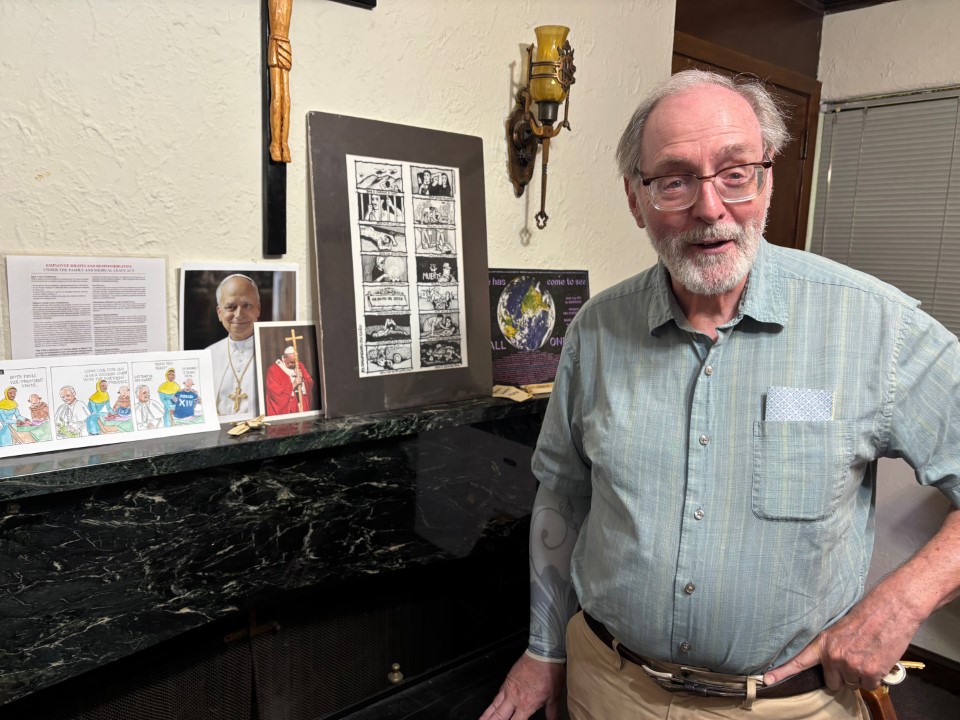
Patrick Marrin, who was appointed “Synodal Parish Director” at St. James earlier this year, told the Register that parishioners “represent all ages, ethnicities and backgrounds.”
Among them, he said, are “an elderly, Vatican II loyalist group” with years of experience volunteering to work for the Catholic Church. Others come from all corners of the world, as reflected by the many flags hanging in the back of the church, representing the parishioners’ countries of origin.
Marrin said, “There’s great diversity here, which makes it both a challenge to put together a unified community, but also a very rich community, because we have in large measure moved from enclaves into a small parish where people know each other.”
Marrin, 80, a member of the parish for 25 years, is the former editor of Celebration, the National Catholic Reporter’s pastoral planning publication. He’s also a cartoonist and creator of “Francis, the comic strip” now called “The Leo Chronicles.”
In late 2024, the parish began holding the first monthly meetings after Mass on Sundays to discuss the meaning of synodality and the parish’s future.
“The idea is that all the baptized are responsible for their church. And if we come together in a belief that the Holy Spirit is part of our conversation and we encounter each other and talk with each other, then the policy that emerges becomes the parish policy,” Marrin explained.
The first item on the agenda was to hire a synodal parish director to replace the outgoing parish administrator.
“St. James is looking for a leader to take us into the next phase of our parish life. This is a bold move since no Catholic Church in our diocese uses this leadership model. We want to make Pope Francis’s call to be a ‘Synodal Church’ a reality at St. James,” read the ad for a “Synodal Parish Director” that was posted on the diocesan website.
After the ad failed to attract any applicants, Marrin decided to throw his hat in the ring.
“This is my last gift to the church,” Marrin, who is a laicized Dominican priest who was later a member of the Catholic Worker Movement said.
And for members of St. James parish, the “missionary” aspect of synodality means a commitment to “social justice.”
The minutes of the monthly parish-wide meetings which are held in the church after the 10 a.m. Mass are shared in the bulletin so parishioners can give feedback on proposals before a plan of action is decided upon.
Last month, they met to discuss ways to protect migrants if ICE were ever to raid the church. On next month’s agenda: how to support the homeless in their community. The Kansas City National Security Campus, which produces non-nuclear components of the U.S. nuclear weapons stockpile, is expected to be the subject of an upcoming parish meeting.
Father Don Farnan, who serves as pastor at St. Francis Xavier, St. Therese the Little Flower, as well as St. James Catholic churches, doesn’t think that St. James is doing anything out of the ordinary.
He said what’s happening at St. James is also happening at other parishes that embraced the Second Vatican Council and “are implementing the synodal idea of how we move forward together as communities.”
“I guess there are different ways that is it’s being manifested, but they’re doing it their way. In that sense, it’s unique, but I guess every parish does it their way,” he told the Register.
The other two parishes where he serves as pastor, have also embraced elements of synodality, he said, such as praying together before parish council meetings.
“Sometimes people say these are lay-led parishes. I’m not sure if that’s exactly fair to say, but it’s a way to describe [them] that people understand. In other words, the role of the laity is very prominent in these three parishes, and it has been for quite a long time,” Father Farnan said.
For Marrin, the St. James community’s commitment to serving the poor and vulnerable, many of whom come to the church for meals and assistance getting drivers’ licenses or help finding substance abuse programs, is a top priority. The homeless are also invited into the church to use the bathroom and stay for Mass — one homeless man is preparing to join the choir, Marrin said.
Sarah Hirsch runs the St. James Community Garden on the grounds of the church.
“It's a communal garden. We plant and care for these vegetables, but then we allow for anyone in our neighborhood to come and pick them. We actually pick and take whatever is left over to the local food pantry,” she told the Register.
Caring for the environment, she said, is also a priority.
“We aren’t actually mowing our lawn at the church to allow for our bees, the pollinators, to have a place get their pollen,” she said.
Marrin stressed that parish’s engagement on social justice issues is an expression of their faith.
“Our emphasis on social justice issues is an aspect of what flows out of the experience of meeting Christ in the Eucharist, experiencing the transformation that comes from putting our lives on the altar in his death and then taking up his risen life in communion.”
Becoming a “synodal” parish — with monthly meetings where discussions are held and plans are made — allows the parish to respond to what they identify as needs more quickly.
“I think that waiting for the diocese to speak on some social justice issues is sometimes a long wait,” Marrin said. Because of the poverty in evidence just outside St. James, he said, the parish can protest what they see as injustice and take action to help where they can.
When asked what would happen if the synodal community of St. James were to endorse something contrary to the teachings of the Catholic Church, Marrin said he doesn’t expect there will be any such conflicts.
“If there are questions that are clearly controversial and the diocesan bishop says to us, ‘St. James, you’re going too far. You’re being too explicit on an issue that we’re trying to deal with pastorally without having to make public decisions about these things,’ then we will have that synodal dialogue with the diocese,” he explained.
While the Diocese of Kansas City/St. Joseph lists Marrin’s title as “pastoral associate,” rather than Synodal Parish Director (the title that appears on St. James website), interactions between the parish and diocese have thus far been harmonious.
Bishop James Johnston was not available for an interview, but Ashlie Hand, director of communications at the Diocese of Kansas City-St. Joseph, said that he is “aware of the effort at St. James Parish.”
“He is not intimately familiar with their plans, but he is supportive of their desire to engage with their pastor in this way and is interested in observing how it goes,” she said.Father Farnan told the Register that the bishop himself has embarked on a synodal path in the sense that he is a “listener.” He travels to various parishes across the diocese to hear the concerns of people in rural, urban and suburban parishes. The bishop, he said, “encourages the people who have gathered to listen to the Holy Spirit, to find God in these gatherings so that we go forth together.”At the same time, Farnan said, he expects that the bishop “would also recognize that there are going to be areas of the diocese where [synodality] might be implemented in a more structured or activated way.”
“In these three urban parishes that I serve that are a little bit closer together,” he said, “he's seeing that these parishes could, possibly, be a model for other places to embrace that synodal sense of church.”
- Keywords:
- synodal church
- synod on synodality