Vance Addresses Pro-Life Critics at the March for Life — But Not Their Big Critique
ANALYSIS: In his speech, the vice president said he ‘heard’ pro-lifers, but sidestepped the movement’s top policy priority: curbing the spread of the abortion pill.
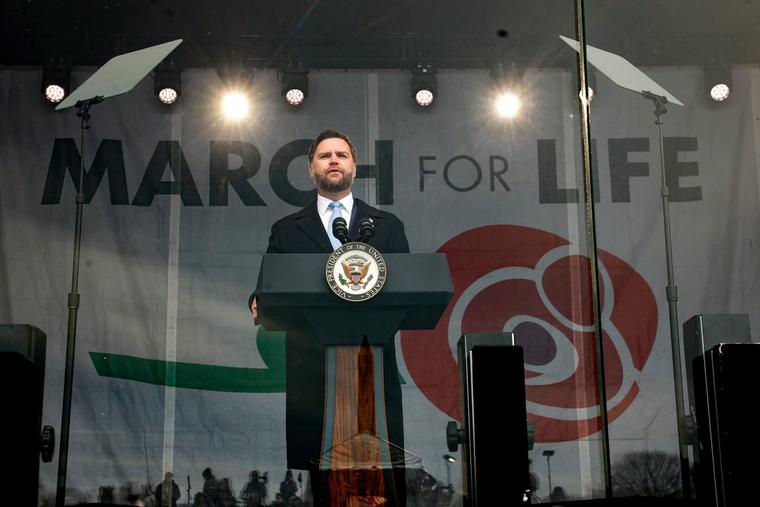
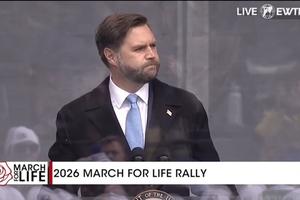
In the days leading up to JD Vance’s speech to the 53rd annual March for Life Friday in Washington, many were wondering: Would the vice president address mounting criticism by pro-lifers of the Trump administration?
In recent days, several prominent pro-life leaders, from Marjorie Dannenfelser to Ryan Anderson, had made their disappointment with the administration known via interviews and op-eds. Their chief concern? That President Donald Trump and his cabinet have done little to stop the proliferation of the abortion pill, a chemical killer responsible for two-thirds of the nation’s abortions each year.
When Vance was announced as the speaker for the march, criticism became even more acute. Nic Rowan wrote in The Wall Street Journal that the march should be rerouted to go past the White House, which “is the pro-life movement’s main impediment now.” National Review’s Kathryn Jean Lopez went so far as to wonder if she should boycott the march with the vice president speaking. And Alexandra DeSanctis, a fellow at the Ethics and Public Policy Center, called the invite a miscalculation.
The critical prelude cast a strange tension over things as Vance’s speech drew near, with heightened attention over what the vice president would and wouldn’t say. Would he address his critics directly? Or play it safe with generic applause lines? And would he indicate any change of approach on chemical abortions?
To his credit, Vance didn’t shy away from addressing what he called “the elephant in the room.” In fact, when he transitioned to that portion of his prepared remarks, he made a point to acknowledge a man in the crowd who had periodically been shouting “ban the abortion pill!” while Vance was speaking.
Vance went on: “A fear that some of you have is that not enough progress has been made, that we’re not going fast enough, that our politics have failed to answer the clarion call to life that this march represents and that all of us, I believe, hold in our hearts. And I want you to know that I hear you, and that I understand.”
However, while Vance certainly seems to have heard the pro-life movement’s concerns, his speech didn’t give any evidence that they have been factored into the White House’s calculus.
Because while Vance used his appearance to claim the pro-life mantle and cite a list of related accomplishments in Trump’s second term, he never once mentioned the abortion pill.
And if the Catholic vice president, who continues to describe himself as pro-life and proudly shared that he and his wife are expecting their fourth child, is unwilling to even address the issue by name, it suggests that the Trump administration won’t be changing their related policies anytime soon.
Pro-life advocates have insisted that the Trump administration restore basic abortion-pill regulations that were swept away during the Biden administration, especially the safety requirement that a woman meet in person with a doctor before receiving the drugs, which can have fatal complications. Using the COVID-19 pandemic as justification, President Joe Biden allowed for the drugs to be prescribed via “telehealth” consultations. Today, this effectively allows for the abortion pill to be shipped throughout the country, even to states where abortion is illegal. As a result, the rate of abortion is 30% higher today than it was at the start of Trump’s first term, with 1.1 million performed in the U.S. annually.
But the Trump administration hasn’t just failed to reverse Biden-era allowances of the abortion pill. It has also seemingly facilitated the drug’s distribution, whether by blocking states from attempting to ban abortions by mail or by allowing the Food and Drug Administration to approve a new generic version of mifepristone.
And while Vance didn’t outright ignore the controversy in his speech, he also didn’t give any ground.
This isn’t the first time the Catholic vice president has employed such a rhetorical tactic. At the National Catholic Prayer Breakfast one year ago, Vance acknowledged that Pope Francis had just directly criticized the Trump administration’s deportation program — before sidestepping the actual substance of the critique. The move seems to be aimed at giving concerned parties a sense that the matter has been addressed without anything substantive taking place.
At his March for Life speech Friday, Vance did this in a variety of ways. He cited pro-life policy accomplishments the Trump administration has secured, many of which were announced in just the past few days: expanding the Mexico City Policy’s ban on funding abortions abroad; banning research using tissue from aborted babies, and launching a fraud investigation into Planned Parenthood’s use of federal COVID-19 aid.
But rather than justifying the lack of any action on the abortion pill, some of these measures call it into question. The ban on fetal tissue research, for instance, was already in place before Biden reversed it — just like the doctor-visit requirement for chemical abortion. If the Trump administration is willing to restore one regulation, why not the other?
Another focus of Vance’s speech was the need to act prudently in the post-Dobbs landscape, particularly by focusing on the states.
“We're not trying to argue to the Supreme Court anymore,” said Vance, hailing Trump for appointing justices who overturned Roe v. Wade in 2022. “We are trying to persuade our fellow citizens that we must build up that culture of life.”
But DeSanctis had argued earlier in the day that the call to focus on the states is “a fig leaf,” given that federal policy currently allows women to obtain the abortion pill no matter where they live.
“We are tacitly permitting legal abortion throughout the U.S. by executive fiat,” the pro-life commentator wrote for the Register.
Vance also used his March for Life speech to advocate for what the moral theologian Charles Camosy has called a “Pro-Life 3.0” approach: namely, pursuing policies that make it easier for women to choose life by addressing socioeconomic factors that contribute to abortion.
In this vein, Vance cited the Trump administration’s expansion of the child tax credit, restrictions against corporate purchases of single-family homes, and funding of investment accounts for newborns.
The administration’s pursuit of these sorts of policies will likely be welcomed by many pro-lifers, as well as other Catholics who have been dubious of efforts to end abortion via legal recourse.
But as Ethics and Public Policy Center fellow Patrick Brown has already argued, restricting the abortion pill and pursuing pro-family policies like a “baby bonus” can and should be pursued at the same time. The Trump administration’s pursuit of some “Pro-Life 3.0”-type policies doesn’t seem to justify scrapping the kinds of legal restrictions employed by previous versions of pro-life advocacy.
In other words, instead of addressing chemical abortions, Vance cited other pro-life accomplishments and areas of focus — none of which mutually exclude regulating abortion pills.
While Vance was very well-received at the March for Life, his remarks appear to have done little to quell pro-life leaders’ concerns, based on their immediate reactions.
“It is because of the inaction of the Trump-Vance administration on abortion drugs that this opportunity isn’t being realized — and abortions are going up, not down,” SBA Pro-Life America said in a statement. “It’s time for the Trump-Vance administration to act and at a minimum restore in-person dispensing, getting these dangerous drugs out of the mail. Doing so would allow states to enforce their laws, protect countless unborn lives, and restore essential medical oversight to stop the coercion and abuse of women nationwide.”
Adding to the worries of the pro-life movement is likely the fact that the current approach of the White House may have implications beyond the current administration. Vance is the current front-runner for the GOP’s presidential nomination in 2028. His willingness to treat pro-life priorities as politically flexible now may suggest he takes a similar approach on the campaign trail and beyond. And, of course, while inaction is one thing, Vance went even further in the lead-up to the 2024 election, telling NBC News that he supported the availability of the abortion pill.
In his March for Life speech, Vance himself said that “building a culture of life requires persuasion.” Perhaps the most important person for the pro-life movement to focus its powers of persuasion on right now is the vice president himself.
After all, Vance said in his speech that pushback from pro-life leaders helps “keep people like me honest, and that’s an important thing.” And he said something similar at last year’s prayer breakfast, requesting that his fellow Catholics tell the administration “when we get things wrong.”
But the pro-life movement has been loud and clear that the Trump administration’s refusal to curb the spread of chemical abortion is a profound failure. And at this point, it’s fair to wonder if all of the vice president’s listening will ever lead to action.