‘You Are Gods’: The Ancient Theology That’s Making a Comeback — and Could Help Unite East and West
The revival of deification theology in the Catholic Church has big implications, from ecumenism to AI.

When Grace Simcox came across the concept of deification last year, the Catholic theology student thought she might be dealing with something more pagan than Christian.
The Franciscan University undergrad was debating her now-boyfriend, an Eastern Orthodox catechumen, and wasn’t sure if his constant emphasis on how the Christian life was aimed at theosis, or becoming like God, squared with her Catholic commitments — or if it did at all.
“At first, it seemed provocative and borderline mythological,” she said.
But after turning to Scripture, the Church Fathers, and especially the medieval Catholic theologian St. Thomas Aquinas, Simcox discovered that deification wasn’t merely compatible with her Catholic faith — it was one of its most profound and essential truths.
Simcox isn’t the only Catholic to have made this discovery. Over the past three decades or so, the Catholic Church has undergone a profound recovery of the theology of deification, also known as divinization. The ancient approach to the Christian life emphasizes that salvation isn’t merely about being freed from sin, but is more fundamentally about being united to God and sharing in his divine life.
Although never lost, the theology of deification had long been overshadowed by more juridical approaches to salvation which emphasized concepts like expiation of guilt and deliverance from punishment. Promoted by figures like St. Anselm of Canterbury in the 12th century, juridical accounts became especially dominant in the West during the Reformation, as Protestant emphases on justification prompted the Church to use similar legalistic frameworks in defense of its doctrines.
But theosis began making its way back into the Catholic mainstream in the 20th century, largely through the resourcement movement’s renewed interest in Patristic theology, which was deepened by post-Vatican II ecumenical dialogue with Orthodox Christians.
“In the 20th century, it was commonly praised or disparaged as a peculiarly Eastern Christian phenomenon,” said Dominican Father Andrew Hofer, an expert on the topic who teaches at the Dominican House of Studies in Washington, D.C. “Now people are realizing that it is a basic Christian doctrine.”
In other words, deification is having a moment — with big implications ahead.
Books on the topic, both academic and devotional, have surged since the mid-1990s, after St. John Paul II’s Catechism featured deification prominently. And at Catholic universities and seminaries today, theosis is all the rage, with one professor telling the Register he has a veritable “feeding frenzy on my hands.”
“Students love writing about the subject,” said Paul Gavrilyuk, an Orthodox theologian who teaches mostly Catholic students at the University of St. Thomas and the Saint Paul Seminary in Minnesota. “Juridical language becomes secondary; therapeutic or healing language comes to the fore.”
A major milestone in the renewal of deification theology occurred last year, with the publication of an Oxford University handbook. Co-edited by Father Hofer, Gavrilyuk and the prolific Catholic theologian Matthew Levering, and including contributions from leading Catholic theologians like Tracey Rowland, Cyril O’Regan, and Dominican Father Gilles Emery, the 752-page text is set to serve as a foundation for deification studies going forward.
But the likely impact of the deification revival isn’t merely academic. Instead, it’s already touching on every aspect of the Christian life — from how Catholics pray and participate in the liturgy to how the Church contends with emerging threats posed to human dignity.
Deification and Ecumenism
But, like Simcox found with her now boyfriend, perhaps deification theology’s greatest potential impact is its capacity to serve as a meaningful common ground for Catholic and Orthodox Christians on their path to greater unity, a priority of Pope Leo XIV’s.
A development at the Vatican last month put this potential front and center.
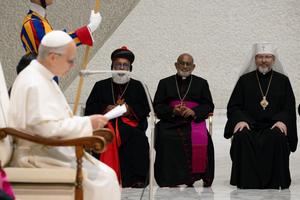
On June 7, Pope Leo held a private audience with participants of a just-concluded Catholic-Orthodox conference marking the 1,700-year anniversary of the Council of Nicaea. The conference itself had been organized by the International Orthodox Theological Association (IOTA) and was hosted by the Dominican-run Pontifical University of St. Thomas Aquinas under the patronage of the Dicastery for Christian Unity.
During the audience, Gavrilyuk, the founding president of IOTA, took the opportunity to present the Holy Father with a copy of The Oxford Handbook of Deification, and to share with him plans for a next step of Catholic-Orthodox collaboration: a joint declaration on deification.
A video capturing the moment in the Sistine Chapel shows the Holy Father stop and speak with the Orthodox theologian, listening with great interest and nodding several times.
“He smiled and looked rather positively upon the endeavor,” recalled Gavrilyuk.
Gavrilyuk believes that the joint declaration on deification, which is being organized by both IOTA and the Angelicum, is fertile ground for bringing together East and West, in part because of the doctrine’s deep roots in both traditions as well as Revelation itself.
Key passages in Scripture include Psalm 82, where it is written that “You are gods, sons of the Most High, all of you.” St. Peter wrote that God has called all believers to not merely “escape from the corruption of the world,” but to “become partakers of the divine nature,” while St. John wrote that God’s children “shall be like him, for we shall see him as he is.” (1 John 3:2)
Church Fathers revered by both Catholics and the Orthodox developed theologies of deification from these sources. St. Athanasius, for instance, taught in his On the Incarnation that “the Son of God became man so that we might become God” by grace. Dionysius the Areopagite developed the concept even more explicitly, writing about deification as a sacramentally-grounded process of purification, illumination, and divine union, leading to the “attaining of likeness to God and union with him so far as is possible.”
And the great Catholic theologian St. Thomas Aquinas, while addressing the effects of the Eucharist, wrote that “since it was the will of God’s only-begotten Son that men should share in his divinity, he assumed our nature in order that by becoming man he might make men gods.”
Aquinas didn’t reject juridical language. Instead, he incorporated concepts like satisfaction for sin into a broader account that held participation in divine life as the ultimate goal. Amid deification’s resurgence in Catholic circles, some scholars have stressed the need to integrate theosis more fully with other aspects of Catholic teaching by, for instance, maintaining the Creator-creature distinction, rejecting pantheism, and not downplaying the significance of Christ’s atoning death on the cross.
However, Father Hofer stresses that such concerns are no reason for Catholics to avoid using terms like “gods” or deification language altogether. After all, these terms are found in Sacred Scripture and were used by the doctors of the Church who elucidated their meaning.
Gavrilyuk notes that despite deification’s prevalence in both the East and the West, the teaching has never been explicitly defined at an ecumenical council — a lacuna that he believes a joint declaration including Catholic and Orthodox bishops could help to address. For his part, he envisions the document articulating a core common to both Catholic and Orthodox Christians, while still allowing for “different ways of unpacking it doctrinally.”
Gavrilyuk also hopes that the declaration could serve as a “template for future ecumenical dialogue” and notes the fittingness of a document on union with God serving as a means for greater Christian unity, which he said is “ultimately a work of God.”
“That vertical union is ultimately what renders horizontal union,” shared the Orthodox scholar.
The Deification Difference
In addition to an ecumenical path forward for Catholics and Orthodox, Gavrilyuk sees unpacking the theology of theosis as key to addressing several other pertinent issues — including the emergence of what he describes as “misguided ways of becoming divine.”
Without an account of how to pursue man’s longing for divinity rooted in Christ’s Incarnation, the Orthodox scholar warns that a slate of contemporary practices, from attributing divine-like characteristics to AI to attempting to use cryogenics to preserve one’s genetic code indefinitely, are filling in the gap. Gavrilyuk compared these practices to errant attempts to seize divinity portrayed in Genesis, such as eating from the tree of knowledge or the construction of the Tower of Babel.
Similarly, the Orthodox scholar notes that the idolization of authoritarian governments in places like China or Russia is another manifestation of the tendency to attempt to aggrandize oneself via power, rather than through Christ’s demonstration “that human nature can acquire likeness to God precisely by being obedient to the will of God.”
“Without the doctrine of deification, the danger of idolatry is actually very high,” he warned.
Others point to the theology of deification’s capacity to transform their experience of prayer, liturgy and the Christian life as a whole, reframing it as invitation to enter into union with God here and now, rather than merely a set of boxes to check in order to get to heaven.
That has certainly been the experience of Carl Olson. The Catholic author and former Protestant says that his discovery of the concept of deification in the 1990s helped him understand the connection between the Incarnation, grace and salvation in a way he never had as a fundamentalist.
“For me, it was recognizing that I have not just been saved from sin, but have been filled with divine, Trinitarian life and called to enter into the Mystery of the Trinity for all eternity,” shared Olson, who co-edited a 2016 work entitled Called to Be the Children of God: The Catholic Theology of Human Deification.
Olson said that deification theology has informed his personal faith “in every possible way.” For instance, he better understands his vocation as a husband and father as a participation in God’s divine work “precisely because it is animated by God’s divine life,” as opposed to something separated from it. Furthermore, he is better able to experience Catholic liturgy as “an entrance into the life of the Kingdom and a foretaste of the heavenly communion.”
Simcox, the theology student who first encountered deification via her Eastern Orthodox boyfriend, reports a similar experience, noting that she now frequents the sacraments “with a greater desire.”
“Catholicism is not ultimately about rules and ‘being good,’” said Olson. “It’s about being filled with the Trinitarian life and having real and eternal communion with the God Who is Creator of all things, the Giver of Life, and the Lover of Souls.”
- Keywords:
- deification
- eastern catholicism