Meet the Bishop of Taiwan’s Silicon Valley
Bishop John Baptist Lee speaks on leading his flock with a missionary spirit in the heart of the nation’s tech industry.
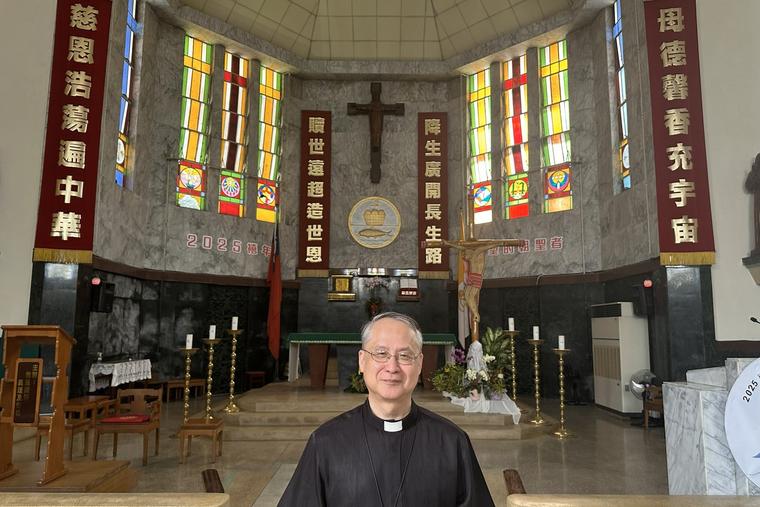
HSINCHU CITY, Taiwan — When I sought an interview with the bishop of Taiwan’s Silicon Valley, I did not imagine that reaching the bishop would require a bumpy ascent along a winding mountain road through a humid subtropical forest to a remote Marian shrine.
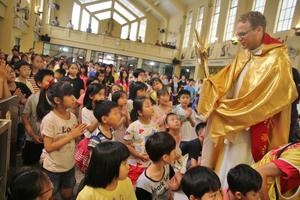
But that is where Bishop John Baptist Lee Keh-mien was spending his Saturday, offering a special Mass for pilgrims in a mountain shrine dedicated to Our Lady of Lourdes.
Lee is the bishop of Hsinchu, the city at the heart of the global semiconductor industry. The diocese is home to the Hsinchu Science Park, a massive, government-initiated hub established in 1980 that now hosts more than 500 high-tech companies. The most prominent is the Taiwan Semiconductor Manufacturing Company (TSMC), the firm that produces the majority of the world’s most advanced chips, the invisible engines of artificial intelligence, and a key part of Taiwan’s security strategy to deter a potential invasion by China.
With the majority of people working in the technology and manufacturing sectors, Bishop Lee, 67, Hsinchu’s shepherd since Pope Benedict XVI appointed him in 2006, has found that one of the most effective ways to build bridges with the tech industry is by offering opportunities for charitable engagement.
“People find the Catholic Church also through charity work,” Bishop Lee said, noting that only 1% of the population is Catholic.
This approach reflects the bishop’s own leadership. He has initiated partnerships with both the private sector and the government for many charitable initiatives to help the disadvantaged, while encouraging diocesan-affiliated social-welfare institutions to integrate more fully into the local community.
From Tech Industry to Quiet Mission
The journey through Hsinchu was one of juxtapositions. I arrived in the city from Taipei on Taiwan’s high-speed rail, a marvel of punctuality and restraint, where businessmen queued neatly on each platform.
From the station, however, the scene changed quickly. When I asked an elderly taxi driver to take me to the Catholic shrine in Guanxi, he frowned but agreed to take me. However, the route’s required steep, winding roads made him visibly agitated, and speaking rapidly in Chinese I could not follow, he turned the car around and deposited me without ceremony at a local police station, refusing to go any farther. For a moment, my heart froze. Old memories surfaced of working with missionaries in rural mainland China, where an unexpected stop at a police station would not bode well. Then I remembered where I was. Taiwan is not the People’s Republic. It is a free and democratic society with robust protections for religious freedom, and one of the most religiously diverse places on earth.
A friendly police officer was able to convince a second taxi driver to take me. We climbed steadily into the hills and the humid subtropical forest closed in around us. When we arrived, the heat was sweltering. Beneath a replica of the grotto at Lourdes, Bishop Lee was celebrating Mass.
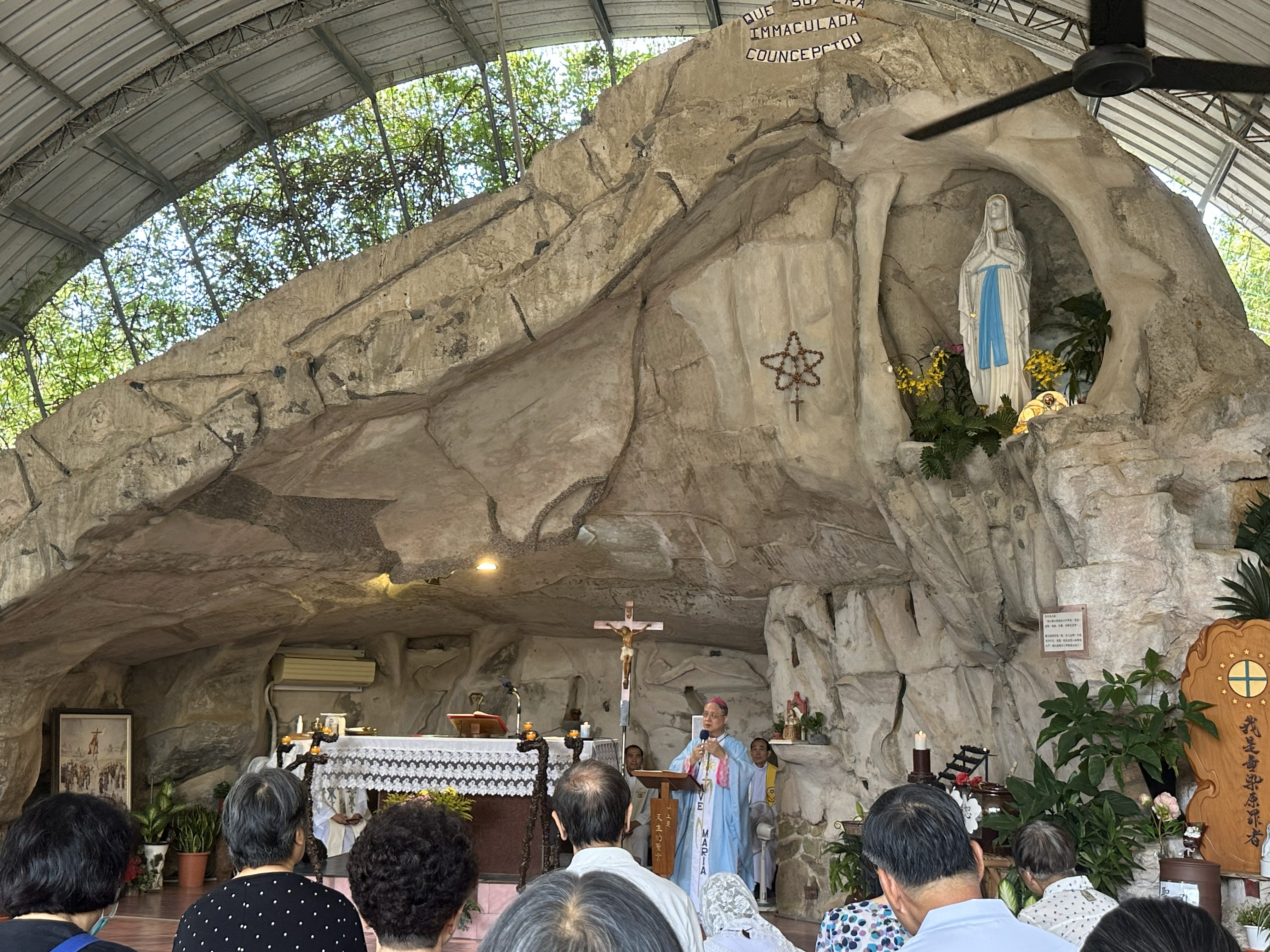
Pilgrims had come from across Taiwan. The liturgy was in Mandarin Chinese, concelebrated by a half-dozen missionary priests from across Asia who serve in the Hsinchu Diocese. Hymns to the Virgin Mary rose passionately into the humid air. An attentive woman kindly pressed a hymnal into my hands, gently pointing me to the correct page, but the words to the hymn, of course, were entirely in Chinese.
The most moving moment came when people queued to receive blessings with holy oil reverently beneath the gaze of Our Lady of Lourdes. At the end of Mass, people waited for the chance to offer flowers and prayers to Our Lady.
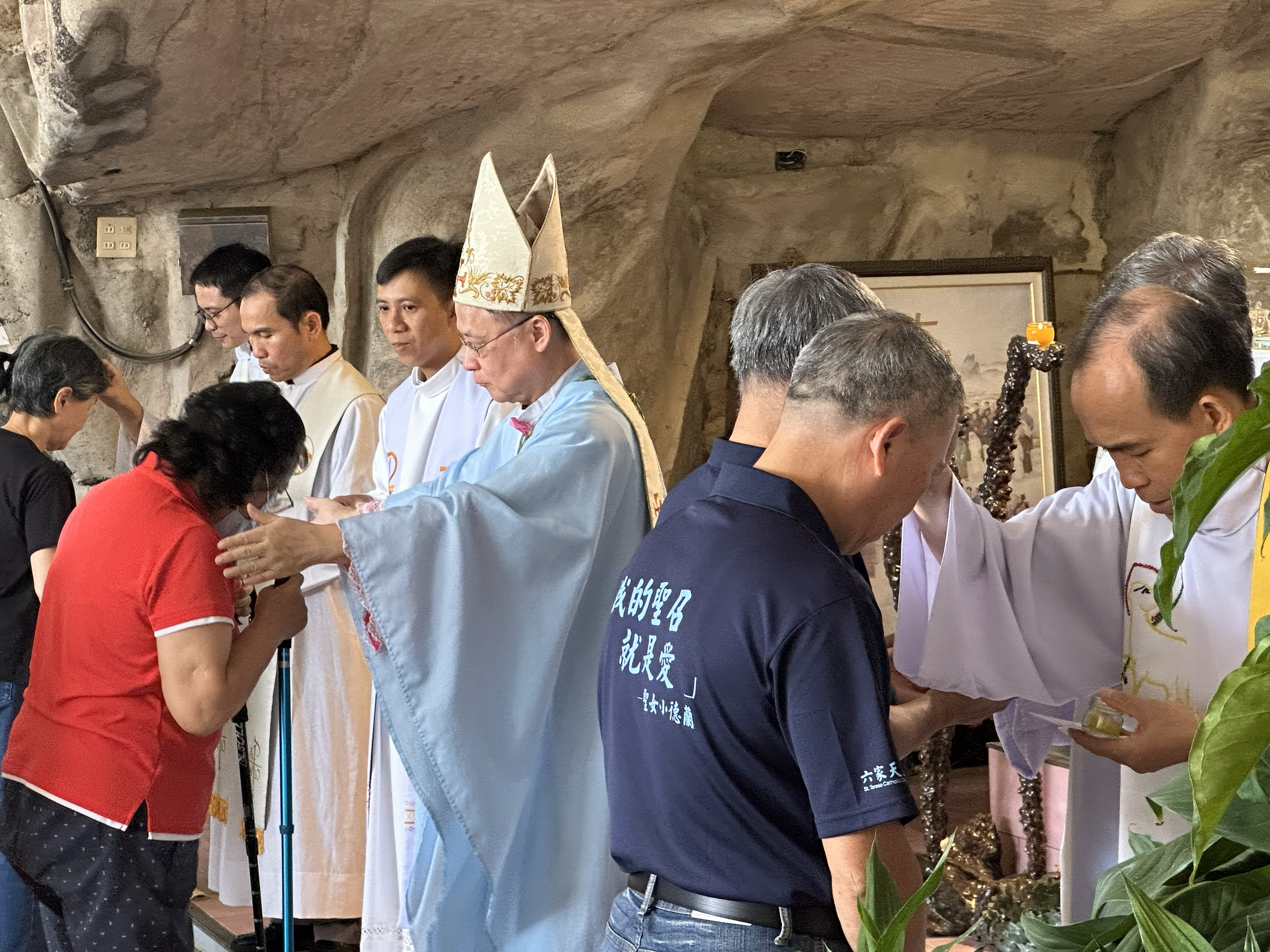
The Lourdes shrine in Guanxi was built in 1958 by Father Ge Minyi. At the time, it was impossible for cars to access the site, so all the materials to build the shrine needed to be carried up the mountain by the priest and parishioners. Surprisingly, it is not the only replica of the Marian shrine within the Taiwanese diocese. Hsinchu is also home to Asia’s first replica of the Holy House of Loreto.
A Heart for Missionaries
I finally reached Bishop Lee after one of the sisters rescued him from the crowd of pilgrims eager for photographs. Since 2020, Bishop Lee has served as president of Taiwan’s bishops’ conference, formally known as the Chinese Regional Bishops’ Conference. He has a gentle manner and a big smile.
Bishop Lee’s parents were not Christians. They fled mainland China for Taiwan before he was born. Looking for a place to educate their eldest children, they enrolled them in a kindergarten in Taiwan run by Catholic sisters. Bishop Lee’s mother noticed a marked improvement in the children’s behavior and began asking questions about the sisters’ faith. She wanted to convert, but, as she put it, her husband was the head of the family. She urged him to speak with the priest. In 1957, the entire family was baptized.
“After one year, I was born,” Lee said, laughing. “I was the only one born into a Catholic family.”
Two of the four children would eventually enter religious life. Lee’s older sister joined the Congregation of the Daughters of Jesus, founded in Spain, and later became superior of her order, a role that took her back and forth between Taiwan and mainland China in earlier decades. Bishop Lee himself discovered his vocation during his final year of university, after attending daily Mass.
“He called me to do this,” he said simply. “I responded.”
When he shared his sense of calling with his sister, she replied, “Me too.” That same year, he entered the seminary, his sister entered the novitiate, and their two other siblings married.
“All in one year,” he recalled, “the four of us made a decision. We followed Jesus’ calling.”
As a child, Lee had known missionaries who had been expelled from mainland China by the communist government and had remained in Taiwan for the rest of their lives. As bishop, he has worked to welcome a new generation of missionaries into the diocese.
“Before, there were only three main congregations: Franciscans, Jesuits and Maryknoll priests from America,” he said. “I invited over 15 congregations, because each congregation can only offer a few priests.”
The missionary model has changed. Where missionaries once arrived in Taiwan and stayed for the rest of their lives, now several orders send missionaries for only five years, made up of two years to learn Mandarin and three to serve. Despite the presence of many missionary religious orders, Catholics remain a small minority.
“We are lacking good witness,” Bishop Lee said. “We are not really practicing our faith well.”
Parishes that once had hundreds now have dozens, he said. And yet, the bishop sees signs of revival, particularly through Taiwan’s National Eucharistic Congress, which has spread devotion to the Eucharist on the island over the past 15 years. He also sees the fruits of missionary work: two new local vocations, discerned with the help of priests from abroad.
In collaboration with the missionary orders present in Hsinchu, the diocese also provides spiritual care for the terminally ill and vulnerable, services for people with disabilities, migrant-worker immigration services, and preschool education.
Ministry Amid Threat From China
Semiconductors manufactured in Hsinchu are closely tied to Taiwan’s security strategy. Taiwan’s computer-chip industry accounts for roughly two-thirds of the global market and produces about 90% of the world’s most advanced chips, technology essential to the computing power that drives artificial intelligence. Officials in Taiwan’s Ministry of Foreign Affairs are quick to note that a Chinese invasion of Taiwan would send shockwaves through the global economy.
I asked the bishop about how the existential threat of a potential invasion by mainland China influences his ministry and preaching. His response may surprise readers accustomed to headlines about Beijing’s ambitions toward the island, but it echoed what I heard repeatedly in conversations in Taipei, where people often moved quickly to change the subject when asked about it.
“If you find Taiwanese people here, they don’t want to talk about that,” the bishop said.
“We know they are strong and we feel some suffering from that situation,” he added, but it is not that people are walking around in constant fear. Life goes on.
The return trip to Hsinchu was much easier due to one simple reason. Bishop Lee offered me a ride. And that’s how I found myself on a modest road trip with a bishop and a young Augustinian missionary from the Philippines, Father Ariel Lara.
“There were invitations for me to work in Europe and also Australia,” Father Lara told me. “But I said to my superiors, ‘I want Asia.’ Being given the chance to be here in Taiwan, I am really happy. It is like an answered prayer. I cried in front of the altar.”
“I want to be here forever,” he added.
Like any good road trip, we made a few pit stops. At Hsinchu’s Immaculate Heart of Mary Cathedral, the bishop showed me archival photographs from the 1950s of Jesuit missionaries, newly arrived after being driven from mainland China, standing in the Catholic church they had begun to build in Hsinchu.
Then we visited Sacred Heart of Jesus Church, a striking Chinese palace-style sanctuary completed in 1972. Funded largely from the United States, it was designed by U.S. Jesuit Father John Baptist Palm, who had been arrested in Shanghai in 1953 and expelled by the communists before continuing his ministry in Taiwan. The church’s three interconnected octagonal structures symbolize the Holy Trinity, rendered in an unmistakably Chinese architectural style.
Outside of the church, we ran into another missionary: Consolata Father Caius, a priest from Kenya who has served in Taiwan since 2022.
“I never expected to be sent outside Africa,” he told me. The culture shock had been profound. Learning Chinese, he said, was humbling.
Father Lara agreed that the transition is difficult, but added, “It is challenging for me, but I have to face all of the challenges; that’s the life of the missionary. I have Christ with me in my heart and the prayers and the intercession of the Blessed Virgin Mary. With this trust in my heart, I feel that I can work here for a very long time.”
Reporting for this article was supported by the Ministry of Foreign Affairs of Taiwan.
- Keywords:
- taiwan
- our lady of lourdes
- catholic bishops

Courtney Mares Courtney Mares is a Rome correspondent for Catholic News Agency. A graduate of Harvard University, she has reported from news bureaus on three continents and was awarded the Gardner Fellowship for her work with North Korean refugees. She is the author of Blessed Carlo Acutis: A Saint in Sneakers”.