‘Liturgy Wars’ Claim Altar Rail In North Carolina Parish — Are More Changes Coming to the Diocese of Charlotte?
The pastor of St. Mark’s in suburban Charlotte says he acted on his own initiative as the diocese reviews its liturgical norms and has issued no directive on altar rails.

A North Carolina pastor plans to stop using the altar rails in his church so he can prepare his parish for coming liturgical changes expected in the Diocese of Charlotte without waiting for an order to do so, he told the Register.
But Charlotte Bishop Michael Martin has not banned altar rails throughout the diocese, contrary to what has been reported elsewhere.
Father John Putnam, pastor of St. Mark Catholic Church in Huntersville, North Carolina, since 2015 and a member of the diocese’s presbyteral council, which advises the bishop, announced recently that starting Nov. 30 the church will stop using altar rails when distributing Communion.
But in an interview Thursday, Father Putnam told the Register he hasn’t been ordered to make the change.
Father Putnam said he made the decision on his own, partly to stay in harmony with Bishop Martin, who has expressed a desire to remove altar rails, but also because of the parish’s prominence as the site of the diocese’s ordinations and a desire to minimize disruption in his parish if such an order is issued later on.
“It’s something that has been discussed,” Father Putnam said in an interview Thursday, “but it’s my decision to implement it on the first Sunday of Advent — number one, because we’re the location of large diocesan events. And for my people, it’s better that I do it on my time schedule, that I work with my parish, rather than wait for something later that would be required.”
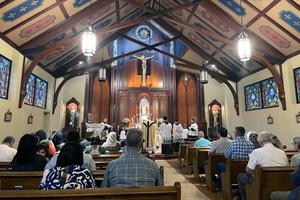
The parish’s current practice is for a priest to stand behind the altar rail while people either kneel or stand to receive. In the future, people at St. Mark’s can still kneel to receive Communion, the pastor said in a parish bulletin item Nov. 9. But they won’t be able to use the altar rail to do so.
Other priests in the diocese told the Register this week they have not received any directive from the diocese regarding altar rails, something the diocese confirmed.
The Diocese of Charlotte “has not issued any instructions on its liturgical norms, which were last updated in 2004,” the diocese’s communications director, Liz Chandler, told the Register.
“The bishop is working with our priest council and Office for Divine Worship to reaffirm, among other things, the Church’s universal norms for the care, distribution, and reception of Holy Communion, as outlined in the General Instruction of the Roman Missal and the norms of the U.S. Conference of Catholic Bishops. They are engaged in a reflective and consultative process, and when completed, any updates will be published,” Chandler said by email.
Bishop Not Directly Involved
Father Putnam has published two versions of why he is stopping the use of altar rails.
In both versions, he says of using altar rails for Communion, “Personally, I believe it promotes reverence and devotion.”
The pastor’s initial notice, published Nov. 7 on the parish’s website, implies that Bishop Martin ordered St. Mark’s to stop using altar rails. In that version, Father Putnam wrote:
“At the same time, obedience is a virtue, and I think it is important to be united with other parishes in the Diocese and return to the normative practice as noted above which Bishop Martin is asking to be implemented on the First Sunday of Advent, November 30.”
But Father Putnam told the Register that first version was in error — that the bishop has not asked for the change at St. Mark’s.
The pastor’s revised notice, which appeared in the parish’s Nov. 9 bulletin, omits mention of the bishop, and suggests that the “obedience” is to what Father Putnam calls the “normative practice” of the U.S. Conference of Catholic Bishops, which in its General Instruction of the Roman Missal states: “The norm established for the Dioceses of the United States of America is that Holy Communion is to be received standing, unless an individual member of the faithful wishes to receive Communion while kneeling …” (160).
In that second version, Father Putnam wrote: “At the same time, obedience is a virtue, and I think it is important to be united with other parishes in the Diocese and return to the normative practice as noted above, which we will implement here at St. Mark on the First Sunday of Advent, November 30. (Correction: The previous sentence was updated to clarify that this change applies only at St. Mark.)”
Why Altar Rails?
Putting a barrier between the sanctuary where the altar sits and the nave where congregants sit has roots in the Temple in Jerusalem, in which only Jewish priests entered the Holy of Holies.
Altar rails, which are also called Communion rails, first appeared in the Catholic Church during the Counter-Reformation of the 1500s, because Catholic reformers of the time called for replacing higher barriers so people attending Mass could easily see what was going on at the altar, according to historian Richard Kieckhefer’s 2004 book Theology in Stone: Church Architecture From Byzantium to Berkeley.
Even so, the altar rails made Catholic churches “sharply divided into two zones: the laity prayed in the nave, and the clergy rarely moved out of the sanctuary.”
“The priest’s space or sanctuary is separated from the congregation’s space or nave by a low communion rail, and at the communion the clergy and laity met on opposite sides of that rail, which served as an effective barrier to movement if not to vision,” Kieckhefer wrote.
In the modern era, supporters of altar rails say they effectively set off the sanctuary as sacred space and promote reverence for the Eucharist by making it easy for people to kneel while receiving. Opponents of altar rails say they set up an unhealthy divide between priests and laypeople instead of uniting the faithful as one people of God.
The documents of the Second Vatican Council don’t mention altar rails. But altar rails fell out of favor around the 1960s, as church designers typically favored a more open floor plan aimed at increasing participation in the Mass by congregants.
Traditional Latin Mass Leads To Altar Rails
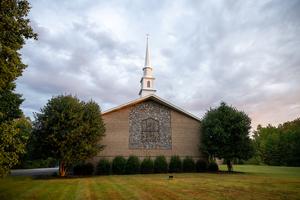
St. Mark’s in Huntersville, which is about 15 miles north of Charlotte, has a modern, open design, from a time long after altar rails fell out of general use.
When St. Mark’s was established in 1997, Masses took place at a bowling alley, according to a parish history. The current church building, which opened in September 2009 and is among the biggest in the diocese, was originally designed to accommodate 1,400 people.
St. Mark’s offered its first traditional Latin Mass in January 2017, according to Catholic News Herald, the diocese’s newspaper. That took place under the diocese’s previous ordinary, Bishop Peter Jugis, and about four and a half years before Pope Francis issued restrictions on the traditional Latin Mass in his apostolic letter Traditionis Custodes in July 2021.
Around the time St. Mark’s started offering the traditional Latin Mass, the church also put in altar rails.
The Tridentine Mass in Latin, which was the dominant form of the Mass in the Latin rite of Catholicism before the Novus Ordo Mass was implemented in 1970, assumes that congregants will receive Communion kneeling and on the tongue, following the Code of Canon Law of 1917 and widespread practice of the time. Altar rails are common at traditional Latin Masses because they provide a permanent structure for people to kneel.
“When we began offering the Traditional Latin Mass a number of years ago, we added the altar rails to meet the requirements of that particular celebration,” Father Putnam wrote in the Nov. 9 parish bulletin.
Eventually, St. Mark’s used altar rails to distribute Communion at all Masses, including the parish’s Novus Ordo Masses in English.
“The use of the rails gradually became the norm at the parish because more and more people started to use them,” Father Putnam wrote. “Many believe it promotes reverence and devotion.”
Bishop Ignored Altar Rails During Ordination Mass
Bishop Martin, 63, a Conventual Franciscan who most recently served as a pastor in Jonesboro, Georgia, became bishop of Charlotte last year.
His episcopal ordination Mass on May 29, 2024, took place at St. Mark’s because it’s much bigger than the Cathedral of St. Patrick in Charlotte.
During his ordination Mass, Bishop Martin distributed Communion without using the church’s altar rail, a video of the Mass shows. His decision caused comment last year from some parishioners, Father Putnam said in the parish bulletin Nov. 9.
This year, the bishop has taken aim at traditionalist Catholic practices in a diocese long known for being tradition-friendly.
In May 2025, Bishop Martin issued a decree banning traditional Latin Masses at the four parishes in the diocese that offered it, restricting the Latin Mass to one non-parish chapel. Parish traditional Latin Masses were originally supposed to end July 8, but Bishop Martin delayed the ban until Sept. 26, when it took effect.
The decree follows the directives contained in Pope Francis’ Traditionis Custodes, but observers have suggested that the decree also follows the bishop’s preferences, arguing that he could have asked the Vatican for an extension of the dispensation granted to his predecessor, Bishop Jugis.
In late May 2025, a leaked draft document calling for sweeping liturgical changes in tradition-minded parishes in the Diocese of Charlotte was published by the traditionalist website Rorate Caeli.
The undated draft pastoral letter says the proposed changes are meant to encourage what it calls “our joint venture toward a more uniform celebration of the Mass in our diocese.”
The 7,800-word draft document takes aim at altar rails, but also criticizes using Latin in the Novus Ordo Mass, not using lay extraordinary ministers to distribute Communion during Mass, not offering Communion under both species (the consecrated Host and the Precious Blood), and excluding females as altar servers.
“Using the altar rails to keep people out of the sanctuary, removing lay people’s assistance with Holy Communion, and welcoming only boys to serve at the Eucharistic mysteries create an air of clerical superiority, communicate a spirit of unwelcoming as if the congregation should just be spectators, and can suggest that the parish rejects the liturgical reforms brought about at the behest of the Second Vatican Council,” the draft document states.
Two other optional elements of the Novus Ordo Mass often omitted by tradition-minded priests — presentation by laypeople of the gifts of bread and wine to the priest before the altar and the sign of peace after the consecration — “should ordinarily take place in Masses celebrated with the people,” the draft document says.
The draft document also singles out certain traditionalist practices that it says “have no place in our Eucharistic celebrations,” including the priest “making the sign of the cross with the Sacred Host during reception of Holy Communion”; “overly ornate vestments”; vestments that are no longer prescribed in the Roman Missal; celebrating Mass ad orientem (literally, “to the east”) with the priest and people facing the same direction; having “[c]andles, standing crucifixes, and Missal stands” on the altar; and saying Pope Leo XIII’s prayer to St. Michael the Archangel as a community immediately after Mass.
The bishop has not issued the document.
What’s Going On?
The Register spoke and corresponded with several priests in the Diocese of Charlotte earlier this week, all on condition of anonymity. Some priests said they are trying to stay out of what some are calling the “liturgy wars” in the diocese, which they say have roiled the clergy.
One priest, who said he fears retribution if his name were made public, said a common theory among priests in the diocese is that Bishop Martin has decided to walk away from the leaked draft document and instead plans to make liturgical changes piecemeal, including eventually banning altar rails throughout the diocese, among other things.
Bishop Martin has reportedly ordered the removal of portable kneelers at the Cathedral of St. Patrick in Charlotte. He also reportedly has ordered Catholic schools in the diocese to stop using altar rails at Communion.
The Register also spoke this week with a parishioner of St. Mark’s, where altar rails are set for disuse.
Bill Pugh, who has attended St. Mark’s since 1997, told the Register he prefers the Novus Ordo Mass in English to the Traditional Latin Mass, and that he attended the Novus Ordo almost exclusively before Bishop Martin banned the Traditional Latin Mass in parishes.
But he also prefers altar rails for Communion.
“I receive on my knees. I feel it’s more reverent to do so. I certainly appreciate the opportunity to do so,” Pugh said.
“The bishop’s the bishop, and we’re expected to follow his leadership, as well as the clergy. At the end, I’m still receiving the Eucharist, and that’s the main focal point — the source and summit of our faith,” he said.
But he added, “Do I wish the bishop had a different focus and picked a different fight? Yes.”