Is the ‘Revival’ of Faith in Gen Z Real?
While there are near-record numbers converting to Catholicism in some regions in the US, there’s no conclusive statistical answer.
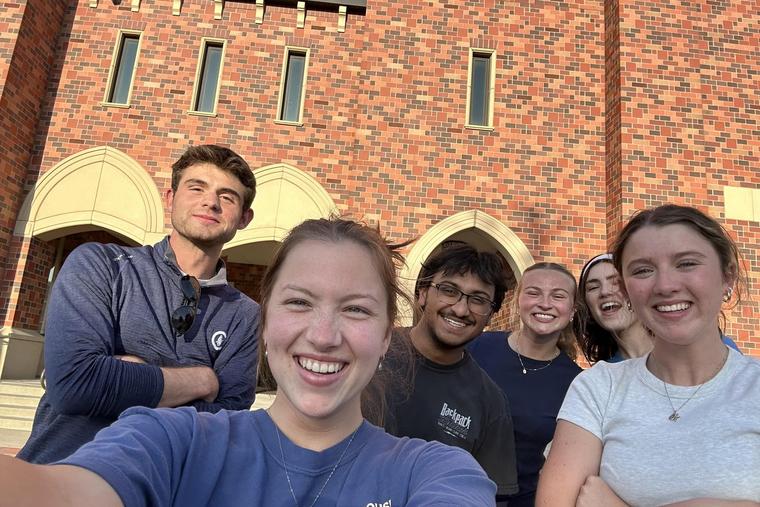
Has Gen Z found religion?
If the headlines are to be believed, more people are becoming Catholic these days than ever before — including many members of Generation Z, those born approximately between 1997-2012.
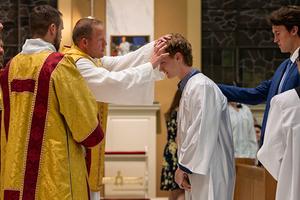
Many young people of this generation are still in school, and major universities across the country have seen record or near-record numbers of converts to the Catholic faith in the past year, campus ministers previously told the Register.
Ashwin Mannur, 21, a senior at the University of Nebraska-Lincoln, converted in 2025. Now slated to become a FOCUS missionary, he said the packed daily and Sunday Masses on campus speak for themselves.
“I think it's hard to deny, when you're living on a college campus, that faith is big here, even beyond the Catholic Church,” Mannur told the Register.
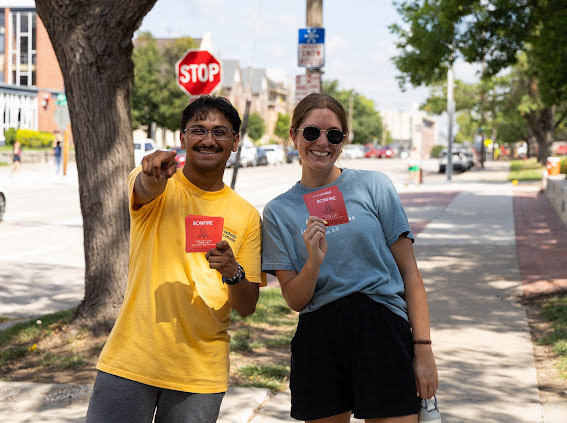
And it’s not just at colleges — ongoing research by the Register has found that in dozens of dioceses across the country, the number of people converting through the Order of Christian Initiation of Adults (OCIA), the Church’s process for initiating adult converts, has grown by double-digit percentages this year. Several U.S. dioceses — Austin, Texas, for example — recently confirmed to the Register that young people ages 18-36 are indeed making a strong showing.
But as Christian leaders and headlines trumpet an apparent revival of religion in America, other voices have risen to “debunk” the narrative and point out that the data doesn’t support the idea of widespread conversions to the Catholic faith among Gen Z.
Looking at the Data
Taking a very broad view, any perception that Gen Z is more religious than previous generations misstates what the available data shows. Throughout U.S. history, successive generations have tended to be less religious than the preceding, and there’s no evidence — as of yet — that Gen Z is poised to break this trend.
In fact, according to the Pew Research Center, Gen Z is the least church-attending generation in American history, with only 17% attending weekly. Perhaps even more strikingly, 38% of Gen Z individuals report never attending church.
This does not, of course, mean that the vast majority of Gen Z identifies as atheist or agnostic. According to Pew, 46% of 18-24 year olds still identify as Christian, even if far fewer actually practice.
Barring a truly spectacular religious revival — which some people believe is already happening — this downward trend when it comes to religious practice in America is expected to continue. Research shows that non-religion tends to be very stable across generations; in other words, children of non-religious parents are overwhelmingly likely to remain nonreligious.
It’s also worth pointing out that the number of converts it would take to fully reverse the ongoing trend of Christianity’s decline in America would require every single one of the 350,000 houses of worship nationwide to add several dozen new members in a very short period of time — dwarfing any previous “revival” trend.
“Could millennials and Gen Z find God in the years ahead? Possibly — but it would require a transformation unlike anything seen in modern times,” Ryan Burge, a widely cited religion researcher, wrote in a column for Deseret News.
“Roughly 10 million millennials would have to reaffiliate with religion, followed by another 18 million Gen Zers,” he added. “There’s no sign of that happening in any dataset,” he wrote.
Speaking recently to the Register, Burge doubled down on his statistical findings, saying the current revival narrative feels to him to be founded more on “vibes” than on actual data.
“I’ll admit, I feel like the vibes have shifted a little bit in the last couple of years … [but that] doesn’t mean that we’ve moved towards a ‘Yay Jesus’ stage either. One does not logically follow from the other,” he said.
What About Catholics?
What about the data on Catholics, specifically?
Here, it gets trickier, as the ages of those entering the Church each year are not formally recorded in the Official Catholic Directory (OCD), the authoritative repository for data on the number of Catholics in the U.S. But the overall picture, when it comes to adults of all ages becoming Catholic, is promising.
The available data is summarized in a recent blog post from the Center for Applied Research in the Apostolate (CARA), which used data from the OCD to determine how many people — regardless of age — have entered the Catholic Church in recent years. “Entries” into the Catholic Church in the United States include infant and minor baptisms, adult baptisms and receptions into full communion of those previously baptized in other Christian traditions.
Of the more than 600,000 entries into the Catholic Church in 2024, roughly 475,000 — a vast majority — were infant baptisms. Just under 60,000 were baptisms of minors, about 55,000 were receptions into full communion, and around 37,000 were adult baptisms. The number of minor and adult baptisms and receptions has all risen since 2022, while the number of infant baptisms has declined slightly.
Individual dioceses, when asked, often have a rough idea of how many of their converts are young adults. The Diocese of Lincoln, for example, reported having nearly 100 prospective converts who are from the University of Nebraska-Lincoln Newman Center, most of them aged 18-22, at their recent Rite of Election.
But, as previously mentioned, the OCD does not record the ages of adult converts, meaning an 80-year-old and an 18-year-old will essentially show up the same. Minor baptisms are slightly on the rise, but it’s unclear how many of those minors qualify as Gen Z.
The second limitation is that updated figures for 2025 are not yet available — neither from Pew nor from the Official Catholic Directory, the latter of which likely won’t be available until summer or fall 2026. Moreover, many prospective Catholics who entered the OCIA process in 2025 will not be formally received into the Church until the Easter Vigil, which this year is not until April 4. Those converts won’t show up in the OCD data until 2027.
Rubén Rodríguez Barron, a Ph.D. student at the University of Chicago and one of the authors of the CARA article, pointed out that every year conversions must be recorded at the parish level, then recorded by dioceses, then included in the Official Catholic Directory — with each step introducing delays and potential rounding and estimation errors. He encouraged parishes and dioceses to take steps to improve their data reporting, as numbers matter for understanding trends.
Though he knows full well that the data’s not yet showing it, Rodríguez Barron said he has personally noticed signs of revival among his Catholic community in Chicago.
“I go to Mass every day, and I see there are more people in the pews. I also look at the numbers as a scientist, and I see that the numbers are not yet there. … We just have to wait for the data to catch up to what we are seeing,” Rodríguez Barron told the Register.
Something Is Happening — So What Gives?
Even as the data lags behind the anecdotes, ministers who work with young adults — and the young adults themselves — continue to excitedly proclaim that the tide seems to be turning in favor of Catholicism, and theories abound as to the reasons why.
Mannur, the Nebraska-Lincoln senior and convert soon to start work as a missionary, said he sees his fellow young men, especially on campus, attracted to the Church’s unequivocal affirmation of their inherent goodness and dignity, as well as the Church’s unapologetic teaching on difficult but important topics.
“There are so many people who are trying to find their identity in college, and the Church stands very firm as a beacon in that regard — whereas a lot of other institutions on campus organizations can never do the same, because they just fundamentally don't have that level of truth,” he said.
The fact that so many young people today have never or rarely been exposed to religion actually presents an opportunity for the truth of the Catholic Church to capture their hearts. That happened to Kaitlyn Golyski, a senior at the University of South Carolina who grew up nominally Christian but quickly fell in love with the Catholic Church after discovering Catholicism amid an earnest search for a faith community of her own.
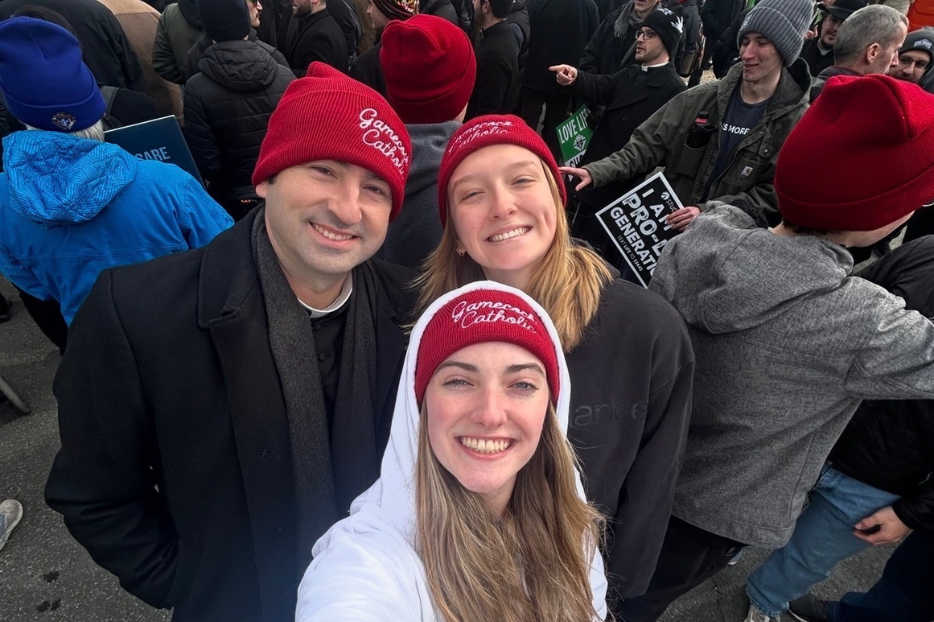
“People are searching for the truth, and then when they do, they're finding the Catholic Church. It's so cool,” Golyski, 21, said.
Dominican Father Cassian Derbes, director and chaplain of The Catholic Center at New York University, said he speaks to roughly two students every week who are interested in becoming Catholic, many of whom “have been raised with no religion whatsoever” but are interested in it.
“Things that pertain to wisdom and the thoughtfulness of the ages, I think, are very attractive to [Gen Z],” the priest said.
So, is a revival really happening among Gen Z? There’s no conclusive answer yet, statistically. But as the data catch up, the anecdotes will doubtless continue to capture the public’s imagination — and, hopefully, move them to pray that the Holy Spirit will continue its work in young people’s hearts.
Register Senior Writer Zelda Caldwell contributed to this story.
- Keywords:
- generation z
- gen z
- conversion
- catholic conversions