75 Years Later: Iconic ‘Jeep Mass’ Photo With Father Kapaun Still Inspires Hope
Far from being a stuffy image from another century, the content of the photo, in a very real way, lives on today.
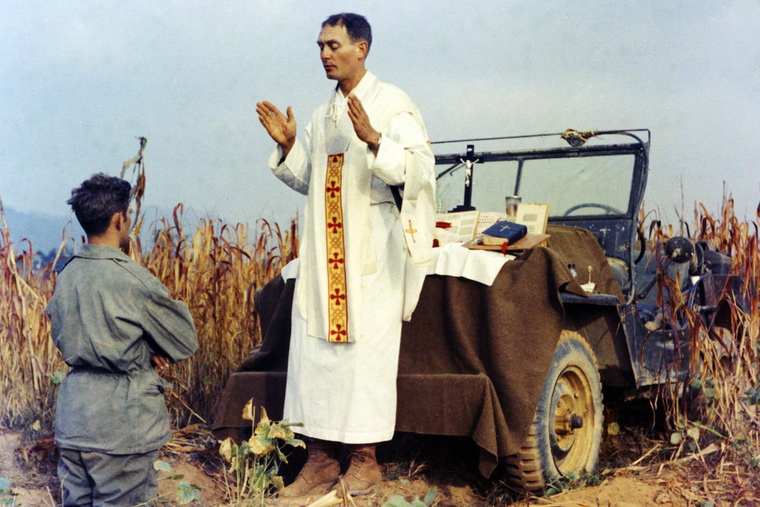
WICHITA, Kan. — When considering reverent places to celebrate Holy Mass, the hood of a battered Willys Jeep in the middle of a muddy cornfield might seem, at first, to be near the bottom of the list.
The setting looks highly unusual to us today, but in the midst of the brutality and misery of the Korean War, it showed how Venerable Emil Kapaun did whatever he could to nourish U.S. soldiers’ souls as he served alongside them as their chaplain.
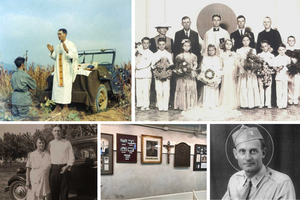
The iconic “Jeep Mass” photo — the last known photo of Father Kapaun, who died a few months later in a Chinese prison camp — turns 75 years old this month, having been snapped on Oct. 7, 1950, the feast of Our Lady of the Rosary.
The photo stands as one of the most well-known and beloved images of its subject, the Kansas-born Father Kapaun, who is now well on his way to being declared a saint.
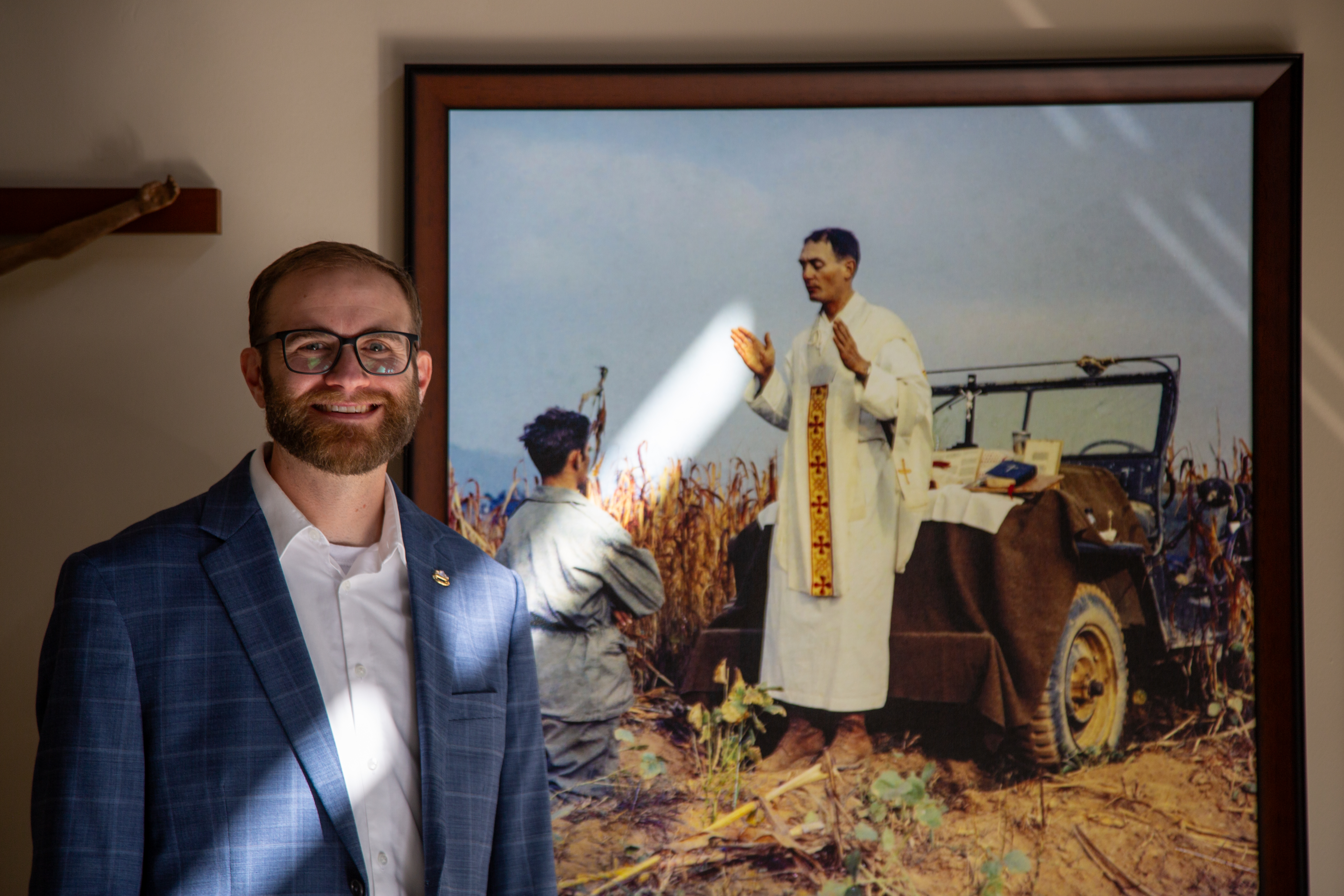
Scott Carter, coordinator of the Father Kapaun Guild in Wichita, Kansas, told the Register that the “Jeep Mass” photo is one of the only photographs of Father Kapaun in Korea that is dated. It was taken in a field on the South Korean side of the North Korean border, less than a month before Father Kapaun was taken prisoner.
In the image, Father Kapaun stands in the orans (“with hands extended”) position, facing his kneeling assistant, Pvt. Patrick Schuler, praying the Mass — wearing not only his priestly vestments, but also muddy combat boots. As a chaplain, Father Kapaun provided the sacraments for the men in his care anywhere and in any manner that he could.
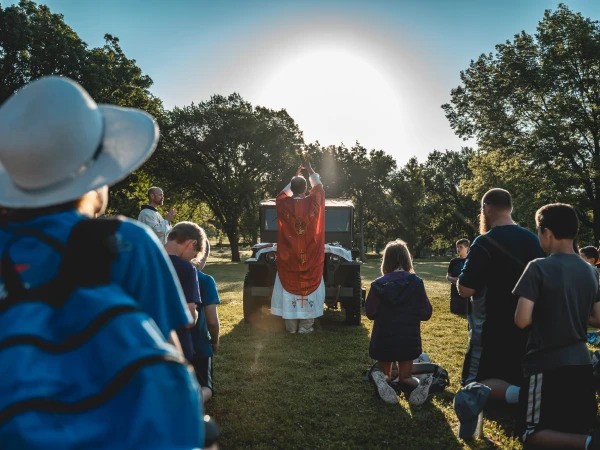
Far from being a stuffy image from another century, the content of the photo, in a very real way, lives on today. The daughter of the private kneeling in the photograph, Peggy, comes and walks the Father Kapaun Pilgrimage each year in Father Kapaun’s honor, Carter said. And across the country, “Jeep Masses” are still occasionally celebrated to honor Father Kapaun and give thanks for his holy priesthood and sacrifice.
“I think in a lot of ways, [Father Kapaun’s] message is hope. And it's not something that we talk about, but hope is a fundamental necessity for us as humans. Even to face every day, we need it. And a lot of times we can get that from our surroundings, but for a lot of people, it's hard to find that in our day and age or our culture. … He was determined to bring that everywhere,” Carter said.
Pursuing Priesthood
Emil Kapaun was born in 1916 and grew up relatively poor on a farm in the rural village of Pilsen, Kansas, about an hour north of Wichita. The striking — and at the time brand-new — parish church of St. John Nepomucene served as Kapaun’s home parish and nurtured his Catholic faith and interest in the priesthood.
From a young age, Father Kapaun was excited about the idea of being a missionary in far-flung lands, but eventually, with the advice of his pastor, he decided to pursue parish priesthood. After his ordination in 1940, the bishop assigned Father Kapaun to his home parish in Pilsen, but Father Kapaun soon felt the call to serve his fellow young men in the Army as the U.S. entered World War II.
It took him several years to convince his bishop that he should be allowed to join the Army and serve as a chaplain, and he was finally sent to Burma and to India in the waning years of the war, but saw little combat. Nevertheless, he cared for the soldiers’ spiritual needs and displayed great humility, not wanting to be recognized for what he did but rather doing it because it was the right thing to do.
After World War II ended, Father Kapaun’s bishop sent him to Washington, D.C., to get a master’s degree in education at The Catholic University of America. He served for over a year at an Army base in Texas before being shipped out to Japan in 1949 as part of the 8th Cavalry Regiment, 1st Cavalry Division as tensions simmered on the Korean Peninsula.
When the war did break out on the peninsula in late June 1950, Father Kapaun was among the first U.S. troops to be sent over. He tirelessly and good-humoredly poured himself out for the men in his care and endured a series of near-death experiences, including a moment when his tobacco pipe was shot out of his mouth by a sniper. His Mass kit and Jeep were at one point destroyed, and Father Kapaun took to carrying the Blessed Sacrament, confession stole, holy oils and a Mass kit on his person wherever he went.
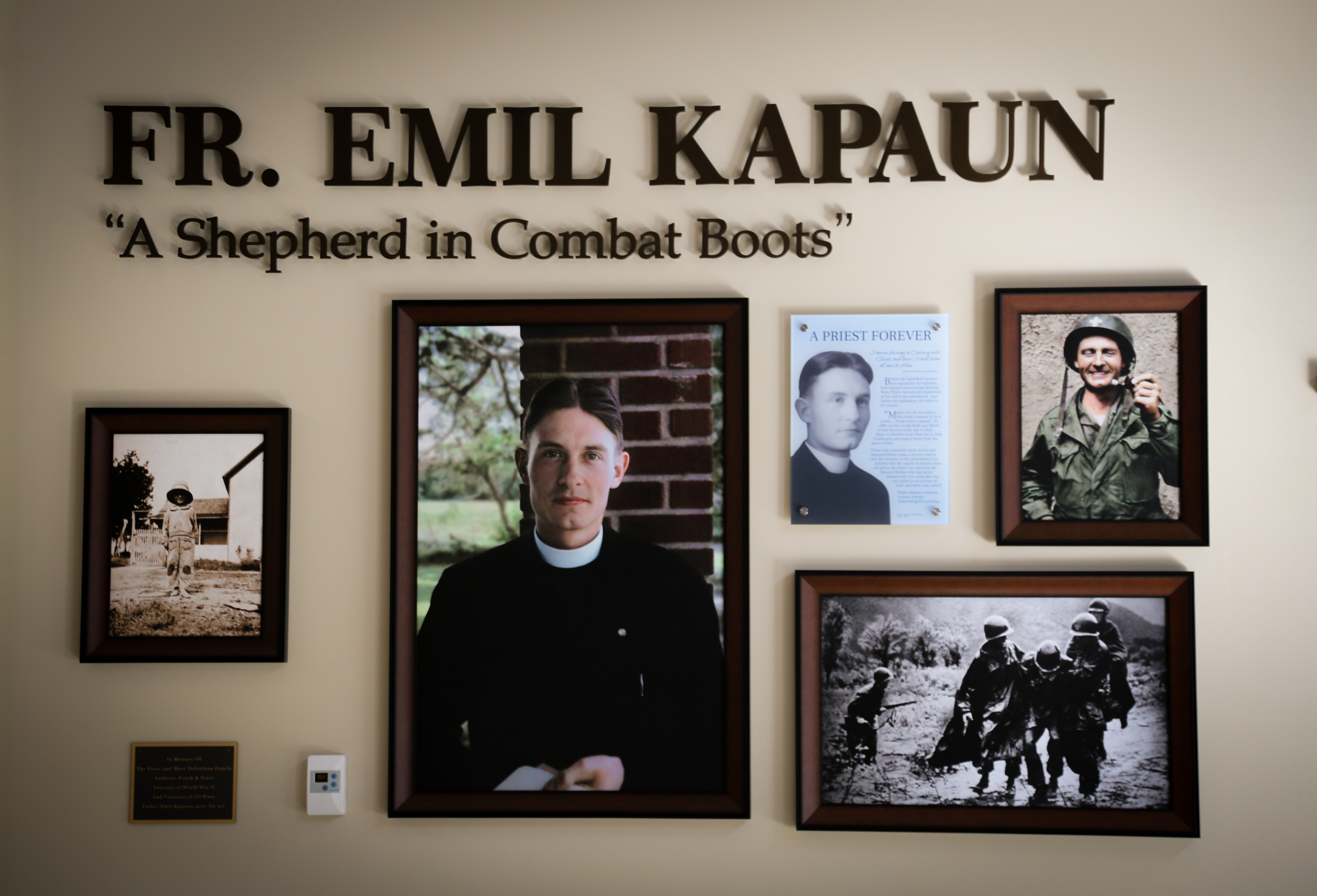
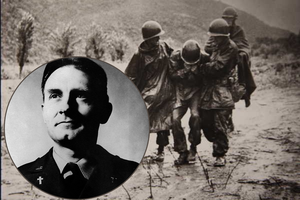
The night of Nov. 1, All Saints’ Day, Father Kapaun’s unit was ambushed by an overwhelmingly larger force of Chinese troops at the Battle of Unsan. Father Kapaun likely saved 30 to 40 men that night by pulling them out of foxholes to safety.
A number of the men, including Father Kapaun, were ultimately captured and taken to a prison camp in Pyoktong, North Korea. That winter, the men endured starvation, freezing temperatures, and torture at their captors’ hands.
Many of the POWs who survived the camp speak of the countless ways Father Kapaun helped his fellow men physically and materially, but above all they laud his unwavering hope and optimism.
“Everything that he did to instill hope in the men, from the very basic level of providing for their needs — stealing food for them, feeding them when they wouldn't eat themselves or picking lice off their bodies — all those things taught them a little bit about their dignity and that they were worthwhile. Visiting the men, when I’m sure that they were isolated and lonely, and trying to just bring some cheer or laughter with jokes; and obviously praying with them as well, especially when he wasn't supposed to,” Carter said.
After seven months in the camp, ill and broken down from malnutrition, pneumonia and his unwavering service to his fellow men, Father Kapaun died on May 23, 1951. He posthumously received the Medal of Honor in 2013.
Like so many POWs in Korea, Father Kapaun’s body was lost and unidentified for years, until March 2021, when the skeletal remains of Father Kapaun were identified among 866 other unknown Korean soldiers buried at the National Memorial Cemetery of the Pacific in Honolulu.
After a triumphant but solemn return to the U.S., Father Kapaun’s funeral Mass was held on Sept. 29, 2021, at Wichita’s Hartman Arena. More than 5,000 people came together to honor and remember him. He is buried today in Wichita’s Cathedral of the Immaculate Conception.
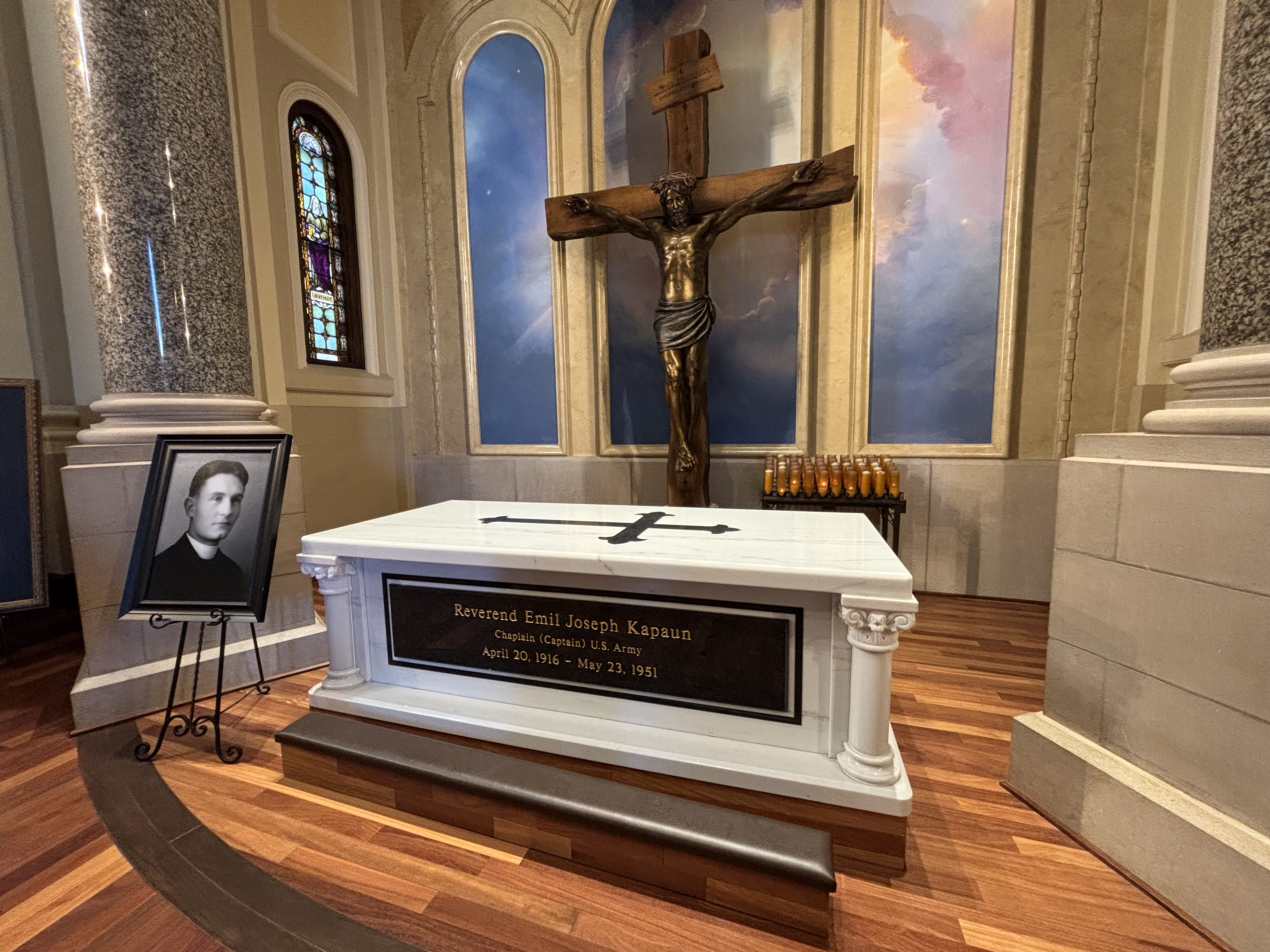
The Archdiocese for the Military Services opened Father Kapaun’s sainthood cause in 1993, and the Diocese of Wichita picked it up in 2008. In February 2025, the late Pope Francis declared Father Kapaun “Venerable,” meaning he lived a life of heroic virtue. If the Vatican verifies that a miracle can be attributed to his intercession, he will later be declared “Blessed.” (A handful of potential miracles attributed to Father Kapaun’s intercession are currently being considered, Carter added.)
If Kapaun hadn’t given his life for his fellow soldiers, dying in that prison camp, there’s a good chance he’d still be remembered today — for his courage as well as numerous other positive attributes. But it was the fact that he kept hope alive in the prison camp, even to the point of his own death, that elevated Kapaun from “very impressive and inspiring” to truly saintly, Carter said.
Today, Father Kapaun’s courageous, self-giving love serves as an inspiration to Catholics everywhere, especially to young men and to the Catholics of Wichita, where his image is almost ubiquitous. As a “hometown” priest on the path to sainthood, he gives the Wichita diocese a joyful, unifying focal point and a model to “cheer on” and imitate.
Carter said, “A lot of times people say that the sense of peace they have after praying with [Father Kapaun] is a very profound and powerful thing. And obviously, that’s something on the battlefields men talk[ed] about, too, is that he brought peace in the midst of all this chaos and suffering and fighting.”
- Keywords:
- father emil kapaun
- military chaplains