Cardinal Eijk Praises Cardinal Burke’s Christlike Endurance in the Face of Criticism
Preaching at a Mass at Marian shrine in Wisconsin, the Dutch cardinal said Cardinal Burke has been unjustly criticized for proclaiming the fullness of the faith.
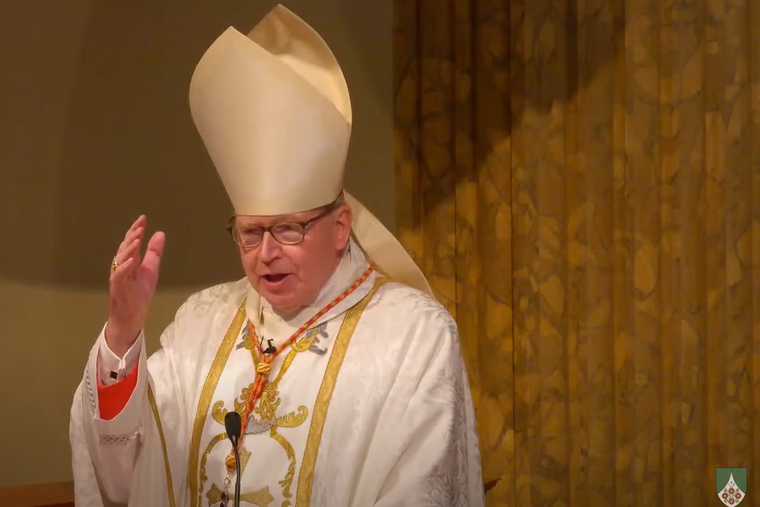
Dutch Cardinal Willem Eijk has warmly praised Cardinal Raymond Burke for the way he has endured attacks for proclaiming the fullness of the Catholic faith, saying that his example imitates Christ’s suffering and opens the way to heaven.
Preaching at a July 31 Mass to celebrate Cardinal Burke’s founding of the Shrine of Our Lady of Guadalupe in La Crosse, Wisconsin, in 2008, the cardinal archbishop of Utrecht held up the American cardinal as “an exemplary priest, an outstanding canonist, a prophet of canon law.”
But despite his ecclesial achievements — which Cardinal Eijk pointed out included serving as prefect of the Apostolic Signatura, the Church’s highest court, from 2008 to 2014 — Cardinal Burke did not always receive the gratitude he would have expected, the Dutch cardinal noted.
“On the contrary, you received painful criticism, opposition and humiliation from people in the Church from whom you might have expected otherwise,” Cardinal Eijk said.
He added that it is “understandable” that people who proclaim the Catholic faith in its fullness can expect criticism and opposition from outside the Church, “but it is most painful when it comes from circles within the Church, your own Church, from your fellow Catholics.”
Throughout the pontificate of Pope Francis, Cardinal Burke became well known for his dedication to upholding the established teachings of the Church, especially on issues pertaining to faith, morals and the correct use of papal power at a time when these were under attack within the Church. It was a stance that frequently led to clashes and harsh criticism, primarily from some Church leaders and laity who disagreed with the cardinal’s positions, but also from the previous Pontiff.
Cardinal Eijk praised Cardinal Burke’s approach.
“You suffered through it, but remained balanced in the face of it, trusting in Christ,” the Dutch cardinal observed. “You did never lose the inner joy of the priesthood, which is anchored at the bottom of your soul — not for a moment. No, you united yourself in suffering with that of Christ. And precisely in that, heaven opens up for us.”
He said that those who follow social media are quick to label Cardinal Burke as an “archconservative” and “even a traditionalist who still celebrates the Tridentine Rite,” but he added that just because a priest or bishop “admires the beauty of the liturgy that the Church has celebrated for almost one and a half millennium that does not make him a traditionalist.”
Simply Catholic
The American cardinal, he continued, “accepts the Second Vatican Council” and also celebrates the new Mass. “Neither ‘conservative’ nor ‘progressive’ are terms by which you can qualify Church leaders, bishops, priests,” Cardinal Eijk said. “These are psychological reaction mechanisms. Perhaps you can apply them to politicians but not to bishops and priests.”
“Shall I tell you, Cardinal Burke, what your real problem is?” he said. “You hardly dare to say it loud these days, but you’re Catholic, simply Catholic, but Catholic in the full sense of the word, not the Catholic faith mixed with water to make it more digestible. No, the full Catholic faith. The full truth.”
Cardinal Eijk, a former physician who for many years has served as a member of the Pontifical Academy for Life and has been at the forefront of upholding key Church teachings on marriage and life, pointed out that, “unfortunately, if a Catholic priest proclaims the resurrection of Christ, not all listeners will agree with him.”
But he noted that the intolerance is even greater when a priest openly proclaims the Church’s teaching on moral issues, or in favor of the fundamental values and norms concerning respect for human life, marriage and sexuality, “because moral issues affect people existentially.”
He praised Cardinal Burke for nevertheless often proclaiming these aspects of Church teaching publicly, and in doing so, he said, “you have shown great, great courage.”
Cardinal Eijk shared these comments within the context of a homily that celebrated the spiritual reality that heaven is not distant but opens to believers during certain moments in life, particularly through the Eucharist. He drew on the image from the Letter to the Hebrews of believers becoming part of the “assembly of the firstborn” in heaven, explaining that the faithful, even now, can share in God’s life.
The Dutch cardinal illustrated this with the story of Our Lady of Guadalupe’s apparition in 1531 to St. Juan Diego in Mexico and contrasted the violence of the Spanish conquest (conquista della spada — “conquest by the sword”) with the peaceful evangelization that followed the Marian apparition (“conquista de la gracia” — “conquest by grace”), noting the profound conversion and blessings that followed for Mexico and South America.
Opening of Heaven
He stressed that, just as heaven opened then, so it opens for the faithful during the Mass, particularly through Scripture and the Eucharist, which brings Christ truly among the people. This “opening of heaven” through the Eucharist is possible only because of the priesthood, he said, and he honored Cardinal Burke for 50 years of priestly ministry, which he celebrated on June 29, the feast of Sts. Peter and Paul.
“By presenting Jesus in person, you opened the heavenly Jerusalem for us,” Cardinal Eijk said. “You have done so by being a priest, but also, by the way in which you lived your priesthood, during all these 50 years.”
Those who point out sins to fellow men, Cardinal Eijk observed, are like Jesus in the Gospel: “a spiritual physician for their souls.”
“Something of heaven also opens up for them, for the proclamation of fundamental values and norms,” he said.
Quoting from the First Letter of John — “For the love of God is this: that we obey his commandments” — he said that by respecting the fundamental norms that God has placed in his creation, “we love the created order, and by doing so, we love the Creator himself, and also the Redeemer, who perfected the creation by his incarnation, by his death on the cross and his resurrection. Loving God is an important condition for sharing in his life, for having access to heaven,” he said.
Cardinal Eijk closed by calling on the Blessed Virgin Mary to intercede for Cardinal Burke, that God “may bless you richly and that you may be a precious witness of Christ among us for many times to come.”
And he expressed his hope that, through Our Lady’s intercession, many holy priests will come forward who “have one aim in their lives: to open the heavenly Jerusalem for their fellow human beings, by proclaiming, by celebrating and living the fullness of the Catholic faith. Amen.”

Edward Pentin Edward Pentin is the Register’s Senior Contributor and EWTN News Vatican Analyst. He began reporting on the Pope and the Vatican with Vatican Radio before moving on to become the Rome correspondent for EWTN's National Catholic Register. He has also reported on the Holy See and the Catholic Church for a number of other publications including Newsweek, Newsmax, Zenit, The Catholic Herald, and The Holy Land Review, a Franciscan publication specializing in the Church and the Middle East. Edward is the author of The Next Pope: The Leading Cardinal Candidates (Sophia Institute Press, 2020) and The Rigging of a Vatican Synod? An Investigation into Alleged Manipulation at the Extraordinary Synod on the Family (Ignatius Press, 2015). Follow him on Twitter at @edwardpentin.