Boston Auxiliary Bishop Says He ‘Wept’ First Time After Celebrating Traditional Latin Mass
Bishop Robert Reed’s social-media post welcomed by Latin Massgoers.

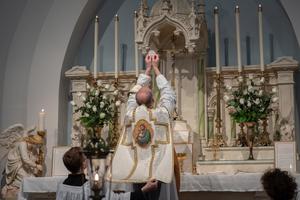
A Boston auxiliary bishop says celebrating the traditional Latin Mass was an overwhelming experience.
“In offering the Traditional Mass for the first time, after removing the vestments, I knelt in the back pew and wept,” Bishop Robert Reed tweeted Wednesday.
Bishop Reed, 66, president of the local CatholicTV Network headquartered in Watertown, was responding to a post on Rorate Caeli, which publishes content on traditionalist Catholic practices, including the traditional Latin Tridentine Mass in Latin. The post asked, “What did you think or feel the first time you attended a Traditional Latin Mass?”
Bishop Reed did not say in the post when he first celebrated the traditional Latin Mass or how often he has said it.
Bishop Reed declined an interview request from the Register on Thursday morning through a spokesman for the Archdiocese of Boston.
Bishop Reed’s post had received 116,000 views as of late morning Thursday.
The post has also received dozens of affirming comments online, including one that said, “Many of us so called ‘trads’ feel like we are disliked, even hated, by our spiritual fathers just for being in love with the tradition of the Church. You don’t know how much a statement like this from a bishop can mean to us. Thank you, Your Excellency.”
Another commenter said, “As a convert from Protestantism, whose entire family of converts — Dad, Mom, Step Dad, Sister, Brother, etc. — we all attend the Traditional Mass. Not because we hate the Novus Ordo, or ‘Novus Ordo Catholics,’ but because we love our ancient rite.”
Bishop Reed’s public statement comes as Catholics worldwide are wondering how Pope Leo XIV will handle the traditional Latin Mass — particularly in the wake of the sharply different approaches his immediate two predecessors took.
Pope Benedict XVI, who served from 2005 to 2013, made the pre-Vatican II Latin Mass widely available, enabling priests to celebrate it without requiring special approval from local diocesan bishops.
Pope Francis, who served from 2013 to April 2025, sought to restrict it, citing a need to promote unity in the Church, and set forth rules (except for dispensations) in his July 2021 apostolic letter Traditionis Custodes that would prevent it from being celebrated in parish churches and that require new priests to get permission from the Vatican to say it.
The vast majority of Latin Rite Catholics attend Mass in their local language according to the Novus Ordo form of the liturgy, which the Vatican implemented in 1970 among post-Second Vatican Council reforms. Novus Ordo supporters say it’s more accessible because it’s easier to follow Mass in a person’s native language, and they note that the Novus Ordo has more readings from Scripture than the traditional Latin Mass.
A small minority of Catholics prefer the pre-Vatican II Rite of the Mass in Latin, which has ancient roots and was standardized during the Council of Trent. (The Church will mark the 480th anniversary of the Council of Trent in December.) The Tridentine Mass includes prayers not found in the Novus Ordo and often diverges in liturgical calendar and in Scripture readings. Traditional Latin Mass supporters say the liturgy is more beautiful and is often celebrated more reverently than the Novus Ordo and that it conveys a sense of mystery more effectively.
Pope Benedict argued that the Tridentine Mass in Latin should be celebrated and attended as an “extraordinary form” of the Mass without restriction because the richness of the liturgy appeals to some Catholics, and he noted that it’s the Mass that centuries of saints prayed at.
In a letter to bishops in 2007, Pope Benedict said there is no inherent conflict between the two forms of the Mass. He also said of the traditional Latin Mass that some Catholics, including some young people, have “felt its attraction and found in it a form of encounter with the Mystery of the Most Holy Eucharist, particularly suited to them.” He said he hoped by making it more readily available to “enable for all those who truly desire unity to remain in that unity or to attain it anew.”
Pope Francis contended that the traditional Latin Mass is a source of division in the Church, in part because some traditionalist Catholics, including the canonically irregular Society of St. Pius X, deny the validity of the Novus Ordo.
In May 2023, during a talk to Jesuits in Budapest, Hungary, Pope Francis said the traditional Latin Mass was “being used in an ideological way, to go backward.”
Some observers expect Pope Leo to steer his own course on the question of liturgy, but it’s not yet clear what course that will be.
- Keywords:
- traditional latin mass