Jim Lovell, NASA Astronaut Who Read Genesis From Lunar Orbit, Dies at 97
The Apollo 8 commander’s reading of the Scriptures reached a worldwide audience at the dawn of humanity’s journey to the moon.
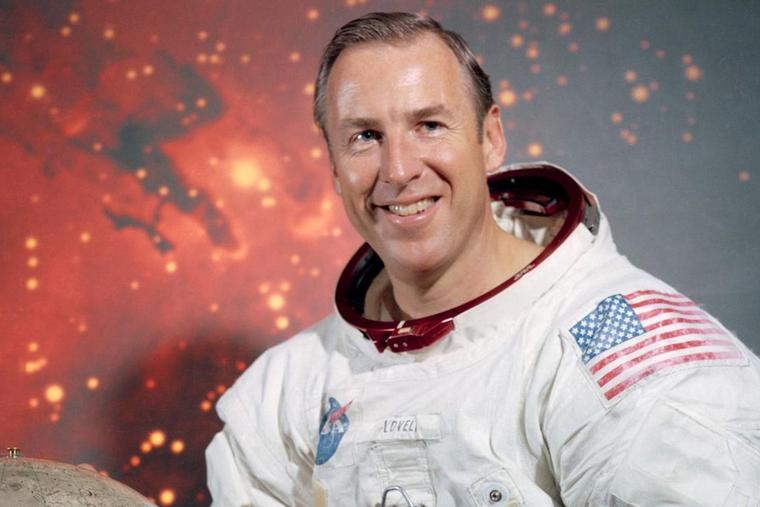
Jim Lovell, a U.S. Navy aviator, officer and astronaut who pioneered U.S. spaceflight and took part in a widely broadcast Christmas Eve reading of the Bible’s creation story during a 1968 NASA mission, died at his home in Illinois on Aug. 7. He was 97.
U.S. Transportation Secretary Sean Duffy, who is currently serving as NASA’s acting administrator, offered his condolences to Lovell’s family in an Aug. 8 statement and noted Lovell’s pioneering role, through his missions with the Gemini and Apollo programs, in leading U.S. astronauts to the moon.
“Known for his wit, this unforgettable astronaut was nicknamed Smilin’ Jim by his fellow astronauts because he was quick with a grin when he had a particularly funny comeback,” Duffy said.
“Jim’s character and steadfast courage helped our nation reach the moon and turned a potential tragedy into a success from which we learned an enormous amount. We mourn his passing even as we celebrate his achievements.”
James A. Lovell was born on March 25, 1928, in Cleveland, Ohio. He attended the University of Wisconsin-Madison for two years and later transferred to the U.S. Naval Academy in Annapolis.
Lovell was selected as a NASA astronaut in 1962 after a distinguished career as a naval aviator. He piloted two successful space missions with the Gemini program — the forerunner to the Apollo program, which would later bring astronauts to the moon — including Gemini 7 in 1965, which included the first rendezvous of two manned maneuverable craft in space.
Lovell and fellow astronauts Frank Borman and William Anders later became the first human beings to orbit the moon after blasting off on Dec. 21, 1968, aboard the newly-developed Saturn V rocket. Borman, Lovell and Anders, on Apollo 8, became the first human beings to leave Earth’s orbit and the first to glimpse the far side of the moon.
By Christmas Eve, Apollo 8 had reached lunar orbit. The men had been doing audio broadcasts to an eager radio audience back on Earth throughout the mission; for the Christmas Eve broadcast, NASA had given the men no specific instructions on what they should say — only that they say something “appropriate.”
And so, while beholding the breathtaking blue marble of the Earth, and with an estimated audience of 1 billion hanging on their every word, Anders, Lovell and Borman read out the Bible’s first passage: the creation account from the Book of Genesis.
Lovell’s portion was:
And God called the light Day, and the darkness he called Night. And the evening and the morning were the first day. And God said, Let there be a firmament in the midst of the waters, and let it divide the waters from the waters. And God made the firmament, and divided the waters which were under the firmament from the waters which were above the firmament: and it was so. And God called the firmament Heaven. And the evening and the morning were the second day.
The astronauts later said they picked that passage because of its importance not just for Christians, but for many of the world’s major religions.
“I put my thumb up to the window of the spacecraft, and I [could] completely hide the Earth behind my thumb. The Earth is a mere speck in the Milky Way Galaxy, [but] look what we have here. Water and an atmosphere. We’re orbiting a star just at the proper distance to absorb that star’s energy,” Lovell later recalled in a video interview posted by NASA.
“God has given mankind a stage upon which to perform. How the play turns out is up to us,” he reflected.
Arguably just as famous as the Apollo 8 mission was the remarkable Apollo 13 — dramatized in the 1995 Ron Howard film — which, in 1970, had nearly reached the moon when the craft experienced a catastrophic oxygen system failure. It was Lovell who first uttered the phrase “Houston, we’ve had a problem,” which would later enter popular culture (albeit with a little variation).
And so, 200,000 miles from home, Lovell and fellow crewmen Jack Swigert and Fred Haise coolly cooperated with Houston ground controllers to make emergency repairs and managed to return to Earth safely — surviving what has been hailed as one of history’s most “successful failures.” Their perilous return was bolstered by worldwide prayers — including those of Pope Paul VI.
Still, Lovell never got to set foot on the moon — his “one regret,” he told the Associated Press in 1995.
A Presbyterian, Lovell married Marilyn Gerlach, from Milwaukee, in 1952. The couple had four children; Marilyn died in 2023.
In a statement Aug. 8, Lovell’s family said: “We are enormously proud of his amazing life and career accomplishments, highlighted by his legendary leadership in pioneering human space flight. But, to all of us, he was Dad, Granddad, and the Leader of our family. Most importantly, he was our Hero. We will miss his unshakeable optimism, his sense of humor, and the way he made each of us feel we could do the impossible. He was truly one of a kind.”
- Keywords:
- jim lovell
- astronauts
- nasa