The Holy Cards That Shaped Saints — and One Family’s Mission to Preserve Them
What began as a homeschool curiosity has grown into a family-run printing press dedicated to preserving sacred imagery.
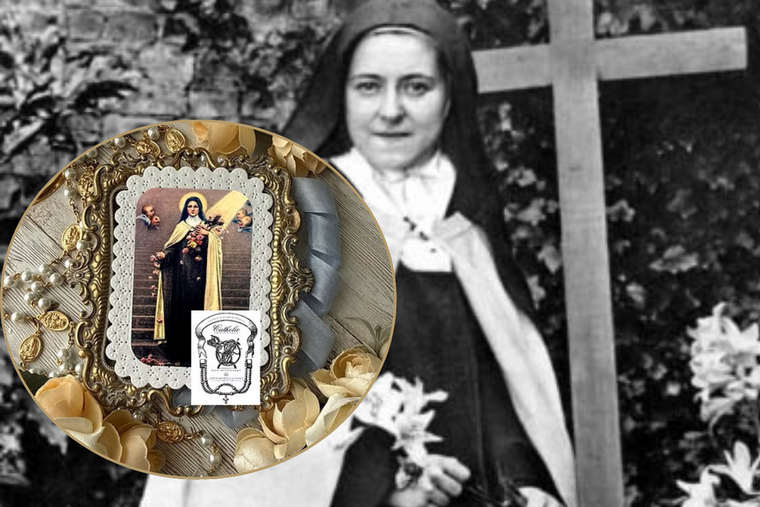
When St. Thérèse of Lisieux was a child, one holy card captivated her so deeply that she later credited it with inspiring the title by which the world now knows her: “Little Flower.”
The card, titled La Petit Fleur du Divin Prisonnier (“The Little Flower of the Divine Prisoner”), depicts Christ crowned with thorns behind prison bars, reaching toward a small flower blooming outside the cell. Intended as a meditation of Christ’s presence in the Blessed Sacrament, the image remained fixed in the mind of the future saint for years.
For Lisa Pellegrini, founder of Catholic Printing Press in rural Michigan, the card represents something larger than a rarity from another era.
“These cards were the formation of the saints,” Pellegrini told the Register. “Most people couldn’t afford books back then, and that’s why the holy cards were made.”
While Pellegrini does not possess the exact card that passed through Thérèse’s hands, her collection includes examples from the same devotional tradition and printing houses that shaped the young saint’s imagination.
Through Catholic Printing Press and its contemplative art publication, Immagini Sacre — a magazine dedicated to devotional imagery and forgotten traditions — Pellegrini has spent nearly a decade collecting, restoring and reproducing religious artwork she believes much of the modern world has forgotten.
According to Pellegrini, much of that work stems from a deep devotion to St. Thérèse.
In Chapter Four of Story of a Soul, Thérèse reflected on the impact sacred images had on her as a child after one of her sisters introduced her to devotional pictures and holy cards:
“So far I have not said anything about my love for pictures and books, and yet I owe some of the happiest and strongest impressions which have encouraged me in the practice of virtue to the beautiful pictures Pauline used to show me. Everything was forgotten while looking at them.”
Of La Petit Fleur du Divin Prisonnier, Thérèse later recalled that the image “suggested so many thoughts that I would remain gazing at it in a kind of ecstasy.”
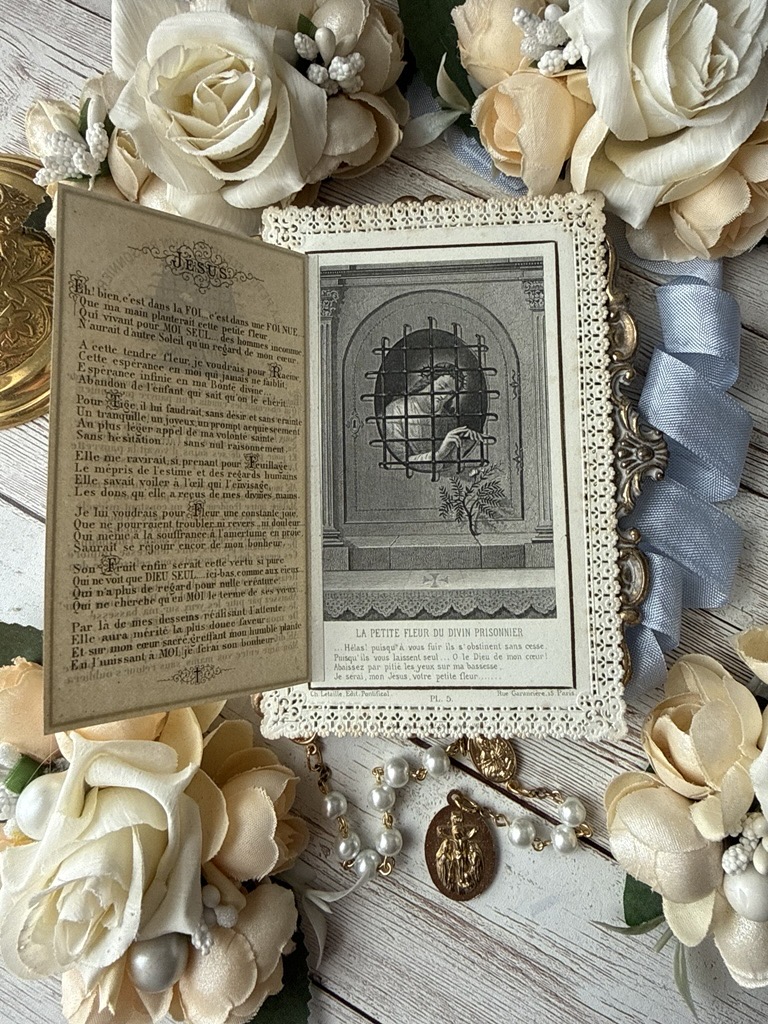
Eventually, she came to identify herself as that flower.
“I offered myself to Our Lord to be His Little Flower,” she wrote. “I longed to console Him, to draw as near as possible to the Tabernacle, to be looked on, cared for, and gathered by Him.”
For Pellegrini, the card illustrates the role sacred imagery once played in Catholic devotional life. “These images taught people how to pray,” she said.
‘Zélie, I Need Your Help’
Pellegrini’s fascination with antique holy cards began around 2014 while researching materials for her children’s homeschool curriculum.
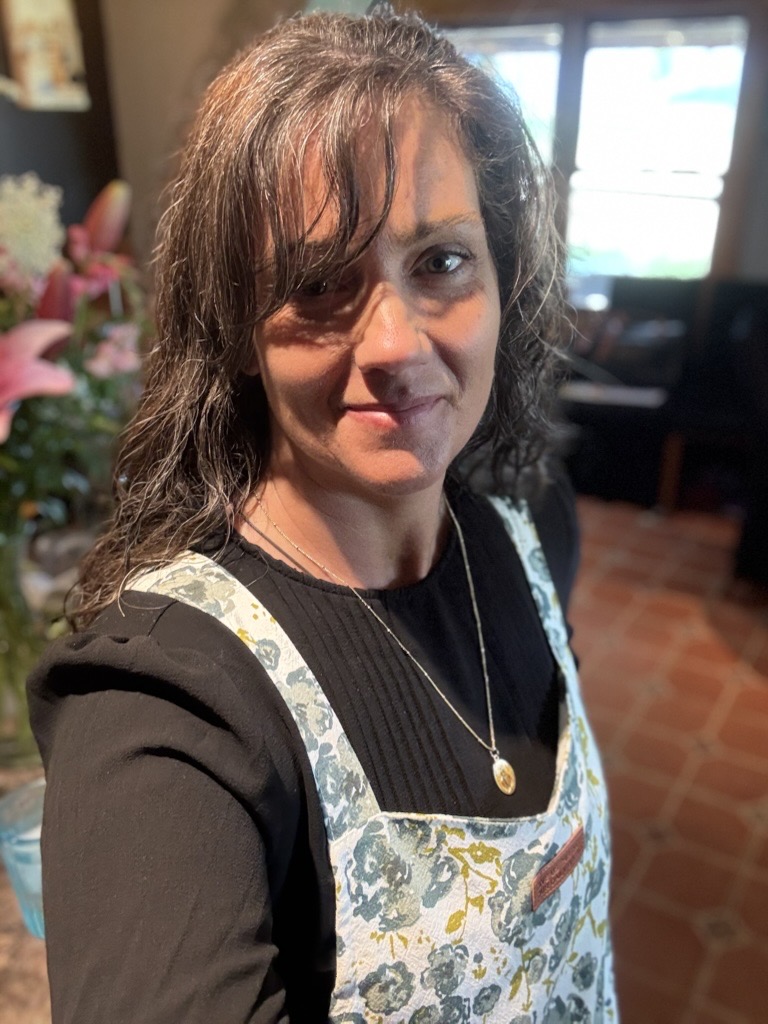
A former hospice nurse assistant, Pellegrini and her husband Jason now operate the family’s heritage Michigan farm while raising their seven children and balancing the work of Catholic Printing Press.
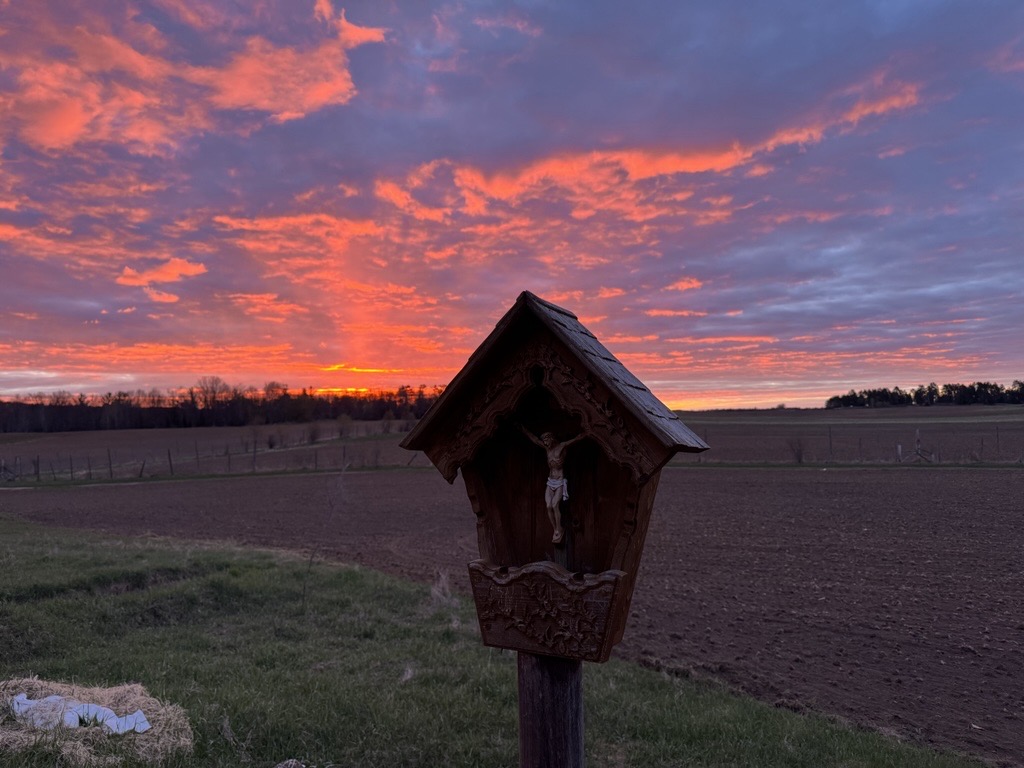
“I’m just a farmer’s wife,” Pellegrini said. “And in discovering these holy cards and the contemplative journey they brought me on, it was a way of discovering Christ in a new light.”
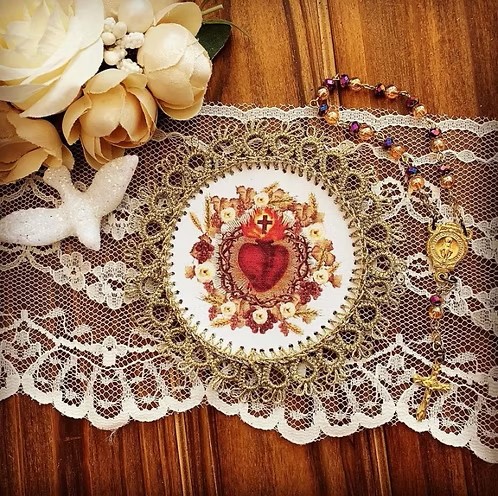
As the family had been consecrated and enthroned to the Sacred Heart of Jesus, Pellegrini became especially interested in traditional Sacred Heart badges and détentes — fabric devotional emblems often produced with intricate lace-like borders and textile work.
Though she had some experience crocheting, she had little idea how such objects were made. Seeking help, she turned to asking for the intercession of St. Zélie Martin — the mother of St. Thérèse and a lacemaker by trade.
“I said, ‘Zélie, I need your help,’” she recalled.
What began as a personal interest soon became a yearslong effort to recover devotional art that had largely disappeared from public view.
Around 2015, she began posting antique holy card images online. Interest arrived quickly from Catholics around the world. One of the first people to contact her was a Carmelite hermit in Pennsylvania who asked whether she could reproduce her détentes.
At the time, reproducing traditional lace holy cards seemed nearly impossible. But Pellegrini continued experimenting with old techniques and materials.
“We were discouraged a lot at first,” she said, “but we just kept working and trying to figure out a way to do it.”
Recovering a Lost Visual Language
Today, Pellegrini works with antique dealers, auction houses and collectors throughout Europe in search of rare devotional images hidden away in private collections and forgotten family archives.
“I’ve been studying the holy cards long enough to know what printing house they came from and which Parisian house had that specific image,” she noted.
One collection that especially captured Pellegrini’s interest was a 19th-century series of holy cards known as the “Divine Pilot,” originally produced by the Parisian Letaille Printing House. The series portrays Christ as a nautical pilot guiding souls through the storms and dangers of earthly life, with each card forming part of a larger devotional narrative.
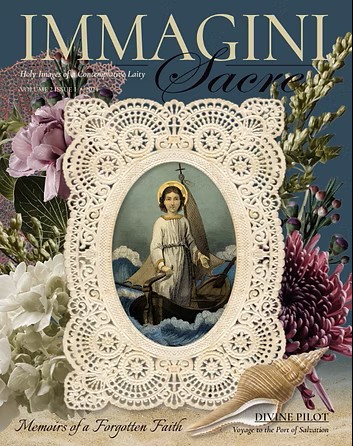
After years of searching, Pellegrini believes her family may possess the only complete known set of the original 13-card series.
“I didn’t even realize they were a series at first,” she said. “I just thought they were worth preserving.”
Many of the cards, Pellegrini explained, effectively vanished from public view after older European printing houses closed and devotional customs changed.
“They were hidden away in people’s breviaries for years,” she said.
Once an original card is acquired, Pellegrini carefully restores it digitally, repairing tears, fading or discoloration while preserving the character of the original engraving. Some restoration and coloring work is completed with assistance from her children, and the images are ultimately reproduced using a combination of antique techniques and custom-built equipment.
The project has gradually become a family effort, with several of Pellegrini’s children assisting in digital restoration, design and packaging.
That work eventually expanded into Immagini Sacre, a contemplative publication dedicated to showcasing antique holy cards alongside translated prayers and devotional reflections. Pellegrini is currently preparing the ninth issue on the “Divine Prisoner” and hopes to publish dozens more.
The project, however, is not simply about preserving antique artwork. Pellegrini believes sacred imagery can redirect attention toward contemplative prayer in a culture increasingly shaped by distraction.
“I think, visually, people are hungry,” she said. “They just don’t realize they’re hungry for the Lord.”
Beauty as a Path to Prayer
For Pellegrini, sacred images offer a way of redirecting attention toward contemplation. Others who have encountered her work say beauty itself becomes the first form of contact.
Steve Cunningham, founder of Sensus Fidelium — a Catholic media apostolate known for its extensive library of traditional Catholic sermons and spiritual resources — said the visual appeal of Pellegrini’s work constantly draws attention.
“People aren’t attracted to ‘ugly,’” Cunningham said. “It’s beauty that first draws a person’s eyes in.”
Pellegrini’s holy cards and issues of Immagini Sacre, he said, quickly became popular when he distributed them at a Eucharistic congress several years ago.
“People nowadays are drawn to traditional items,” he said. “They pick something like Immagini Sacre up and ask, ‘What is this? How can I learn more?’ Then the door to the faith is open.”
For some readers, that initial curiosity becomes something deeper. In a testimonial published in a previous issue of Immagini Sacre, Tammy VanPembrook described the magazine as a spiritual retreat when travel is not possible.
“I work full time and live in a rural area, making it difficult to get away for a spiritual retreat,” she wrote. “When I open a new issue of Immagini Sacre, I pray, ‘Come Holy Ghost, come as you will, Amen,’ and I go on a visual prayer retreat. Every issue is a new prayer experience.”
VanPembrook said the “Divine Pilot” issue particularly resonated with her.
“The Divine Pilot took me back to my childhood days, growing up on a lake,” she wrote. “As I turned the pages, I traveled through the many storms of my youth, safely returned to port by the Divine Pilot in my older age.”
VanPembrook’s experience reflects what Father Lawrence Carney of the Diocese of Wichita, Kansas, has long observed about the role sacred imagery can play in drawing people closer to God.
A longtime promoter of the Holy Face Devotion, Father Carney first met Pellegrini while preaching a mission in Michigan. The two have remained friends, and Father Carney frequently offers spiritual counsel as Pellegrini continues developing Catholic Printing Press and Immagini Sacre.
“I was immediately struck by the beauty of the holy cards with the lace on them,” he said. “The colors were so beautiful. I thought [Lisa] did things in such a tasteful way.”
For Father Carney, that beauty serves a deeper purpose in promoting the “true, good and beautiful,” emphasizing “a connection” between Pellegrini’s efforts and the spirituality he promotes through the Holy Face — a devotion “especially significant in the life and writings of St. Thérèse.”
“It’s through the face of Jesus that we’re all connected,” he said. “Beautiful art, even on cards or linens, can have a profound effect on people of faith.”
As a child, Father Carney said, a holy card of Our Lady of Perpetual Help left a lasting impression on him that led him toward his priestly vocation. “Our Lady’s eyes appeared to me on that holy card,” he said. “In just those few seconds of looking at an image, I felt the face of Mary calling me to the priesthood.”
Today, Father Carney sees sacred imagery as one of many ways God continues to draw souls. “Sometimes people are drawn first by beauty,” he said, “and that draws them deeper into union with God.”
Reflecting on Pellegrini’s work, Father Carney said its impact may be greater than she realizes.
“After all,” he said, “it was a holy card that brought me to the priesthood.”
In that same spirit, Pellegrini’s work with Catholic Printing Press continues the same pattern Father Carney described and which St. Thérèse herself knew so well: beauty that first draws the eye and, at times, draws the soul toward God.
- Keywords:
- holy cards
- sacred art
- sacramentals
- catholic families
- small businesses
- religious art
- prayers and devotions