Mary’s ‘Yes’ in the Age of AI: The Marian Heart of ‘Magnifica Humanitas’
Mark Miravalle discusses the Marian dimension of Pope Leo’s encyclical on Catholic social teaching and artificial intelligence.
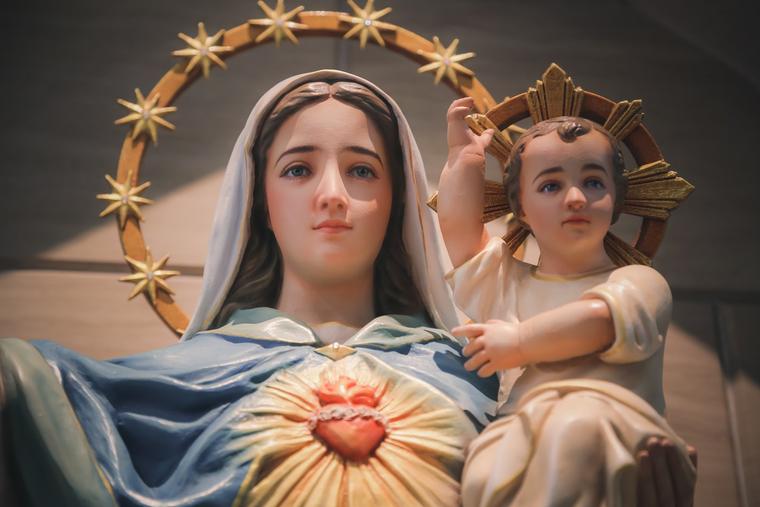
The Blessed Mother has always been present within the encyclicals and documents of recent popes. Pope Leo XIV also draws us to Marian devotion with his first encyclical, Magnifica Humanitas.
In sections devoted to Mary, placing the emphasis on the Annunciation and particularly the Magnificat, he gives the answer and the antidote to society’s rush toward artificial intelligence. Mary is the model of the true human being and shows how humanity fulfills what it is meant to be by choosing God and his will and humility, instead of trying to again build a modern Tower of Babel.
Pope Leo entrusts “our desire to the Mother of Christ, to the Woman of the Magnificat, that she may guide our steps through this time of change and preserve in each of us true faith in the Gospel, so that we may bear witness to the grandeur of humanity, in which God has made his dwelling.”
To explore the Holy Father’s reflections on the Mother of God early in his pontificate, the Register spoke with Mark Miravalle, who holds the St. John Paul II Chair of Mariology at Franciscan University of Steubenville in Ohio. Miravalle also is a professor at Ave Maria University in Florida; author, founder of Ecce Mater Tua, an international journal of Mariology research; and president of the International Marian Association that promotes Marian devotion and doctrine.
Dr. Miravalle, what is Pope Leo emphasizing in his Marian reflections in his encyclical Magnifica Humanitas?
First of all, he’s focusing on Our Lady in the Incarnation because he’s trying to establish what is physical and spiritual and real versus what is artificial and digital. And to do that, he’s trying to get us back to reality.
Mary’s “Yes” is confirming the reality of God becoming man, but it’s also confirming the reality of persons over things.
Why would you say the “things” Pope Leo mentions are primarily related to AI — artificial intelligence?
I think the greatest threat of AI is precisely that we delegate what makes us human. The two things that define us as humans, beyond the animal realm, are our ability to think and our ability to choose. That is our spiritual component, our spiritual dimension — our souls. When we delegate that to algorithms, there’s a real threat that we lose what makes us different as human beings in this universe.
Who exemplifies this the best?
It is Mary. It’s her exercise of her intellect and will in saying “Yes” — and this is brought up even more in Quo Vadis, Humanitas? [on Christian anthropology in light of the future of humanity from the International Theological Commission] — that protects the integrity of the human person rather than just displaced, separated, at times chaotic, bits of information.
So, I don’t think it’s just a devotional, pious idea when the Holy Father is trying to get us to focus on Mary’s “Yes” at the Incarnation and her “Yes” to her vocation — because that’s how she’s fulfilled: by doing God’s will — and that’s how we’re fulfilled — rather than this almost-endless pursuit of individual facts or elements of information, which do not necessarily confirm our person or our humanity or our vocations or our call to holiness. In fact, in many ways, it can be countered.
How does this connect to Our Lady?
While the Holy Father is clear that there’s nothing intrinsically evil with AI, I think he’s really trying to point out that it runs the risk of taking away our personhood and our humanity. And no one manifests human personhood and humanity better than Our Lady. She does so perfectly. She’s the immaculate human person, and she keeps the proper order of things integrated.
Please explain the “proper order.”
It means we are physical, and we are spiritual. You can’t reduce human beings simply to a bunch of facts artificially put forward in algorithms. So, ultimately, I think Leo is pointing to Mary because Mary protects personhood and she exercises her intellect and her will in perfect obedience to God rather than a modern temptation to have disjointed facts put together that do not necessarily come up with a human person [and human dignity] and do not necessarily serve a call to holiness. …
I think that the great danger of AI is precisely this disembodiment; as he talks about, this putting into pieces rather than the whole of the person, both the person, the human person, the person of God — and, of course, the perfect human example of that with Our Lady.
In his meditation during the Jubilee of Marian Spirituality Prayer Vigil and Rosary for Peace on Oct. 11, 2025, Pope Leo was talking about authentic Marian spirituality and living the Gospel. He kept using her words — “Do whatever he tells you” — as a refrain. And though not by Pope Leo, the recent Quo Vadis, Humanitas? by the International Theological Commission has references to John 2:5 and to the Annunciation, tying into Pope Leo’s thought. How does that also work into Marian spirituality and AI?
Notice how these are real acts of the will. And only humans make acts of the will. Here again, the Magnificat is another act of the will to praise God, rather than to praise man. And you can use that analogy he [Pope Leo] uses in Magnifica Humanitas — praising God versus a Tower of Babel, something that we do alone, something we don’t need God for.
And that’s the great danger with AI: We can delegate our free will — anywhere from personal decisions and vocations to going to war, all based on algorithms. That’s a rejection of human freedom. And with the Magnificat, Our Lady is saying, No, God is the only omnipotent being worthy of praise, not the fruits of man, but the works of God.
Now, the human works can reflect that in a beautiful way. But there’s also the danger of Towers of Babel, where the efforts of humanity do not incorporate divine Providence, but only, again, mathematical theories and systems.
Then we risk grave danger of really relegating human choices to machines. Then the machines now have the upper hand, rather than serving humanity. That’s the great danger of AI. And the Magnificat shows it’s a vertical direction. We are called to ultimately use our free will with our mind and raise to God, not to our own products.
It seems that this emphasis is becoming an important theme that repeats in his Marian references and reflections, again, like a refrain.
I think that’s true. And he drops it subtly. But isn’t it interesting that oftentimes when he refers to AI, sooner or later, there’s a reference to Our Lady as the corrective. In the Magnificat, he talks about Our Lady [saying] that Jesus, with the strength of his arm, scatters the proud and casts down the mighty and lifts up the lowly. It is easy to get proud when we have decided that we no longer need to have our minds and wills focused on God, but on the effects of our own artificial intelligence.
On May 8, 2025, right after he was elected, Leo told the crowds it was the feast day of Our Lady of Pompeii and invited them to pray a Hail Mary with him for his new mission. Two days later, he told the cardinals one reason he chose his name was “mainly because Pope Leo XIII in his historic encyclical Rerum Novarum addressed the social question in the context of the first great industrial revolution. In our own day, the Church offers to everyone the treasury of her social teaching in response to another industrial revolution and to developments in the field of artificial intelligence that pose new challenges for the defense of human dignity, justice and labor.” Was there a Marian reason for choosing the name Leo?
On May 8, 2026, when he was at Pompei, he said the reason he chose Leo was of the great Marian love that Leo XIII had. And the second was his social emphasis and how he believed that AI was a critical part of what he had to deal with. So again, you have this coupling of Our Lady and AI — the ultimate humility and “Yes” to God’s will versus the possibility — not the intrinsic evil of — again, a Tower of Babel, of something where we are relinquishing our minds and our wills to machines.
And now we have that real possibility — that instead of thinking and choosing for ourselves, we’re letting machines do it. We’re letting computers do it. That can never be an acceptable way of saying “Yes” to our vocations and “Yes” to Providence. It can be a part of it.
I think we must be careful of the potential to underestimate the ability of AI to begin thinking and choosing for us by our choice, that we allow AI to think and choose for us.
And Our Lady is an incarnational rejection of that. She does it herself, in perfect obedience to God, in the fulfillment of what a human person is supposed to be. It’s fascinating how much the Holy Father seems to connect Mary and AI. That would have to be documented, but there’s certainly a case to be made.