SCOTUS: Are Rights Without Remedies Rights at All?
COMMENTARY: That’s what the Supreme Court will decide in ‘Landor v. Louisiana Department of Corrections.’
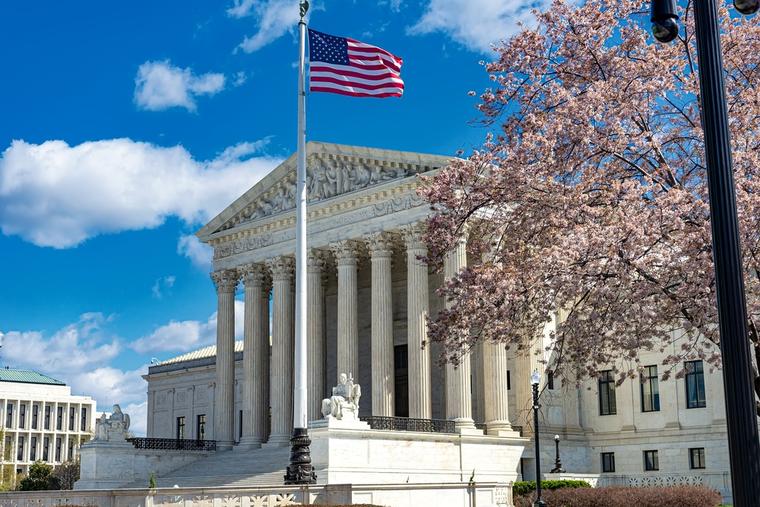
Any day now, the Supreme Court will decide whether America’s landmark law protecting the religious freedom of prisoners has any real teeth.
The case is Landor v. Louisiana Department of Corrections: Damon Landor, a Rastafarian serving a five-month sentence, honored the Nazarite Vow for nearly 20 years, growing his dreadlocks as a sincere expression of his faith.
Three weeks before his release, guards moved to shave him bald. Landor produced a Fifth Circuit opinion confirming his right under the Religious Land Use and Institutionalized Persons Act (RLUIPA) to keep his hair. An officer threw the opinion in the trash, handcuffed him to a chair, and shaved his head anyway. Even judges who ruled against him called the treatment “stark and egregious.”
The question before the Court is whether Landor can sue that officer personally for money damages. It is, at bottom, a question about whether rights without remedies are rights at all.
Among the many different voice[s] supporting Landor are seven leading religious-liberty scholars from Stanford, Notre Dame, Harvard, Pepperdine, and Villanova who argue that dismissing Landor’s claims makes “RLUIPA a dead letter for countless inmates.” Injunctions only prevent ongoing harm. A prisoner like Landor — transferred, then released — has no ongoing harm to enjoin. It is damages or nothing.
The Becket Fund for Religious Liberty underscored that “the ordinary realities of prison life — transfers, releases, and time-limited stays — make it very difficult to vindicate religious freedom, even in the most egregious cases.” The Trump administration also sided with Landor, arguing RLUIPA “puts states on clear notice” that individual officials may be held personally liable.
When Becket, Americans United for Separation of Church and State, and 44 religious organizations stand together, what is at stake transcends politics.
Louisiana, pointing to the Spending Clause, claims that RLUIPA conditions institutions, not the officials within them. This is answered directly by the scholars: The Supreme Court already rejected the premise in Tanzin v. Tanvir, holding that identical language in the Religious Freedom Restoration Act (RFRA) authorizes money damages against individual officials. To read the same words differently in RLUIPA “drives an unjustified wedge” between two statutes Congress designed to work in tandem.
Louisiana also warns that allowing personal damages will open the floodgates to prisoner lawsuits. Becket dispatches that concern cleanly: qualified immunity already protects officials who act in good faith, and the Prison Litigation Reform Act requires exhaustion of administrative remedies, mandates judicial screening of frivolous claims, and imposes a three-strikes rule on serial filers. As Becket notes, these same arguments were made and rejected in Tanzin — and “the sky has not fallen.”
Yet the Supreme Court's conservative justices signaled unease at oral argument. Justice Brett Kavanaugh pressed whether RLUIPA’s phrase “appropriate relief” provides a clear enough statement to subject individual officials to personal damages liability. Justice Neil Gorsuch was more pointed: federal appeals courts have been “unanimously against” Landor on this question “for many, many, many years” — so where, he asked, was the notice to officials that they could be personally sued?
Justice Samuel Alito raised a related concern: If the court held 14 years ago in Sossamon v. Texas that the same language was insufficient to allow damages suits against the state itself, how can it now be clear enough to bind individual officials? These are serious structural questions. But if the court concludes that the notice bar has not been met, Congress should act without delay to amend RLUIPA and make the personal liability of officials explicit. The egregious facts of this case where an officer handcuffed a prisoner to a chair after throwing a federal court opinion in the trash should leave no doubt about what the law must say.
That question echoes even further to countries without RLUIPA, without any enforceable protection for prisoners’ religious freedom at all.
Take, for example, the continuing plight of Jimmy Lai, the Hong Kong media tycoon and Catholic convert. At St. Patrick’s Cathedral in New York City, near the adoration chapel, is a small shrine with a drawing of Christ crucified — made by a man in chains. Lai sketched it from his solitary confinement cell, spending his days reading the Gospel, praying, and drawing images of the Crucifixion.
Lai’s son Sebastian has said his father’s faith has been “a real pillar” in prison — that “faith is why even after having gone through so much with the Hong Kong government trying to break him, he’s still strong.” His daughter Claire says the ordeal has only deepened his devotion. St. Paul, himself a prisoner, wrote that though he was chained like a criminal, “the word of God is not chained.”
Beijing’s attempt to prove otherwise has failed.
That does not mitigate the oppression involved. Lai was sentenced to 20 years under Hong Kong’s National Security Law for the crime, essentially, of running a pro-democracy newspaper. Beijing has denied him access to the Eucharist and Mass — not incidentally, but as policy. Faith that survives confinement, the Communist Party has decided, must be starved of its sustenance. America enacted RLUIPA precisely to prevent that logic from taking root here.
Obviously, Lai and Landor are not identically situated. Lai is a political prisoner. Landor served time on a valid conviction. But they share a common question: Does confinement by the state extinguish religious freedom? American law has long answered No.
If RLUIPA is to mean something, officials who egregiously ignore it must face real consequences. It is right to condemn Beijing for trying to starve Lai’s faith of its sacramental life. Either the Supreme Court or Congress should make sure the same cannot be said of us.
- Keywords:
- supreme court