Can Pope Leo Help Stop the ‘AI Arms Race’?
The time may be ripe for Pope Leo XIV and the Vatican to play a leading role in helping to rein in AI.
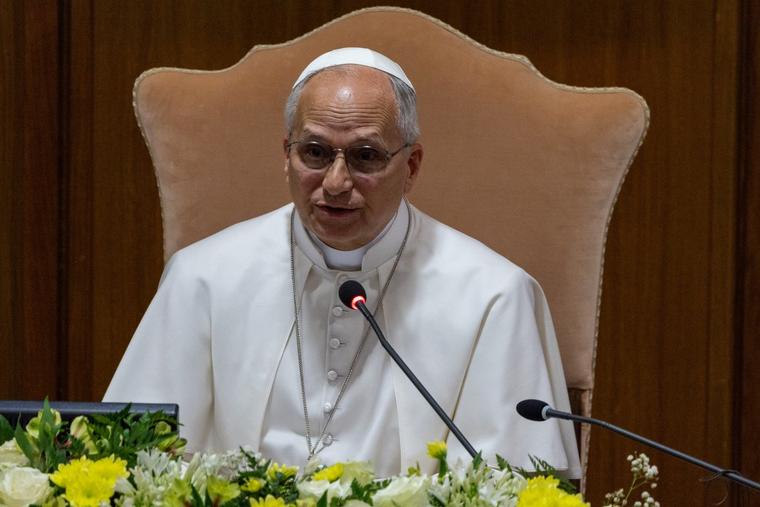
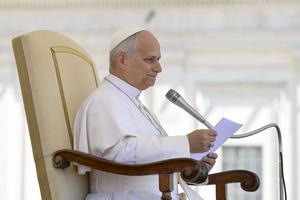
In his new encyclical Magnifica Humanitas, Pope Leo XIV called for international cooperation to mitigate the risks of rapidly advancing AI technology. But could the Pope himself play an important role in bringing relevant parties to the table to slow down the so-called “AI arms race?”
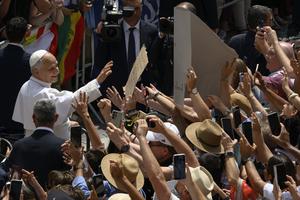
Some experts think so. With trust in multilateralism crumbling and major AI players locked in fierce competition with little incentive to self-regulate, they argue that Leo’s global reach, sky-high popularity, and moral authority among world leaders make him and the Church he leads as well-positioned as anyone to promote international collaboration.
“The Church might be the only institution in the world that can actually lead this moral discussion on AI,” said Brian Green, director of technology ethics at the Markkula Center for Applied Ethics at Santa Clara University, who has served as an adviser to the Vatican on AI. “There’s no other religion that’s big enough or has a central authority — there’s just nowhere else to turn to.”
If Leo does step into a mediating role, it would require fostering dialogue and agreements among both tech companies and nations — particularly AI superpowers China and the U.S. — to ensure that the coming AI revolution does not come at the expense of the common good.
The Pope’s encyclical has already raised awareness of the dangers of uncontrolled AI expansion. But with tech giant OpenAI now calling for “an international organization that helps coordinate leading AI efforts to reduce catastrophic risk,” and other companies like Anthropic calling for a “global freeze” on AI advances, the time may be ripe for Pope Leo’s Vatican to play a leading role in helping rein in AI.
The ‘AI Arms Race’
Experts warn that the coming societal changes AI will bring will be lightning-fast, drastic and possibly even catastrophic. But even with these concerns widely known, and even shared, among tech leaders and government officials, there seems to be little capacity for self-restraint.
In the U.S., widely regarded as the global leader in AI technology, companies like OpenAI and Anthropic are racing against each other to lead the way in creating “frontier models,” which are becoming ever more autonomous. Without overarching regulations of the industry, self-restraint could spell financial ruin, as less scrupulous competitors could forge ahead and dominate the industry.
On the geo-political stage, the American government has largely blocked regulations of AI development, as it attempts to keep ahead of China, its primary challenger in the AI race who trails behind by mere months. The concerns aren’t just economic, but also security-related, as falling behind on AI could lead to vulnerability to new forms of weaponry and diminished deterrence.
Unsurprisingly, this frenzied push to win the AI race, and the sense of inevitability that accompanies it, has been compared to the nuclear arms race that defined the 20th century.
“To be on the most dramatic side possible, the survival of humanity [is at stake],” said Charles Camosy, a moral theologian at The Catholic University of America, who says that the possibility of powerful, autonomous AI systems should be treated with at least the same seriousness as nuclear weapons.
In Magnifica Humanitas, Leo returns again and again to a biblical metaphor for the global AI race: the Tower of Babel. He lists a variety of examples of the chaos that may ensue if we, like the people of Babel, become blinded by a feverish pursuit to build. These include advanced computer-controlled warfare, massive unemployment and the elimination of the weak in the pursuit of transhumanism.
International Cooperation
What is needed in this historic moment, Leo teaches in Magnifica Humanitas, is a united global effort. No single company or country can solve the AI arms race alone. But if actors come together and agree to protect human dignity and the common good in the age of AI, they can collectively use their power to avert a crisis.
Bringing the major players to the table to hash out such an agreement, however, would involve overcoming mutual distrust and narrow views of self-interest. Experts like Green, however, reiterate that the Catholic Church may be particularly suited to play such a role. Unlike national governments, the Holy See does not have its own temporal interests and investments in AI at stake. Its interest, as Leo has made clear, is defending human dignity and flourishing.
The Church has already proven itself capable of this kind of mediating mission in the past, says Will Jones, leader of the religions initiative at the Future of Life Institute, an organization committed to preventing AI disaster. He points to the Vatican’s efforts to oppose nuclear proliferation and human cloning as examples of how the Church used its unique role to successfully foster cooperation on daunting technological developments.
More recently, Pope Leo offered the Vatican as neutral ground for Russia-Ukraine peace talks, but later said that the Holy See did not have the political leverage to bring the two nations to the table.
Leo has already succeeded in initiating a serious global conversation about building a positive future with AI — a conversation being taken seriously by at least some policy and tech leaders. Vice President JD Vance, for instance, has called Magnifica Humanitas “profound,” while Anthropic co-founder Christopher Olah’s presence at the May 25 launch of the encyclical has helped generate interest in the Pope’s perspective in Silicon Valley.
If the world is willing to listen to Pope Leo’s warnings, it may also be willing to come to the table if he calls for it.
If the Church were to pursue this sort of mediating role, experts suggest it could take a variety of forms: leadership of a global summit, Vatican-hosted talks between AI giants of China and the US, and quiet, behind-the-scenes work by the Holy See’s seasoned diplomatic corps.
While much of the effort would naturally focus on the biggest drivers of AI change, experts say that efforts from Leo would almost certainly involve the entire world, including places that don’t often get a say, like small countries and the global South.
“[The encyclical] is saying that everybody in the human family has a stake in this, everybody is affected by it, and therefore it’s really important that everybody has a chance to participate in constructing their future together,” said Paolo Carozza, an expert in international law at Notre Dame Law School and co-chairman of Meta’s Oversight Board.
Prospects for Success
While the Church may be in a unique position to facilitate global dialogue, the prospect of success is far from guaranteed.
“Right now, it looks very poor,” said Carozza of the chances of reaching meaningful international agreements on AI.
The biggest elephant in the room is China. The Chinese government is reluctant to do anything that might cede ground on AI. Its rocky relationship with the Holy See, with whom it has butted heads on issues like bishop appointments, doesn’t help.
“The United States is at least willing to listen to the Pope, but China is absolutely not willing,” said Green. “If the Chinese government was willing to cooperate, then, of course, it would not be a problem because the Vatican is very happy to cooperate with just about anyone. But as long as the Chinese government is uncooperative, then cooperation won't happen.”
Another challenge is a rising skepticism about multilateralism, which Leo laments in the encyclical. At a time when global coordination is most needed, confidence in organizations designed for this purpose — like the United Nations — is at a low point.
“It would take an understanding that we can’t afford to be blocked by ideology here,” said Camosy. “The fate of the human race may be at stake.”
The effort is also a race against the clock. AI progress is hurtling forward at breakneck speed. If AI systems become capable of developing on their own without human intervention, the growth could accelerate exponentially.
“There’s no way for us to see the future anymore – the horizon has become too short,” said Green. “I talked to people who do planning at tech companies, and they said they used to plan for three years out, but now with AI, they only plan 18 months out, or even 12 months.”
Some are also skeptical that the Vatican will pursue an active role in facilitating an agreement. Victor Gaetan, a Vatican diplomacy expert and Register contributor, suggests that Leo’s purpose is not primarily diplomatic, but is rather to impart the Church’s wisdom to AI leaders and to move the conversation in the right direction.
“I do not see mediation as a likely activity flowing from this encyclical, certainly not this year,” he said. “No evidence exists that either [the U.S. or China] has any interest in negotiating restraint. Short of a disaster, it’s hard to imagine what would compel the two superpowers to negotiate.”
‘The Chips Are Down’
Whatever strategy the Vatican takes going forward, it is clear that AI will be a central theme of Leo’s pontificate. It’s a surprising development, given that going into last year’s conclave, there was little to no discussion about the importance of the next pontiff grasping the significance of AI.
“I have no idea what the origin of this interest is in AI, but I will say that I think he’s exactly the right person for this,” said Green, who called the Pope “the man of this moment.”
“The fact that Pope Leo has come along and made this the cornerstone, the most important thing for his pontificate, I think, is extraordinarily foresightful. I think the Holy Spirit is involved here as far as I'm concerned.”
And while some commentators have dismissed Leo’s calls for global cooperation on AI as naïve, Camosy said that such an attitude comes from a poor reading of the encylical. He says that Leo is “hyper-aware of our difficulties,” and calls for cooperation not because it is necessarily a very likely option, but because it is our best option.
“When the chips are down, we can find a way to do this,” he said, pointing to the Cold War as an example of a time when competing powers were able to set differences aside and cooperate to avoid Armageddon. “Part of writing the encyclical, I think, was to try to say, ‘Hey, the chips are down.’”
And perhaps the world will bet on Pope Leo as the man to help lead the way forward.
- Keywords:
- 'pope leo xiv'
- artificial intelligence