EWTN Studios’ ‘Fork in the Road’: When Homeschooling Goes International
Host Jessica Rey talks faith, family, and educating her children on location throughout Catholic Europe.
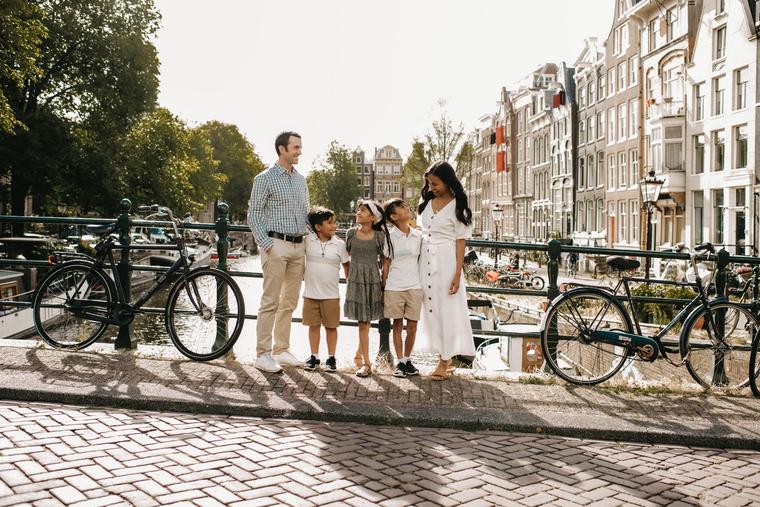
Trips out of the country are few and far between for most American families. For Jessica Rey and her family, it’s a regular part of life.
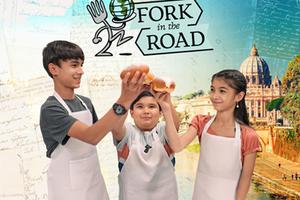
Rey and her husband Stephen take their three children around the world as part of their learning-by-travel model of homeschooling. The family documents their travels through Europe in EWTN+ and EWTN On Demand’s new show Fork in the Road.
Rey, an actress and business owner, said she wanted to make the most of her kids’ childhood by spending as much quality time with them as possible. She received an endometriosis diagnosis shortly after getting married and believed that she would never have any children as a result. When she became pregnant with her oldest son, she said she knew it was a gift from God.
When it came time to enroll her children in school, Rey said she and her husband were hesitant. Rather than sending them to school in California, where they were living at the time, Rey said they decided to keep them home so they could spend more time together and have more flexibility.
The family began traveling around the world, combining online courses with private lessons in music and language to give their kids a customized educational experience with famous historical and religious sites as the backdrop.
While an Italian summer storm raged outside, Rey sat down with the Register to talk about the family’s new show and life in Europe.
What was the genesis behind Fork in the Road?
We’re dual Italian citizens, so we’ve been going to Europe with our kids for a very long time. We just decided last year, “You know what? Let’s bring a little camera crew with us.” So many people always ask us, “How does it work? How do you do it? Is it hard? How do they learn when you’re away?” So we decided to film it and see what happens. It’s a huge blessing that we now have the show on EWTN.
What’s the benefit of traveling to these places? Why not just read about them in a book or watch a video?
We’re all about hands-on learning, and we do read about it in books, too. Everybody learns differently. My kids love board games, and when they get a board game, we all sit down and they try to teach me how to play. They’re reading the instructions to me and my mind just goes blank. It’s like you’re speaking a foreign language because I learn by doing. I find that, [with] my kids, they do learn by reading, but they retain more when they learn by doing and seeing, by going to these places.
For Season One, you’re traveling through Portugal, Italy, Croatia and Austria. How did you pick these places?
They’re all places that we’ve been before several times. Italy was an obvious choice for us because we’re dual Italian citizens and we go there the most. Croatia was a close second because we have so many friends there and spend a lot of time there as well. Only my daughter, Estella, and I had been to Portugal, and that was during World Youth Day. I just thought the food was so wonderful there, and this is a food show. And the faith is just so alive — the churches are beautiful, so we decided to add that in. We were traveling during Christmastime, and the Christmas markets in Austria, you just can’t really beat them.
What goes into planning a good educational trip for the whole family?
A lot of times, there is no plan, particularly when we go to Italy. We sort of have a rough plan. My kids are involved with the music conservatory in Italy, so we know we’re going to have piano lessons and that they’re going to sing in this concert with this orchestra on this day. There’s going to be a recital; there’s going to be a piano competition. So those are the types of things that go into our schedule, and then we work other things around it. But every day is just different, and we don’t really know what we’re going to do most days. We wake up, and, if it’s a free day without piano or language classes, we see what is going on in the area, we get in the car, and we go.
How do you weave your Catholic faith into your travels?
It’s so easy in Europe, particularly in the countries that are in Season One. There are churches on every corner, it seems. And most of them are empty, which is very sad. In Italy in the late spring, there are so many festivals dedicated to different saints — saints we’ve never even heard of before.
Are there any places you’ve encountered on your travels that you think are underrated?
I would definitely say Umbria, which is in Episode 2. People go to Umbria for Assisi, mostly, but they don’t really know it for anything else. It’s actually the only land-locked region of Italy, and maybe that’s why people don’t go there. But it is so rich in our faith. St. Rita is there; we discovered St. Veronica Giuliani’s incorrupt body there; obviously, St. Francis is there — and St. Clare. It’s quiet, and that’s where you find all of the local festivals where there are no tourists and nobody speaks English, and it’s just wonderful. And the food is good; everything is fresh and delicious.
What do your kids take away from these experiences? And what do they think about being on TV?
My kids have been doing TV and commercials since they were in the womb. We don’t actually have a TV, and we haven’t had one since Nathaneal was a baby. They’ve seen this show, but they just don’t watch very much TV, and they don’t like pop culture and all of that. They just don’t really care for it or know about it. I think they actually really don’t care about it. It’s not really any different than what we’ve been doing: just traveling as a family and homeschooling on the road. I think the thing some people don’t understand is that the show just grew naturally out of the way we’ve been living. The only difference is that we have a few extra people with us.
In your opinion, what does the fact that you can give your kids these kinds of experiences say about homeschooling?
I just think it’s amazing. Learning is not a one-size-fits-all thing. I have some friends who have kids and their kids are in school, because that works best for them, and some whose kids are homeschooled and some whose kids are in a hybrid program. I think it’s just wonderful that you can not only recognize the way that your child is going to learn best and help them along with that. For us, travel just happens to be a part of it.
What would you say to someone who says, “Well I can’t afford to take my kids across Europe, so this kind of learning-by-travel doesn’t work for me”?
It’s not even really about the traveling. For us, it’s about spending time with our kids. Like I said, that was a big reason why we decided to homeschool in the first place. And, you know, maybe you can’t homeschool. Maybe it is literally impossible. You can still have experiences and spend time with your kids. When our kids were really young, we never bought toys for their birthdays. For us, it was like, “For your birthday, you can choose an experience.” And so once a year that one kid could choose a special experience. In the beginning it was just, “Oh, let’s go to this museum down the street.” “Let’s go ice skating.” “Let’s go to the zoo.” Wherever. And then, as they got older, the experiences got a little more involved. For example, for Sebastian’s birthday, he wanted to go swimming with manatees. So we went swimming with manatees in the wild. It’s not about buying plane tickets and traveling across the world. It’s really just about spending that special one-on-one time together.
- Keywords:
- ewtn studios
- homeschooling
- catholic families