From Emmy Awards to Exposing Communism: 11 Surprising Facts About Fulton Sheen
Fascinating insights into the media pioneer and missionary extraordinaire now on his way to beatification.
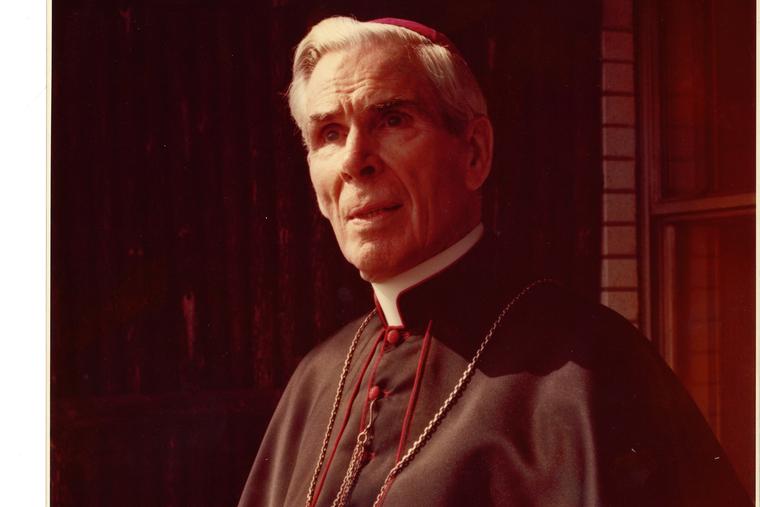
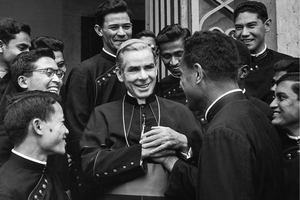
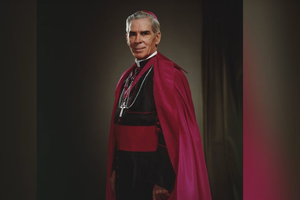
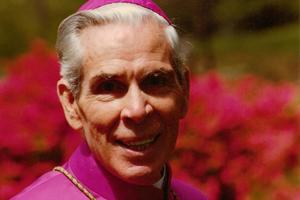
Venerable Archbishop Fulton J. Sheen (1895-1979) was one of the best-known Catholics of 20th-century America and the world. His preaching on radio and TV drew acclaim, and he also served as a bishop, first as an auxiliary of the Archdiocese of New York and then as bishop of Rochester, New York, from 1966 to 1969.
On July 6, 2019, Pope Francis approved a miracle attributed to Fulton Sheen’s intercession, paving the way for the venerable bishop to be beatified that Dec. 19. But a challenge put the beatification in a holding pattern — until now, as Sheen’s beatification is now able to move forward.
Pending the big day, here are 11 surprising, fascinating facts about Fulton J. Sheen.
1. The beatification miracle happened in his home diocese.
Bonnie and Travis Engstrom and their Sheen-named son James Fulton were the recipients of the miracle leading to Sheen’s forthcoming beatification. At the initial beatification announcement from Pope Francis, Bonnie said, “The Church is so big and we are so little in it, but to share in this really special moment is such a grace from God. It’s been a joy.”
The miracle happened on Sept. 16, 2010, at OSF St. Francis Medical Center, slightly less than a mile away from Peoria’s St. Mary of the Immaculate Conception Cathedral, where Sheen served as an altar server, was ordained to the priesthood and now where his earthly remains lie.
Stillborn at his home birth, James Fulton had been rushed to the hospital. His parents and their family and friends “immediately began offering prayers, begging Bishop Fulton Sheen to intercede for their newborn child,” noted the Peoria Diocese. As they prayed for the archbishop’s intercession to heal their newborn son, a medical team worked on the infant.
“Despite receiving the most advanced medical treatment available, the infant continued to show no signs of life,” the Peoria report added. There was no heartbeat.
The moment a doctor was going to pronounce the baby dead, “suddenly and without any medical explanation, the infant’s heart began to beat normally and the baby breathed normally.” All of this after being stillborn and showing no vital signs — for 61 minutes. Mother Bonnie has written about this miracle in her book 61 Minutes to a Miracle.
Even after the baby astounded the medical professionals by reviving, doctors told the parents they believed the baby had massive organ damage and would die soon or would be severely disabled. But within a few weeks, little James Fulton was home with his parents — and he continues to develop as a normal, growing, healthy child.
2. He was a media pioneer, with television and radio firsts.
Fulton Sheen is the first American beatified who hosted major television and radio programs. Sheen’s famous television series, Life Is Worth Living, launched in 1951, just months after he was consecrated a bishop. His magnetic personality and presentations quickly drew millions of viewers — an estimated 30 million each week; even Protestants and Jews tuned in — quickly making him a household name. Happy viewers sent in more than 8,000 letters a week to the station. People even liked his “corny joke style” that was usually at his own expense.
In short order, Sheen won an Emmy Award for “Most Outstanding Television Personality” in 1953, even besting celebrities like Lucille Ball. Accepting his award, with his signature humor, he said, “It is time I pay tribute to my four writers — Matthew, Mark, Luke and John.”
Sheen’s Life Is Worth Living show ran until 1957. He returned to television with a similar series, The Fulton Sheen Program, from 1961 to 1968. (Reruns of his shows are aired weekly on EWTN.)
Sheen was no stranger to the airwaves or to audiences before television. For 22 years, beginning in 1930, millions listened to him on his regular radio show, The Catholic Hour. Whether on television or radio, listeners were drawn to his themes of Christian morality and patriotism.
Unbeknownst to most, earlier as Msgr. Sheen, he appeared on the world’s first television broadcast of a Catholic religious service on Easter Sunday, March 24, 1940. The broadcast was an experimental predecessor to today’s NBC and sponsored by the National Council of Catholic Men, which also sponsored The Catholic Hour radio broadcast.
3. He was a Second Vatican Council attendee.
Bishop Sheen was a familiar face at the Second Vatican Council from 1962 to 1965. He was present at all the sessions and worked closely with the future Pope Benedict XVI, at the time theological expert Father Joseph Ratzinger.
4. He was a great Marian devotee.
The love for Mary was always present in Sheen’s life. He grew up praying the Rosary every night with his family. Among the few items he had on stage during his TV shows was the statue of Madonna and Child that he called “Our Lady of Television.” When made a bishop, Sheen chose as his motto “To Jesus through Mary.”
Among the dazzling treasury of 66 books he wrote — he was a prolific writer — Sheen called The World’s First Love: Mary, Mother of God, his favorite. Sheen, probably the greatest preacher in the 20th century, sheds beautiful light on Mary’s life and role.
In The World’s First Love, Bishop Sheen spurs us on to greater love for and trust in our Heavenly Queen, our Queen of Mercy, our Queen and Mother. She is never a monarch, only waving to her children-subjects from a balcony high above them. “It was the greatest of all honors to be the Mother of Christ; but it was also a great honor to be the Mother of Christians,” Sheen writes. “There was no room in the inn for that first birth; but Mary had the whole world for her second.”
Sheen called the popular Memorare from St. Bernard “the prayer to Mary as the Queen of Mercy. As Christ intercedes for us at the throne of his Father, so Mary intercedes for us to her Divine Son.”
His affection for the Mother of Jesus and the truth and beauty he found in her spilled over into his estimation of all women. On his many overseas trips, there was one place he particularly headed to: Lourdes. This shrine had a very special place in his heart, beginning when he was a young student in Europe.
5. He was a patriot.
In 1941, when the United States entered World War II, Sheen wrote the book A Declaration of Dependence.
“The Declaration of Independence, I repeat, is a Declaration of Dependence,” Sheen said. “We are independent of dictators because we are dependent on God. God is the necessary factor of our salvation. As a result, he is to be the center of our lives. His ways ought to permeate every aspect and area of our lives: education, employment, pleasure, mourning, socializing, etc. All is done in sight of the omnipotent Lord, and all we do should be done reflecting this knowledge. Our every interaction should be filled with the love of our Savior.”
6. He was a relentless foe of communism.
Sheen was an expert on communism, recognizing it as a serious threat to the United States and democracy and exposing its destructive errors.
In the last television show of his first season in 1953, he explained how communism was spreading, calling it “the scavenger of decaying civilizations” because it “makes its way into a country and into a culture only when that culture begins to rot from the inside. The proper way, then, to look upon communism is to see it is a judgment of God.”
7. As a priest, he was an extraordinary missioner.
In 1950, Sheen was appointed the national director of the Society for the Propagation of the Faith, now The Pontifical Mission Societies USA. For the next 16 years, until 1966, he raised millions of dollars for world missions. Viewers of his TV shows learned of the missions and contributed much to the society, to support missions, helping tens of millions of people worldwide. As a Marian devotee, not surprisingly, he also created the World Mission Rosary.
8. He was a convert-maker.
It is impossible to estimate how many people Sheen converted to the Catholic faith through his television and radio shows. Many would write to him, telling him that they converted to the Catholic Church or returned to it by something he said or did. He insisted that he never proselytized. Among the famous, and infamous, who became converts through Sheen’s instruction might not be household names today as they once were. But some famous names include congresswoman and ambassador Clare Boothe Luce, communist organizer Bella Dodd, violinist and composer Fritz Kreisler, and Hollywood actress Virginia Mayo. Through Sheen, they came to either convert or return to the Catholic faith.
9. He exhibited great generosity.
As fast as money flowed into his hands or arrived on his desk, out it would go to those in need. For example, when Sheen asked on his radio shows for dimes for the missions, thousands of dollars in change would arrive. Children even mailed pennies. When he began appearing on television, the donations increased — as well as the money he was able to give away.
One example: After he helped a couple in France, they kept in touch. When the wife died, she left Sheen more than $68,000. Most of it he gave to the Sisters of Mercy to build St. Martin de Porres Hospital, a maternity hospital for Black women in Mobile, Alabama. When the hospital was renovated and enlarged, Sheen raised and donated most of the $600,000 cost.
For years he sent his book royalties and speaker’s fees to Bishop Thomas Toolen to support Black communities in the Mobile-Birmingham Diocese. It was well known that every cent he got while speaking weekly to an estimated 4 million listeners on The Catholic Hour radio program was always turned over to the National Council of Catholic Men.
He never refused people who came up to him on the street asking him for money. There was no limit to his generosity, including to countless individuals like Paul Scott, a destitute leper. Sheen “took him into his care,” got him an apartment and invited him to dinner, sometimes twice a week. Paul eventually became a convert.
10. He was human, helpful and humorous.
Sheen worked 19 hours a day. Yet in a book written about her uncle Sheen, Joan Sheen Cunningham related how even as a child she remembered being “perfectly comfortable around my uncle because I also knew him to be a fun — and funny — person. He had a ready sense of humor and the most infectious belly laugh.”
He loved playing tennis and had a stationary bicycle in his apartment.
He was good-natured and patient, made friends wherever he went, and knew as many poor people as wealthy people, treating them all with the same respect.
Her uncle Sheen was drawn to simple, honest people, Sheen Cunningham recounted, but he also enjoyed getting together with his fellow TV stars Milton Berle and Jackie Gleason, both popular at the same time he was. They also loved spending time together and considered him very funny. Sheen valued good humor as a virtue. And he had a hearty laugh. He always said, “If you don’t have humor in your life, you’re lost.”
Most important, he taught his niece to be thankful: “Always appreciate all that God does for you, he said, ‘be they small things or big things. And always say, ‘God is good.’ Whether wonderful things happen, or difficulty arises, or sadness comes: God is good.’”
11. His daily Holy Hour shaped his priestly life.
On Dec. 9, 1979, Fulton Sheen died in his private New York chapel while making his daily Holy Hour in front of the Blessed Sacrament. Two months earlier, he had met Pope John Paul II in St. Patrick’s Cathedral. John Paul told him, “You have written and spoken well of the Lord Jesus. You are a loyal son of the Church!” Loyal, too, was Sheen’s keeping his Holy Hour that he started from the day of his priestly ordination and never missed. This was a final lesson for what he consistently preached. As he did, and said, “You will have to fight many battles, but you will win the war before the Blessed Sacrament.”