Austen, Dickens, Tolkien: The Films That Get the Classics Right
What movies are worthy of watching?
Editor’s Note: This story is part of literary special content. Find related stories here.
We usually know the answer before we ask the question, “Is it better than the book?” The answer, of course, is usually — but not always — an unequivocal “No.” And how could it? Movies are expensive business models; writing a novel is far less risky. A novel has the bandwidth to explore characters, their environment and situations. But a movie adaptation has the burden of being faithful not only to the source material, but to the imagery that was cultivated differently by readers with their own imaginations.
Cal State Northridge and UCLA film instructor and critic María Elena de las Carreras made two noteworthy points we must consider: “To assess the merits of a film adaptation, one should remember that the journey from the word to the image — two different aesthetic systems — is a form of interpretation. Key issues to consider are fidelity to the literary original and the transformations that take place in this process.”
The Register asked some Catholic movie buffs for their recommendations of quality film adaptations of classic reads.
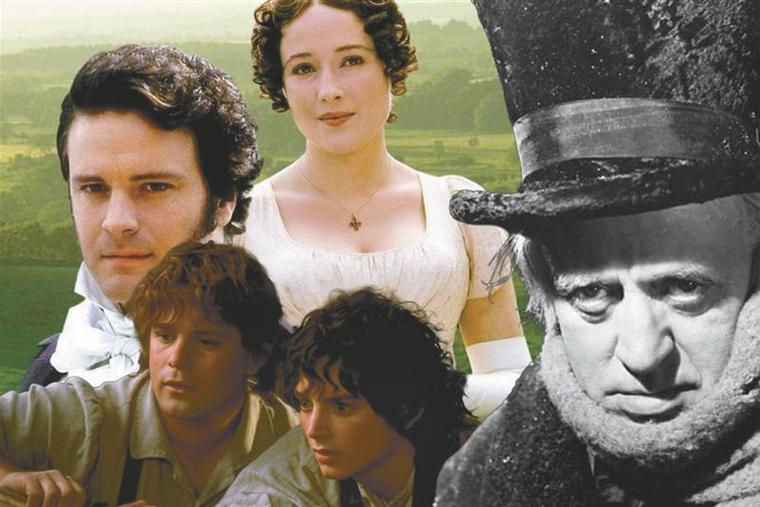
Catholic actress and producer Siobhan Hogan cited the 1995 six-episode miniseries of Jane Austen’s 1813 classic, Pride and Prejudice. Hogan cited the “amazing performance by Colin Firth, who is always top shelf.” Prolific screenwriter Andrew Davies adapted the Austen novel for television.
EWTN Director of Studio Operations Stephen Beaumont selected the 1951 film version of the 1843 Charles Dickens novella, A Christmas Carol. Beaumont noted the story “has probably had more screen adaptations than any other piece of literature,” but singled out this version particularly because of the performance of Alastair Sim. “Sim embodies the character of Scrooge perfectly, and the film strikes the right balance of drama and humor,” Beaumont added.
Father Peter Malone, author of the Lights, Camera, Faith book series, also selected the 1951 A Christmas Carol. “I have liked the black-and-white film versions of Dickens’ world, especially the world of exploitation in Oliver Twist,” Father Malone said. He is referring specifically to David Lean’s 1948 version of the 1837 Dickens classic. “Alec Guinness and Robert Newton are Fagin and Bill Sykes forever,” Father Malone added. He also could not help but mention the other Dickens adaptation by David Lean, Great Expectations, from 1946.
As for Jane Austen film versions, Father Malone recommended 1995’s Sense and Sensibility, directed by Ang Lee and adapted by Emma Thompson, who also co-starred.
Father Christopher Renz of the Dominican School of Philosophy and Theology and curator of the Biblical Movie Poster Collection cited three 19th-century novels that were later adapted into popular sword-and-sandal epics: Nicholas Patrick Wiseman’s Fabiola (1854), Lew Wallace’s Ben-Hur: A Tale of the Christ (1880), and Henryk Sienkiewicz’s Quo Vadis (1895-1896). Ben-Hur, of course, is one of Hollywood’s finest moments. Winner of 11 Academy Awards for 1959, including “Best Actor” for Charlton Heston, it was previously adapted twice during the silent era. Quo Vadis was adapted in 1951, but it also was filmed numerous times in the silent era. Cardinal Nicholas Wiseman’s Fabiola, a novel set during the Diocletian persecutions, has been made into a film on three occasions.
Finally, what of old J.R.R. Tolkien? Tolkien was fond of a term he coined, “eucatastrophe,” his definition for the part of the story that occurs just when all seemed lost, when catastrophe or doom loomed for our protagonists, our heroes. Just then, the tide would turn, hope would prevail, good would triumph over evil, and love would find a way. Gandalf says it himself in The Two Towers: “Be merry! We meet again at the turn of the tide. The great storm is coming, but the tide has turned.”
For that reason, I have selected The Two Towers in Tolkien’s The Lord of the Rings trilogy. The 2002 version by Peter Jackson is arguably the best-constructed film in his series. In his 2015 book The Soul’s Upward Yearning, Jesuit Father Robert Spitzer, EWTN TV host and president of the Magis Center, explains why certain mythical stories like Tolkien’s remain ever popular: “The objective of myths is to express ultimate truth and meaning, and in order to do this they must reach beyond the contingent barriers of this world and universe and reveal the source of ultimate truth and meaning — that is, ultimate reality.”
Tolkien considered the birth of Christ the moment of eucatastrophe in our imperfect, flawed and fallen world. A star pierced the darkness; a Savior was born in the unlikeliest of places. The Creator entered his creation. The tide turned forevermore.
“I enjoy this dynamism between text and screen because it reminds me of the Incarnation,” Father Renz said. “The Word-made-flesh is also the Word-made-visible. Illuminating words on the big screen reminds us Christians of our obligation to illuminate the Word on the screen of our life.”
- Keywords:
- classic literature