Characters of Hope: Well-Read Catholics Reflect on Inspirational Protagonists
Stories have a way of opening for readers new horizons of hope.
Editor’s Note: This story is part of literary special content. Find related stories here.
Stories have a way of opening for readers new horizons of hope. In a world so often hemmed in by the sorrowful, what a gift it is to be able to turn to literature that offers light, space to contemplate the good, and strength for our journey.
As we approach the conclusion of the Church’s Jubilee of Hope, the Register asked Catholics to share the most hopeful character they have encountered in literature.
Marcie Stokman, founder and president, Well-Read Mom
In Les Misérables, Victor Hugo’s famous prisoner, Jean Valjean, escapes from prison and, through an act of mercy by a holy bishop, undergoes a radical conversion. But what moves me most is not just that moment of grace, but how Valjean continues to live out his conversion.
Again and again, in painful circumstances, he chooses to forgive. He offers mercy. As I watched Valjean grow, in his person and his capacity to forgive and sacrifice, my own desire exploded. I realized that this is the most attractive way to live.
When Valjean returns to prison, I think of how often I find myself back in my own “prison” — old patterns of thought that harden my heart. Watching him move from a bitter prisoner to a man of mercy gives me courage and hope that this kind of conversion is possible for me, too.
Sally Read, writer and poet
The character that for me embodies hope in literature is Alyosha from Dostoevsky’s The Brothers Karamazov. It’s rare to find such goodness in a character that doesn’t stray into sentimentality. He seems to embody charity — the supernatural ability, and willingness, to see the good in people. Only Alyosha could make the ending of such a book a (tearfully) happy one!
James Matthew Wilson, director, MFA program in creative writing, University of St. Thomas-Houston
It seems to me that there can only be one correct answer to this question. Dante, the hero of his poem, The Divine Comedy, is necessarily the most hopeful character in the history of literature. He was lost in the woods of sin, but through the grace of God and the intercession of the Blessed Virgin Mary, St. Lucy, and his lost love Beatrice, he is privileged to be guided by Virgil through hell and purgatory all the way to the highest heaven. There, he sees the face of God. Along the way, Dante transforms the classical epic with its tragic tenor into a true comedy, a tale that starts out sad but ends in a state of hope.
Msgr. Stuart Swetland, president, Donnelly College
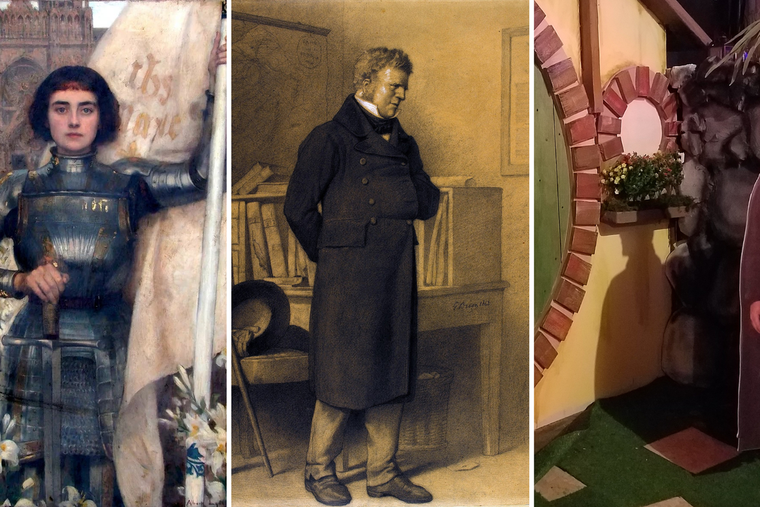
St. Joan of Arc, as depicted by Mark Twain in Personal Recollections of Joan of Arc, is the embodiment of perseverance and the belief that innocence and fidelity to God’s will for one’s life can overcome worldliness, corruption and materialism. Joan’s love of God and simple devotion to his will demonstrates the truth of Romans 8:28: “We know that all things work together for good for those who love God and are called according to his purpose.”
Sophie Caldecott, creative director, Verily magazine
I think that Gerda in Hans Christian Andersen’s fairy tale The Snow Queen is such a beautiful embodiment of hope. She sets off alone without any special preparation or provisions to find her best friend, Kay, who unbeknownst to her has been kidnapped by the Snow Queen. At every turn of the adventure, she never loses hope, but keeps taking each next step as it becomes clear to her. In one incredibly moving scene towards the end of the story, she prays the Lord’s Prayer when beset by the Snow Queen’s henchmen, and her breath turns into angels who defend her and clear her path. I come back to her story again and again when I feel overwhelmed and unclear of the bigger picture, because she reminds me that hope doesn’t need to be able to see the whole path in order to take the next brave step.
Dale Ahlquist, Society of G.K. Chesterton president
Innocent Smith in G.K. Chesterton’s novel Manalive is not only one of the best-named characters in 20th-century literature, he’s one of the best characters. His irrepressible sense of wonder affects everyone around him. Their lives change. They are awakened out of dead-end existences. And then their newfound hope is put to the test in an incomparable climax.
Joseph Pearce, author, publisher and editor
Samwise Gamgee epitomizes the virtue of hope. In one of the darkest moments in The Lord of the Rings, when Sam believes Frodo to be dead and when he has himself come to “a dead end” and all seems lost, he sings a song in which he proclaims that “above all shadows rides the sun.”
Instead of surrendering to suicidal despair, he raises his heart to the heavens and knows that there is a light above all darkness and beyond the reach of any shadow of evil. In his darkest of moments, Sam is doing what we are all called to do in such moments: He looks up.
Holly Ordway, author of Tolkien’s Faith: A Spiritual Biography
For me, the most powerful example of hope is Sam Gamgee, the humble hobbit in J.R.R. Tolkien’s The Lord of the Rings, who accompanies Frodo Baggins on the quest to destroy the One Ring.
Near the end of their terrible journey, Sam realizes that they have just enough provisions to get to Mount Doom, but not to make the long return trip through the desert. He swiftly realizes the implications: “So that was the job I felt I had to do when I started ... to help Mr. Frodo to the last step and then die with him? Well, if that is the job, then I must do it.” Sam is saddened to realize (as he thinks) that he will never again see his home and loved ones, but “even as hope died in Sam, or seemed to die, it was turned to a new strength,” a strength that he uses to help Frodo, who is at the point of collapse, to fulfill his mission and save Middle-earth. Sam demonstrates an essential quality of the virtue of hope: that it is not just an optimistic feeling or confidence in the future, but a deep-rooted sense that we should keep on doing the right thing, even if it seems futile or unseen, because what we choose to do matters.
Trappist monk Brother Alberic Henry, Abbey of Gethsemani
The most hopeful character I’ve encountered in literature is Samwise Gamgee from The Lord of the Rings. No matter how bad things get, no matter how dark the world becomes, Sam never gives in to despair; he never loses hope.
Bernardo Aparicio, publisher, Dappled Things
The character known simply as “the boy” in Cormac McCarthy’s The Road has stuck with me long after reading that brief but powerful novel.
In a post-apocalyptic world that is relentlessly dark, the boy represents a last spark of innocence that endures in an otherwise hellish landscape. The goodness he carries within seems a frail thing in a world of cannibals, criminals and calculation, yet it is powerful enough to keep his father human at a crucial turn in the story. Aside from The Lord of the Rings, if through an almost opposite approach, no novel has ever made it so clear to me what a precious and powerful thing goodness is — especially when the world seems overwhelmed by darkness.
Jessica Hooten-Wilson, Fletcher Jones Chair of Great Books at Pepperdine
Dana Franklin from Octavia Butler’s Kindred is my choice. Dana unvolitionally travels back into the antebellum South to save a white boy whose parents own a plantation with slaves. But the boy and his slaves are her ancestors. She must save the man she hates, who owned and raped her great-grandmother, or she herself would never be born. Such a frightening way of confronting the past should haunt us all and yet reminds us with a thick assurance that God proffers hope through evil, pain and suffering. There is no sin that Jesus cannot redeem, and there is no past that he is not King of — therein lies the implicit hope of the novel.
Sister Fidelity Grace, Sisters of Life
Victor Hugo’s Les Misérables stunningly portrays the power of hope that transforms misery into beauty. Though reduced to convict #24601 during his prison sentence, Jean Valjean’s release allows for a journey of hope and discovery of his true identity. A compassionate bishop sees beyond Valjean’s theft and extends an olive branch: “Jean Valjean, my brother, you no longer belong to evil, but to good. It is your soul I am buying. I give it to God!”
Hope received becomes hope given, when Valjean pledges to care for the daughter of a dying woman, awakening in him the delight of fatherhood. And when the life of the police chief — who relentlessly chased Valjean down through the years — is in his hands, he chooses mercy. Every heart is capable of change from despair and vengeance to joy and sacrificial love. “Even the darkest night will end and the sun will rise!”
Haley Stewart, editor of Word on Fire Votive
The most hopeful character might be Anne Shirley from L.M. Montgomery’s Anne of Green Gables.
Anne Shirley has always been the exemplar of hope that has shaped my understanding of this virtue. Despite her many sorrows, she maintains a defiant belief in the existence of goodness and beauty, which allows her to see the world through a lens of awe and wonder. The persistence of her hope motivates her to bring goodness and beauty with her wherever she goes, transforming even bleak places and bitter people into new creations.
READ AND SHARE
Of course, there are many more characters that could be discussed! Readers are encouraged to share their most hopeful characters in literature in the comments online or in letters to the editor. The Register invites you to pick up a book and pilgrimage with a hopeful character.
- Keywords:
- classic literature
- 2025 jubilee
- christian hope