7 Steps to a Deeper Understanding of St. Patrick
St. Patrick's Day is the perfect opportunity for Catholics to deepen our understanding of the Apostle of Ireland.
Many of the traditions associated with St. Patrick are well known. His capture and enslavement in Ireland as a youth of 16 years, herding animals on Slemish mountain in County Antrim, the legend of the snakes banished, the fire on Tara Hill, and the use of the shamrock in teaching the Irish people about the Trinity.
Two texts are known to have been written by Patrick himself. His Confessio is his autobiography, written in defense of his missionary work in Ireland in response to his accusers in England, who, he says, considered him “worthless.”
By examining his authentic words and the enduring traditions he left behind, we find a saint whose fifth-century faith remains extremely relevant. Here are seven ways to deepen your understanding of the Apostle of Ireland.
1. Letter to Coroticus on Slavery and Trafficking
St. Patrick’s lesser-known piece of writing is his “Letter to Coroticus,” addressed to Coroticus, a Roman commander in Britain. The letter is a stern rebuke because of the “evil-minded” Coroticus’ slavery and human trafficking, a timeless message so relevant today.
Patrick writes:
I have written and put together these words to be given and handed on and sent to the soldiers of Coroticus. I cannot say that they are my fellow-citizens, nor fellow-citizens of the saints of Rome, but fellow-citizens of demons, because of their evil works. By their hostile ways, they live in death, allies of the apostate Scots and Picts. They are blood-stained: blood-stained with the blood of innocent Christians.
The rebuke is unrelenting in its criticism and calls for repentance.
Anyone who believes will be saved; anyone who does not believe will be condemned – God has spoken. … However late it may be, may they repent of acting so wrongly, the murder of the brethren of the Lord, and set free the baptized women prisoners whom they previously seized.
2. The Lorica
The prayer most commonly associated with St. Patrick is the Lorica. A Lorica is a hymn or rhythmical prayer recited as spiritual armor and divine protection. Also known as “St. Patrick’s Breastplate” and sometimes “The Deer’s Cry,” this is one of the most impressive and oldest such prayers and is among the most spiritual in tone in this genre.
Among the known loricae, there are common themes, but Patrick's fourth and fifth stanzas have unique characteristics, particularly within the context of early Irish monasticism.
One stanza clearly reflects a time when paganism was a formidable foe for Patrick:
I summon today all these powers between me and evil, Against every cruel, merciless power that opposes my body and soul, Against incantations of false prophets, Against black laws of paganism, Against false laws of heretics, Against encompassment of idolatry, Against spells of women and smiths and druids, Against every knowledge that is forbidden the human soul.
3. St. Patrick’s 28 Days in the Wilderness
St. Patrick spent 28 days in the wilderness after his escape from slavery and voyage from Ireland. He escaped on a boat to which our Lord directed him and landed in what is believed to be Gaul or modern-day France. There, in his Confessio, he describes wandering in the desert for 28 days with his seafaring companions.
There are strong parallels with Jesus’s 40 days in the desert. The sailors with whom he left Ireland appealed to Patrick for help as they had no food and were gradually weakening. The only food they could find was wild honey, which Patrick, although starving, refused to eat because it had been used in a pagan sacrifice.
Eventually, after a night under heavy assault from Satan, Patrick called out to Christ to help them be released from their wandering, and his prayers were answered. In his Confessio, the word helio is used, meaning ‘sun,’ but it is thought to be a mistranslation of Kyrie Eleison.
4. The Thread Linking St. Patrick, Dante, Hamlet and Oscar Winner Jessie Buckley
The ancient pilgrimage site on Lough Derg in County Donegal, Ireland, is known as St. Patrick’s Purgatory. On that island, it is said that, in a cave, an entrance to Purgatory was revealed to Patrick as a means to help him evangelize the local people. In the 12th century, the legend featured in a Latin text written by a monk called Henry of Saltrey, entitled Treatise on St. Patrick's Purgatory, and was widely circulated across Europe. The monk had learned of Lough Derg from a knight called Owen who had been on a pilgrimage there.
The description of Purgatory at Lough Derg is said to have influenced Dante’s Inferno. It is also mentioned by Geraldus Cambrensis in his Topography of Ireland.
Gerald of Wales writes:
There is a lake in Ulster which contains an island divided into two parts. One part contains a very beautiful church with a great reputation for holiness, and is well worth seeing. ... But the other part of the island is stony and ugly and is abandoned to the use of evil spirits only. It is nearly always the scene of gatherings and processions of evil spirits, plain to be seen by all.
St. Patrick’s Purgatory on Station Island is referenced in Shakespeare's Hamlet in the Ghost’s description of his purgatorial punishment (“Doomed for a certain term to walk the night / And for the day confined to fast in fires”) and through Hamlet’s invocation of St. Patrick in Act 1, Scene 5. Shakespeare would have been fully aware of St. Patrick through descriptions in Holinsheds’ Chronicles. The theme of the Ghost in purgatory suffering in Hamlet continues powerfully in the 2026 Shakespeare-themed movie, Hamnet, starring Irish convent-educated Oscar-winning actress Jessie Buckley.
5. St. Patrick’s Love of the Holy Trinity
Patrick is traditionally associated with teaching the mystery of the Trinity, symbolized by the shamrock. This devotion highlights faith in God the Father, the Son and the Holy Spirit, and the symbolism of the shamrock was said to have made the Trinity accessible to newly converted Irish communities.
It is a strong theme in the Confessio where Patrick writes:
And so it is proper that according to the rule of faith in the Trinity, I should define doctrine, and make known the gift of God and everlasting consolation, without being held back by danger, and spread everywhere the name of God without fear, confidently; so that even after my decease I may leave a legacy to my brethren and sons whom I baptized in the Lord, many thousands of persons.
It is also strongly referenced in the Lorica in the final verse:
I arise today
Through a mighty strength, the invocation of the Trinity
Through a belief in the Threeness
Through a confession of the Oneness
Of the Creator of creation.
6. Devotion to the Holy Name of Jesus
Patrick’s writings also repeatedly emphasize the power of Christ’s name. The Lorica or Breastplate constantly invokes Christ as his shield and protector:
Christ, shield me today
Against poison, against burning,
Against drowning, against wounding,
So that reward may come to me in abundance.
Christ with me, Christ before me, Christ behind me,
Christ in me, Christ beneath me, Christ above me,
Christ on my right, Christ on my left,
Christ when I lie down, Christ when I sit down,
Christ in the heart of every man who thinks of me,
Christ in the mouth of every man who speaks of me,
Christ in the eye that sees me,
Christ in the ear that hears me.
This reflects a devotion to calling upon the name of Jesus in daily life. He recounts how he prayed 100 times a day and 100 more at night. His practice of praying 100 Our Fathers is commemorated at dawn on St. Patrick’s Day at his grave, where the faithful recite the Lord's Prayer 100 times.
7. St. Patrick’s Hidden Years in Captivity Explored in New Docudrama
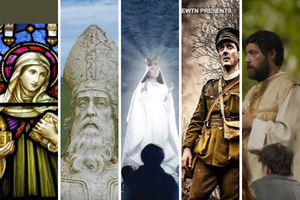
Saint Patrick, The Hidden Years is an original EWTN docudrama from award-winning Irish director Campbell Millar. His previous works for EWTN have included films focusing on Knock Shrine, Father Willie Doyle and the Catholic faith in Ireland in penal times. Hope and Faith of Our Fathers both won prestigious Gabriel Awards. His new production airs globally on St. Patrick’s Day in a primetime slot at 8:00 p.m. for U.S. viewers.
- Keywords:
- church in ireland
- st. patrick's day
- st. patrick