‘Someone Call a Priest’: Sacraments at Time of Crisis Are Not Administered as Often as They Used to Be
The Register contacted pastors across the country asking the question whether emergency personnel call them to life-threatening situations. For the most part, the answer is No.
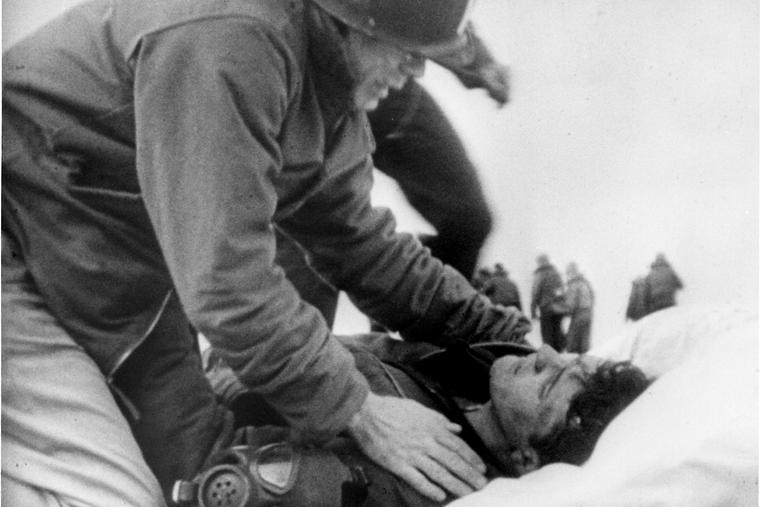
When a multi-ton pile of clay covered a steam-shovel fireman in Cambridge, Massachusetts, in early December 1952, a 40-year-old Catholic priest had himself lowered upside down into a hole workers had dug to try to save the man.
“Only the tips of the priest’s heels were visible as his murmured prayers were heard above,” The Boston Globe reported the next day. Only a portion of the man’s leg was visible when the priest first got near him, and by the time workers freed the rest of Elpidio Baia, a 55-year-old father of three, the accident victim had died. But Father John Tierney’s efforts to bring him the last rites of the Church are an example of what used to be common — police and firefighters calling a priest to an accident so he can administer sacraments to the critically injured.
Priests still frequently offer confession, Eucharist and anointing of the sick at hospitals, of course, but not so much at the scenes of accidents. The words “priest called to the scene” and similar phrases appeared in many news stories in the United States during the last century until the late 1960s, when they started tapering off, according to searches of online databases conducted by the Register.
It’s not common anymore.
“In my 40 years, I’ve probably been called to only two accidents,” said Father Richard Roberge, 68, pastor of Christ the King Parish in Concord, New Hampshire, who was ordained in 1985. In both cases, he said, the police officers were Catholics who knew the victims and knew that they were Catholics.
The Register contacted pastors from various parts of the United States asking the question whether emergency personnel call them to life-threatening situations.
For the most part, the answer is No.
Father Gerard Braun, pastor of St. Anthony of Padua Catholic Church in Fargo, North Dakota, said he can recall only two requests from local police, both to notify a family of death, in his four-plus years at the parish, including more than two years as a police chaplain.
“From experience, this is a rare request,” Father Braun, 67, who was ordained in 1985, said by email. Father Scott Bailey, pastor of Risen Christ Catholic Parish in Denver for the past seven years and a priest for 12 years, told the Register he has never received a call from emergency personnel to come to the scene of an accident.
“I would guess that most of us priests who live in metro areas have the same experience. I don’t think that we are called to the scene of an accident very often, if at all,” Father Bailey told the Register by email. “It’s more likely that we are called to the hospital shortly after the patient arrives or after they get out of emergency surgery.”
Father Christopher Walsh, pastor of St. Cecilia Church in Philadelphia, told the Register that in his 26 years as a priest, police have called him to a scene only twice.
“Once was an accident that took place in front of the church, where a man was killed, and the other was to a home after a suicide,” Father Walsh said by email. “Both took place more than 20 years ago.”
Father Roberge doesn’t blame the police, but instead notes changes in America, where communities are more transient, more diverse and less attached to religion than before.
“Not everybody knows the culture of Catholics and Catholic priests,” Father Roberge told the Register by telephone.
“Younger people I don’t think have a full grasp of the sacrament,” he said.
Anointing of the sick, as the sacrament formerly known as extreme unction has been called since St. Paul VI promulgated the Second Vatican Council document Sacrosanctum Concilium in 1963, is the seventh of the seven sacraments of the Catholic Church.
It has roots in the Letter of St. James in the New Testament: “Is anyone among you sick? He should summon the presbyters of the church, and they should pray over him and anoint [him] with oil in the name of the Lord, and the prayer of faith will save the sick person, and the Lord will raise him up. If he has committed any sins, he will be forgiven” (James 5:14-15).
The priest lays hands on the sick person “in silence” and prays over the person “in the faith of the Church,” according to the Catechism of the Catholic Church (1519), and then he anoints the person “with oil blessed, if possible, by the bishop.”
The Catechism says the sacrament is “a gift of the Holy Spirit” that gives “strengthening, peace and courage” for those who are seriously ill or suffering “the frailty of old age” (1520). While it serves as a “preparation for the final journey,” it also “is meant to lead the sick person to healing of the soul, but also of the body if such is God’s will.”
In generations past, many Catholics were so concerned about receiving the final sacrament that they made provisions for it long ahead of time.
“In the past it was common for people to wear bracelets or pendants with instructions to call a priest in the event of an emergency,” said Father Greg Mathias, pastor of St. Mary’s Parish in Mansfield, Massachusetts, who was ordained in 1991.
He noted that some people put stickers on their dashboard with instructions to call a priest if the car were in an accident, he said.
But that’s rare nowadays.
“I do not think that this consciousness is anywhere near what it was at one time,” Father Mathias told the Register by email.
Father Mathias also pointed out another problem: a shortage of priests.
When Father Tierney (1911-1986) went to the scene of the claypit avalanche in 1952, he was one of five priests stationed at St. Peter’s Church in Cambridge. More than 70 years later, that same church now has only one priest — the pastor.
That means even if someone calls a priest to an accident, he’s less likely to make it there.
Phil Reeves, a lay Catholic patrol chaplain for the Los Angeles County Sheriff’s Department in California, told the Register he sometimes calls a priest to death scenes, “but I’ve rarely found one available to respond expeditiously (if at all, frankly).”
But it’s also the case that accident victims and their families don’t ask as often as they once did.
“As you might imagine, when folks are in shock, it’s not the best time to explain how anointing of the sick (formerly last rites) works,” said Reeves, 72, who retired from the Irwindale Police Department as a sergeant, by email. “Interestingly, many Catholics don’t know. Too much for them to take in. In those situations, I’m not infrequently asked to bless the body even after I make clear I am not ordained.”
Priests do still show up at accident scenes, but nowadays it tends to happen when they come upon one while driving — such as the “angel priest” who drew national headlines when he mysteriously showed up at a near-fatal car accident in rural Missouri in August 2013, as the Register reported at the time.
A 2007 vocations video produced for the U.S. Conference of Catholic Bishops re-creates a crash scene in which a priest caught in an accident backup grabs his prayer book and holy oil and races to a mortally injured victim, anointing him before he dies.
But those occasions don’t require a telephone call from authorities, which is much rarer than it used to be.
Police and firefighters in western Washington state, for instance, generally don’t call priests to the scenes of accidents, said Joe Cotton, a Catholic lay chaplain with the Washington State Patrol, which is the state police.
“I think there was a time when the Catholic Church was more involved in the secular world, and I think it probably was more common,” Cotton told the Register. “But I just don’t think that’s the reality that we have anymore.”
“I think the average police officer or firefighter wouldn’t think about calling a priest. Someone would have to ask them. And even then, they wouldn’t necessarily know how to make that happen,” he said.
But a lay Catholic chaplain might.
In March 2025, Cotton went to the home of a family whose unlicensed 14-year-old boy took his parents’ car on a late-night joy ride and crashed it on a highway, killing him. In the course of speaking with the parents, Cotton learned that they are Catholics, and he contacted their pastor, who within a half-hour was at their home offering them spiritual care.
Cotton knew how to reach the pastor because he is also executive director of the Office of the Vicar General of the Archdiocese of Seattle. In that capacity, he recently founded First Responder Ministry, which aims to support police and fire chaplains as well as emergency responders.
Among other things, he hopes that more Catholic priests volunteer as police and fire chaplains and that the connection between emergency responders and priests becomes stronger — which may lead to more priests offering anointings at the scenes of accidents.
“I think it can make sacramental care in the immediate aftermath of these incidences more possible,” Cotton said.
Several companies sell cards and medals that identify the wearer as a Catholic and ask the reader in the event of an emergency to call a priest, including items available through EWTN Religious Catalogue.
And if you’re on the road, you might still see a priest at the ready — as Father John Killackey, of the Priestly Fraternity of St. Peter, was in 2020 in pouring rain. As the Register reported, the image of the lone young priest in a cassock in a downpour amid a horrific wreck on a Pennsylvania interstate went viral. Father Killackey gave the last rites to a truck driver.
“It was definitely an emotional moment,” Father Killackey told the Register. “They taught us at seminary to memorize the forms of the last rites and apostolic blessing for moments like this, but I was glad for a little card I had in my wallet that had them written out, since my memory would have faltered. I used the oil of the sick that I had with me to make the Sign of the Cross and pronounce the form. I was just trying to do my part right and get out of the way so that the EMTs, police and firefighters who had responded so quickly could do their good work. It was a moment I will never forget.”
He added: “A priest is ordained to bring Christ to people in those solemn moments. I’m sure any priest in my situation would have done the same thing.”