Priest’s Dad Rides Shotgun on Last Rites Calls
Michigan pastor and his father go to emergency requests for sacraments in a pickup truck.
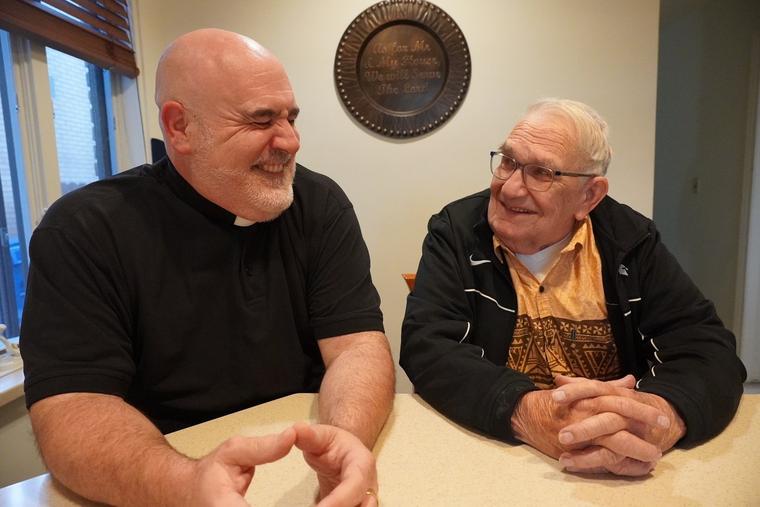
A few years after Father Joe Krupp’s mother died in 2015, the priest got an idea: Why not have Dad move in?
The four-bedroom rectory at Church of the Holy Family in Grand Blanc, Michigan, built in the early 1960s, a time of plentiful vocations, is too big for the two priests who use it now. A first-floor room was available, so Gordon Krupp, a retired pipefitter who is now 89, wouldn’t have to use the stairs.
Gordon, who raised his family in Montrose, about 25 miles northwest of Grand Blanc, left his house for the rectory.
The very day Gordon moved in, around 2019, a middle-of-the-night urgent call for sacraments came in. Father Joe got up to respond to it.
“We had an emergency line back then,” Father Joe told the Register, saying of his father, “He heard it, and it was early in the morning, like 3 or 4, and came out.”
“He was outside his door with his Sudoku and his rosary.”
Why?
“It wasn’t really an idea. It just kind of happened, I guess,” Gordon said.
It’s been like that ever since.
Like many priests, Father Joe, 55, often drives to hospitals, nursing homes and houses to administer the last rites of the Church, which may include confession and Communion but always include the anointing of the sick, formerly called extreme unction.
The sacrament, described in James 5:14-15, is “a gift of the Holy Spirit” that gives “strengthening, peace and courage” for those who are seriously ill or suffering “the frailty of old age,” according to the Catechism of the Catholic Church (1520). While it serves as a “preparation for the final journey,” it also “is meant to lead the sick person to healing of the soul, but also of the body if such is God’s will.”
Father Joe oversees two parishes as pastor — Holy Family and somewhat-nearby St. Mark Evangelist — and he also runs Joe In Black Ministries, which includes a YouTube channel and a podcast, with a significant following.
Calls for anointing of the sick from the two parishes average about three to five a week, Father Joe told the Register, though they tend to come in spurts. Almost every time he has gone on a call during the past half-dozen years or so, Father Joe said, his father has gone along.
They ride together in a pickup truck. Sometimes it’s Father Joe’s black 2022 Chevy Silverado half-ton; sometimes it’s Gordon’s metallic-gray-blue 2012 Chevy Silverado half-ton, which the two men work on together during down time. (They have plans to drop a new 5.3-liter, eight-cylinder (a “V8”) engine in it, with the help of a parishioner.)
On the way, they pray for the person — whose name might, let’s say, be John:
“Lord Jesus, send your Holy Spirit ahead of us. Be with John. Please keep him alive till we get there and help us to be effective ministers of your love and peace and mercy.”
“So we always pray that, and then we list all of Dad’s kids, and we pray for them by name,” Father Joe said.
When Father Joe says “all” of his father’s kids, he means his parents’ six biological children (he’s the youngest), plus six other children his mother and father took in on a permanent basis.
Even that number doesn’t include the 38 other children the Krupps took in for a while.
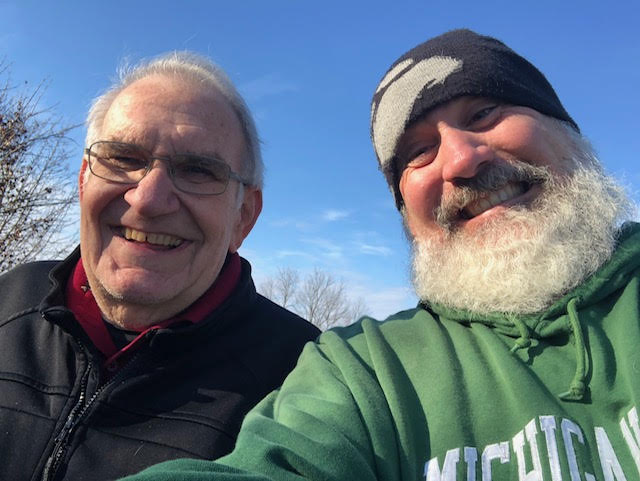
One of the many young people who once lived in the Krupp home is Jesse Ortega, 67, a retired engineer who worked for General Motors. He was a 19-year-old sophomore at the University of California, Berkeley in 1978 when he met the Krupp family at a Fourth of July cookout while he was working an internship at GM in Flint, Michigan. They insisted that he stay with them, which he did for the next couple of summers while working for the automaker.
The bond is so close that Ortega and Father Joe call each other brothers. In his retirement, Ortega spends every Wednesday morning with Gordon, who has an interest in alternative energy. The two of them have set up a small solar panel and a small windmill to charge a 12-volt car battery that provides electricity for, among other things, LED light strips for cabinets in a parish garage.
Ortega has gotten to see Father Joe and his dad interact during the last several years.
“For me, what’s been the best part is how good this has been for both of them,” Ortega said. “Having Gordie there with him, I’ve seen that really liven up Joe.”
“The Catholic Church to me is a communal Church. We’re meant to live in communities,” Ortega said. “But sometimes we take our priests, and they’re alone. We’re not meant to be alone. I wish we could find a way to have priests in communities.”
Cure for Loneliness
The two parishes in the Diocese of Lansing that Father Joe leads are in Grand Blanc, which is about 60 miles northwest of Detroit and about 7 miles southeast of Flint. Father Joe is dean of 11 parishes in his area.
While he currently has a parochial vicar living in the rectory, Father Joe at times lived alone.
More than 40% of priests ordained since 2000 show signs of loneliness, according to a survey released Oct. 14 by The Catholic Project at The Catholic University of America. “Loneliness is like a cancer that is killing the spirit I once had,” one respondent told researchers.
Father Joe’s current active relationship with his father has led him to reflect on the difficulties of celibacy and how they change over time.
“When I was younger, it was like, ‘Jesus help’ — you know, just behave. And as you get older, I think I realized it’s the companionship. It’s the constancy. It’s the ‘This person has seen me at my worst and my best, and they still love me.’ And Dad gives that gift to me, you know what I mean?” Father Joe said.
Then he added: “He has to. That’s why he’s paid the big bucks.”
Father Joe sees his father’s presence as providing companionship in his middle age while also giving him an opportunity to look after his father and do things for him, even if it’s just making coffee for him in the morning.
“And it’s funny; he’ll say, you know, ‘Thank you, you don’t need to do that.’ And I’m like, ‘Yeah, I really do,’” Father Joe said.
Man of Numbers, Not Words
On sacrament calls with his son, Gordon doesn’t go in, but instead stays in the truck. He doesn’t like talking to people he doesn’t know, but enjoys praying for them, even in the middle of the night. He also doesn’t mind long car rides — some of Father Joe’s emergency calls for sacraments take an hour or more.
Gordon prays the Rosary in the truck. After he finishes, he plays Sudoku, the number-placement puzzle that requires logic and manipulation of figures.
Asked if he is good at Sudoku, he said: “Not very; persistent, though.”
Meanwhile, his son sitting next to him during a Google Meet online video call, silently contradicted him by nodding up and down a “Yes” answer to the question.
“Dude can do crazy math in his head. Wow,” Father Joe said. “I mean, insane math in his head.”
As kids, Father Joe said, he and his siblings would give their father double-digit multiplication problems, and he’d immediately answer them correctly.
As for riding along on sacrament calls, Father Joe’s dad makes light of his efforts.
“I don’t know if I really accomplish anything. I just sit there. His hospital calls, when he goes, are relatively short. You know, he goes, and he’s out usually in less than a half an hour. And so it’s no big strain or anything,” Gordon said.
Gordon describes the experience in simple terms.
“It’s nice just to go and be there,” he said. “Sometimes Joe is a little bit upset when he comes back or something like that. We talk.”
Father Joe considers his father a mental lifeline for himself, even as the priest offers a spiritual lifeline to the dying.
The priest describes himself as “an emotional person.” Some of the sacrament calls bother him, including an occasional car accident with traumatic injuries and lots of blood.
“And I mean, not that I freak out, but I feel things deeply,” Father Joe said. “And he’s a real stabilizer. My sister said — I love this — she said, ‘Dad’s our North Star.’ This is the direction.”
“He’s a calming presence,” he added. “I don’t feel alone all the time, you know?”
- Keywords:
- catholic priesthood
- sacramental life
- anointing of the sick
- last rites
- priest administers last rites
- fathers and sons