Scott and Jeremiah Hahn: Like Father, Like … Father
Called by his heavenly Father and inspired and encouraged by his earthly one, Father Jeremiah Hahn expresses sincere appreciation for his calling.
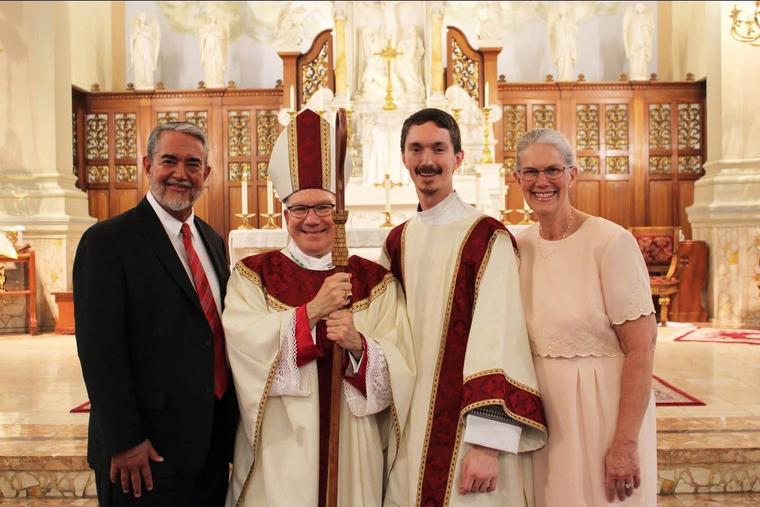
Like many Catholic boys, Jeremiah Hahn considered becoming a priest. At an early age, the devoted altar server “first sensed an inkling” toward priesthood, even attending a meeting to learn more and affirm his future vocation.
This inclination was at least in part influenced by his father, well-known Catholic theologian and scholar Scott Hahn, a former Presbyterian minister who converted to Catholicism and entered the Church at the Easter vigil in 1986.
Scott, 68, holds the Father Michael Scanlan, T.O.R., Chair of Biblical Theology and the New Evangelization at Franciscan University of Steubenville in Ohio, where he has taught since 1990.
A well-known program host on EWTN, he also is the founder and president of the St. Paul Center for Biblical Theology. Scott speaks often nationally and internationally — both in person and on radio and television — on various topics regarding Scripture and the Catholic faith.
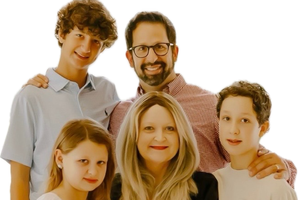
Scott married his wife Kimberly, also a Catholic convert, in 1979. They have six children (five sons and a daughter) and 23 grandchildren.
According to Jeremiah, his father’s teaching and public speaking were impactful and helpful influences on him growing up.
“Across high school and college, as I became more attracted to girls, my interest in the priesthood faded,” he said. “I thought I wanted to be a teacher like my dad, to have a wife and kids like my dad.”
Jeremiah dated, eventually fell in love and hoped to marry. But those plans began to change while he attended Mass one December.
“I heard a voice that said I should be a priest,” he recalled. “I didn’t want that anymore, so I pushed that voice down.”
But it didn’t stay quiet for long.
“At Mass in January, it came back,” Father Hahn said. “I found a desire welling up in me to do the things a priest does: to preach, offer Mass and hear confessions.” Father Hahn said he felt this call to the priesthood was diocesan-centered because the bishop was having the Mass. He recalled that the Gospel that day talked of Jesus sending the disciples out to preach the Kingdom and saying, “The harvest is abundant but the laborers few.”
“Again I heard, ‘I want you to be a priest,’ and again I resisted,” he said. “There was this girl and I wanted to marry her, but the voice kept resonating.”
Scott offered that becoming a father was the most transformative experience of his life.
“All six times, God blessed our marriage; and as I became a father, I began to pray more intensely. You learn to pray in ways you never thought you would need to. When you have children, you’re not working for yourself anymore. The family pulls you out of yourself, revealing those selfish tendencies you covered for years.”
‘Domestic Church’
Scott noted that Vatican II taught the Catholic Church is the Family of God, just as every Catholic family is a “domestic church” or ecclesia domestica (Lumen Gentium, 11; Catechism of the Catholic Church, 1656). His family also gathered each morning for Scripture reading and prayer and then a family rosary after dinner. It was also their daily practice to gather in what they called a “family huddle” for his fatherly blessing.
Scott was once quoted as saying to his kids that he was not just raising children, but also raising up brothers and sisters and calling himself a “rung in the ladder they must climb in order to reach the one true Father of us all.”
“But we never put an ounce of pressure on our five sons to enter the priesthood,” he said. “All five looked into it and prayed about it to discern the direction of their lives.”
While Jeremiah wrestled with his decision, the woman he considered marrying also came to a crossroads. While on a mission trip to Jamaica, the bishop asked if she felt a calling to a religious vocation. Her response was similar to Jeremiah’s: “See, there’s this guy.”
When she returned, she and Jeremiah had a conversation about their recent experiences.
“I asked, ‘Should we break up?’” he said. “She replied, ‘Yes.’ Today, she is happily married.”
Jeremiah, now 33, was ordained May 21, 2021, for the Steubenville Diocese in Ohio. He currently serves as parochial vicar for St. Paul parish in Athens, which includes the Catholic community of Ohio University students, whom he serves as assistant chaplain.
For Scott, who has written more than 40 books on theology and apologetics — including Many Are Called: Rediscovering the Glory of the Priesthood — his son’s ordination was a profound experience.
As his son prepared for his ordination, Scott shared his feelings about his chosen vocation during a priest conference at the St. Paul Center:
“This month, May of 2021, I am watching my son Jeremiah become a priest. … The marvel is in this very moment. I held him when he was born. I walked with him when he was teething. I walked with him through adolescence.
“Yet nothing I’ve witnessed in his life can equal the marvel God will work on May 21 in the sacrament of holy orders.”
Scott noted that a marvel of God’s plan was giving “fathers a priesthood and priests a fatherhood” and that within the family the father stands before God as a priest and mediator and within the Church the priest stands before his parish as a father. He further shared with all priests: “Like any father, you must take responsibility for the souls to whom you’ve given life — those thousands of souls in hundreds of households. You must provide for them, teach them, exhort them, discipline them, guide them, correct them, and forgive them.
“In my home, I expect my children to assume responsibilities as they grow older; but as their father, I am the one who has to assume ultimate responsibility for them and for my household.”
‘Out of This World’
Scott added that to attend his son’s priestly ordination was almost indescribable; to receive Holy Communion from him at his first Mass was “out of this world,” as was going to confession and seeing his son become a father, “not just for others, but for us.”
The significance of these moments for his family was not lost on Jeremiah. “The day after becoming a priest, at a Mass of thanksgiving, the custom is to give two gifts, to mom and dad,” he said. “To my dad, I gave the purple stole I used during my first confession.”
Jeremiah remains “Uncle Jer” to his nieces and nephews and “Jer” to many members of his family. He added that his dad occasionally calls him “Father Jer” or “Father Jeremiah.”
When asked if he has any regrets regarding his vocation, his response is quick and unwavering.
“I have no second, third or fourth thoughts about becoming a priest,” he said. “Do I have questions? Sure. But questions do not a doubt make. Questions can always be good as an opportunity for greater faith and greater faithfulness to my vocation.”
While Jeremiah has no doubts about becoming a priest, he admits to some challenges.
“We make three solemn promises, that of simplicity, chastity and obedience,” he said. “We don’t take a vow of poverty, but rather to live a life of simplicity that mirrors the Gospel.
“As for chastity, there are challenges to that. So the line, or motto, I repeat to myself is that this, too, shall pass.” (His dad’s take on the question of chastity for priests is simple. He says, “The essence of the priesthood is sacrifice. If you are not attracted to women, you are not giving anything up.”)
While Jeremiah says simplicity and chastity seem manageable, he adds that obedience can be difficult — something emphasized to him while in the seminary.
“At a Franciscan retreat we were cautioned that obedience is the most challenging vow,” he said. “They said that no matter how much time we spend around women, you will spend more time with priests. Women are never our bosses, but fellow priests are.”
Reflecting on the formative years for Jeremiah and his brothers, Scott said he never asked any one of them when they were going to become a priest. “Did I see it coming with Jeremiah?” he recalled. “I suppose, but not to the exclusion of other possibilities. But at age 10, he would say, ‘That [the priesthood] would be me.’”
Called by his heavenly Father and inspired and encouraged by his earthly one, Father Jeremiah Hahn expresses sincere appreciation for his calling. “My vocation is the most meaningful, potentially impactful role in the world. It is an incredible way to find your place and to help. It’s a challenge, to be sure, but there has never been a better time to teach the Catholic faith.”
Ron Cichowicz writes from Pittsburgh.
- Keywords:
- fatherhood
- spiritual fatherhood