Priests Learn to Connect With Their Audiences at Preaching Boot Camp
A new weeklong program at The Catholic University of America teaches the ‘lost art’ of delivering an effective sermon.
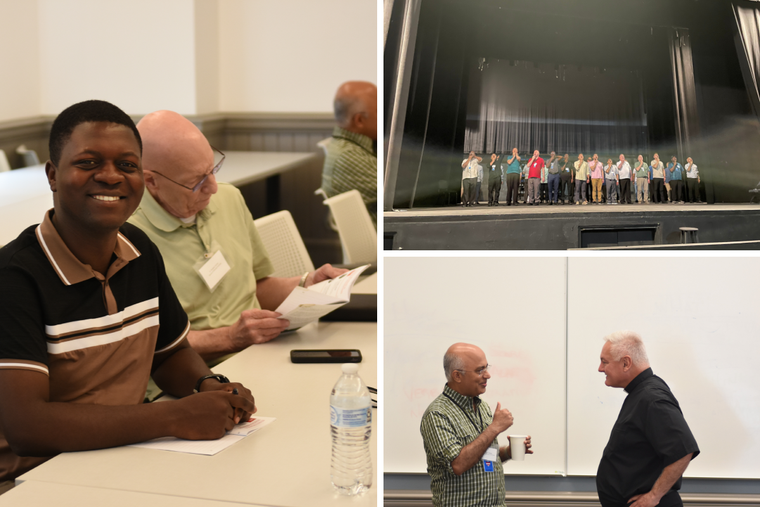
WASHINGTON — Someone who wandered into The Catholic University of America’s Hartke Theater on July 15 might have mistaken the 29 men standing in a circle on the stage for an improv acting troupe — not a group of visiting diocesan priests.
Dressed mostly in polo shirts and khakis rather than their usual clerical garb, the men, widely ranging in age, were playing a game designed to warm up their vocal cords and teach them to project their voices and use eye contact to connect to their audience.
“Bah!” one priest called out to the man beside him.
“Bah!” he said to the man on his other side.
“Zip!” a third priest exclaimed, using his eyes to signal to someone across from him that it was his turn.
“Bah!” the man answered.
Around and around it went, with bahs, zips and gentle corrections from Melissa Flaim, a vocal coach and professor at Catholic University’s Rome School of Music, Drama and Art. After a few minutes of this, Flaim had the men touch their toes, massage their jaws, stretch, hum, breathe deeply and make other sounds.
“How are you feeling?” she asked her pupils.
“Wonderful!” and “Great!” came the replies.
The surprising scene unfolded during the first day of a weeklong boot camp called the “Compelling Preaching Initiative” designed to help priests deliver more effective sermons. Now in its inaugural year, the program was created by Catholic University’s School of Theology and Religious Studies after graduates of the school said they needed more practical training in preaching.
The priests who took part this year were invited by their bishops to participate — free of charge, thanks to a grant from the Eli Lilly and Co. Foundation (Lilly Foundation).
A Lost Art
Having gone through seminary, the men had, of course, received instruction in homiletics — the art of preaching — but nothing like the training they received from Flaim, who teaches drama, voice and speech at The Catholic University of America and has worked with actors at the Round House, Folger, and Woolly Mammoth theaters and the Baltimore Shakespeare Co.
Public speaking, Flaim told the Register, has become a lost art in the age of iPhones and texting. Even people who were once comfortable speaking in front of others are now out of practice, she said, and that includes priests, actors, politicians and lawyers.
It doesn’t help, she said, that public speaking is no longer taught in schools, with many eliminating arts education altogether. As a result, for a new generation of priests, she said, the oral experience of preaching is not as central as it was in years past.
“When you think about how the Church came to be founded, it was founded on preaching, right? It wasn’t as if books were handed out and people read them, Flaim said. “We encounter God through the person speaking.”
Flaim explained that the goal of public speaking is to “communicate our truest self through our voice.”
That truest self can sometimes be obscured, she said.
“If you have a Mass and the person who’s speaking is not giving you access to them … if you can’t hear them, if you can’t understand them, or if they don’t have the skill to let what they have thought about and prayed about and reflected about and crafted in a sermon [be expressed],” she said, “the listener cannot have an encounter with God.”
(No pressure there.)
One of the most common mistakes priests make, Flaim said, is to think only about the lesson they want to impart in their homily, not on the effect their words will have on their listeners.
“It’s just getting them to think about what they want their parishioners to think, or feel, or say, or do when the priest finishes a sermon,” she said.
The exercises the priests took part in during the week are based on Freeing the Natural Voice, a voice-training book by Kristen Linklater about an approach that promises to “liberate the voice you have rather than apply vocal techniques from the outside.”
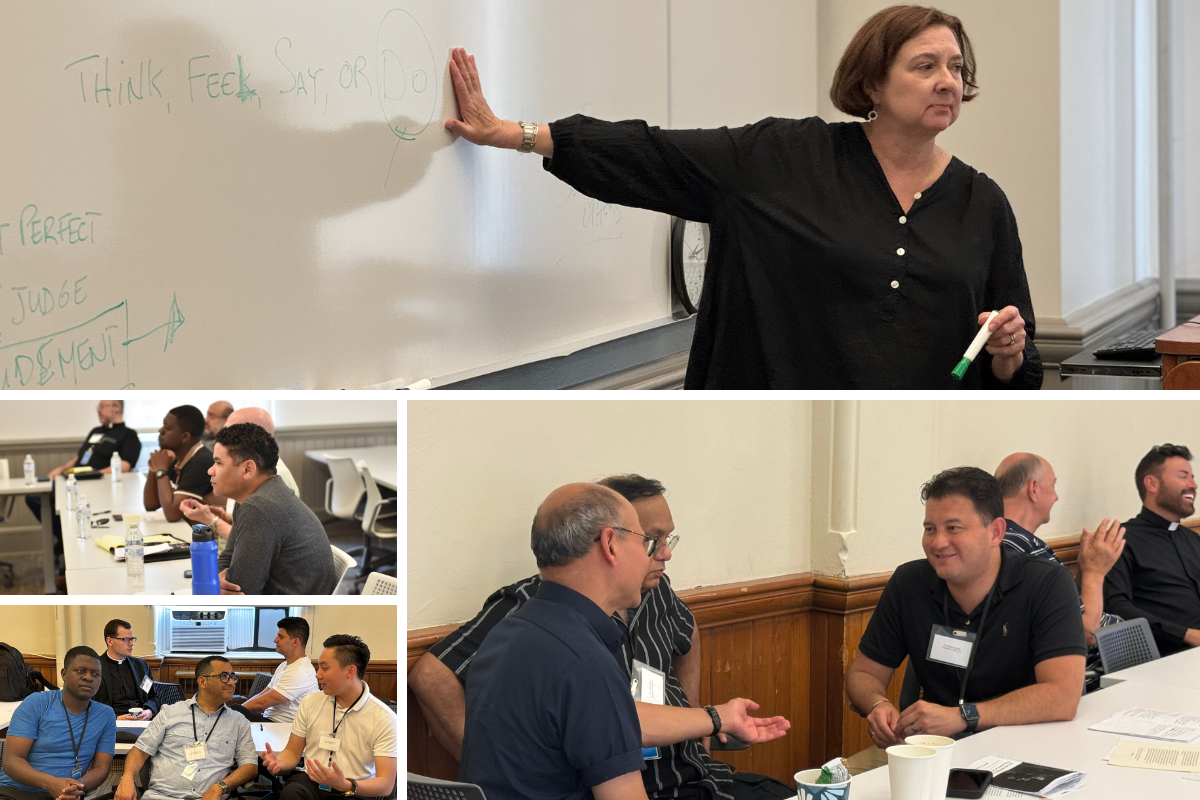
Flaim explained that the emphasis today in vocal training is on helping the speaker find his relaxed, natural and authentic voice. While the approach is rooted in self-expression, she explained, it also includes “powerful” technical tools, like pitch variation and volume.
She offered practical advice on how to correct a lazy tongue and soften a soft palate to give the voice space.
Americans, she said, let their sentences trail off at the end.
“When you are speaking publicly, that is deadly. No one listens to you,” she warned. “End every sentence as powerfully as how you started.”
Eager Learners
The lessons seemed to resonate with the priests.
Franciscan Father Tojy Jose, of the Diocese of Winona-Rochester, Minnesota, and a native of India, told the Register he thought the course was a “blessing.” He said he had been searching for a course to learn how to better project his voice.
The voice exercises “sounded weird” at first to Father Neftali Feliz, a priest with the Diocese of Scranton, Pennsylvania, and originally from the Dominican Republic. But, he said, he loves acting and welcomed the opportunity to practice these new techniques.
Looking ahead to the afternoon’s lectures, Father Feliz said, he already felt comfortable speaking to different age groups but hoped to gain insight into reaching American audiences.
“Sometimes I talk from my own perspective,” he said. “It’s important to learn how to speak in a multicultural society.”
Flaim said she wasn’t prepared for how enthusiastic the priests would be about doing something that was no doubt outside of their comfort zones. “They got into the swing of it!”
“They have that tremendously lovely group energy. They’re really like, ‘Yes, I’m going to show up; I’m going to do this thing, and I’m going to do that thing, and I don’t know what it’s going to be, but I’m excited to find out,’” she said.
That group energy was on full display as the priests gamely followed Flaim’s instructions to walk around the stage while humming. They burst into laughter each time one priest, who clearly had more lung capacity than the others, kept humming long after the others had paused to catch their breath.
For her part, Flaim seemed to enjoy working with these unlikely ingénues, playfully admonishing them when they misunderstood her instructions.
When one of the priests began humming and walking about the stage with his arms outstretched Frankenstein’s monster-style, Flaim in mock outrage exclaimed, “Father! Put your arms down!” To a priest who “locked” his knees, she said, “Don’t make me come hit you in the back of the knees like the nuns used to do!” And to a group that began “chattering,” she scolded, “Pretend that you are in church!”
The gentle chiding (and ensuing laughter) had the effect of loosening the group up. As the lesson progressed, the men seemed to be more relaxed. They definitely were louder.
“I think it is incredibly powerful if as a speaker, you can be loud — I don’t mean overbearing,” she stressed. “I mean, sincere, and clear, and open, and vulnerable, and available in a room.”
At the end of the week, each priest had to deliver a sermon using the new techniques he had learned.
As for whether they passed or failed, that will be for their parishioners back home to decide.