How a Pope ‘Christianized’ Engagement Rings (and Other Ring Stories)
The history of engagement rings extends almost as far back as the history of rings themselves — and there is a Catholic connection with engagements and rings (and the betrothal rite too).
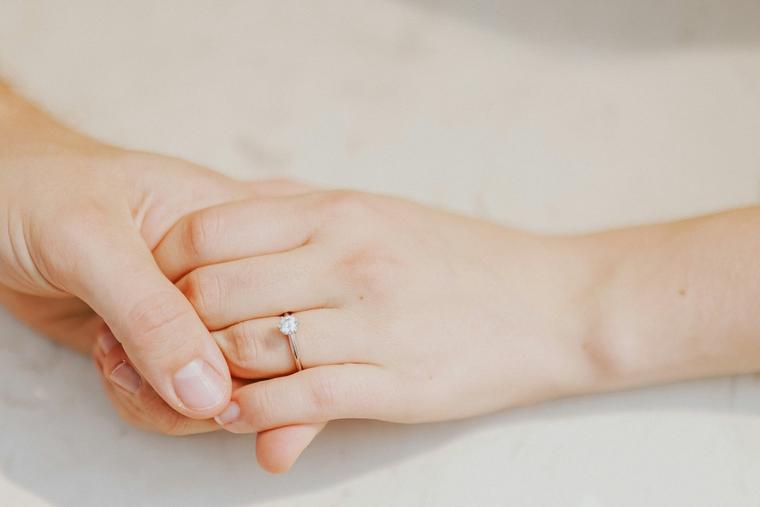
The history of engagement rings extends almost as far back as the history of rings themselves. “Engagement season” takes place between Christmas and St. Valentine’s Day — with an estimated 6 million proposals taking place on Feb. 14 — and there is a Catholic connection with engagements and rings (and the betrothal rite too).
Rings first appeared on people’s fingers in the Bronze Age, as humans began working with metal and fashioning the original jewelry. The ancient Egyptians started the trend, according to George Frederick Kunz in his 1917 book (released as an e-book in 2023) Rings for the Finger: From the Earliest Known Time to the Present, first using the signet ring to establish authority and sign and seal household items or documents.
As Kunz explains in his book, the history of engagement rings is vast. The first ring mentioned in the Bible appears when the patriarch Joseph received a ring from Pharaoh as a sign of his authority.
“With that, Pharaoh took off his signet ring and put it on Joseph’s finger. He dressed him in robes of fine linen and put a gold chain around his neck” (Genesis 41:42, NAB-RE).
Sign of Betrothal
The tradition passed to the Greeks of antiquity, who first used rings as a sign of betrothal, inscribing them with flowery phrases such as “To her who excels not only in virtue and prudence, but also in wisdom,” or simpler terms of endearment still used today — “honey.”
Keeping with ancient norms, the Greeks gave their ring-making customs to the Etruscans, who in turn shared them with the Romans, whose empire spread the custom to the edges of civilization.
Plautus, the famous ancient Roman playwright, makes the first mention of rings for love in his comedy Miles Gloriosus. A man would provide a ring for his soon-to-be wife — iron for in the home and gold for public spectacle — to signify her future right to “seal” (control) the property of the house.
Traditionally, the bride wore the ring on her fourth finger, as the Romans believed it held a vein extending all the way to her heart.
Building on these pagan traditions, the Catholic Church quickly Christianized ring-wearing to complement the theology of sacramental marriage.
Mary’s Ring
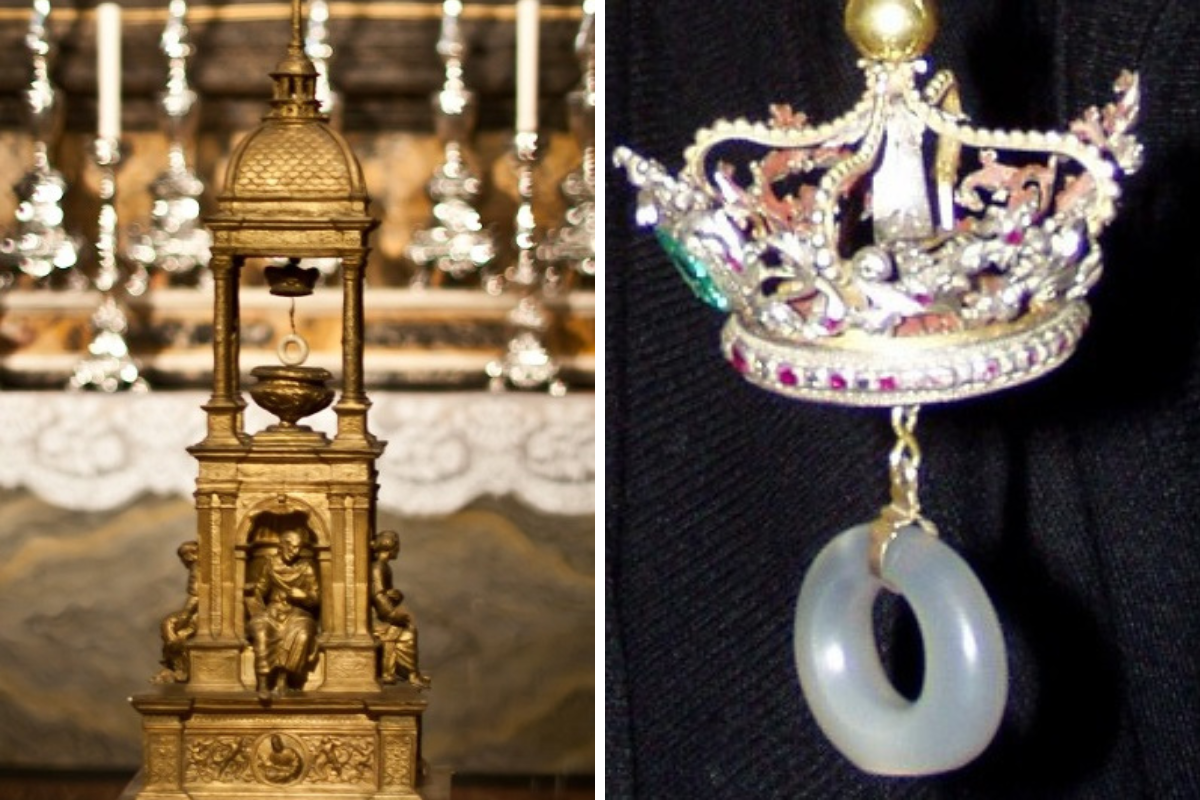
From the very beginning, rings had a place within early Christian practices, as evidenced by the wedding ring of the Virgin Mary, which is now held in Perugia, Italy.
The story of Mary’s wedding band, called the Santo Anello, seems the thing of legend, but a gemological analysis by the Cathedral of San Lorenzo showed otherwise. The study indicated that the chalcedony ring likely came from the East and originated in the first century, squaring with the tradition recounting its storied history from the Holy Land to Italy.
Pilgrims still flock to venerate the ring, especially touching wedding bands to it.
Early ecclesiastical writer Tertullian was the first to mention Christians wearing engagement rings, and St. Clement of Alexandria, known for his writings and leading the Catechetical School of Alexandria, noted that Christian women received engagement rings to show their dominion over household goods.
As with the pagans before them, the giving of an engagement ring symbolized that a Christian woman would soon be exercising authority over the resources of the house. It also served as a solemn declaration and monetary incentive for the groom to show up at the wedding.
St. Augustine attested to the continued juridic emphasis on rings in the early Church, writing that inability to procure rings should not bar a couple from marriage, according to Kunz.
Pope Nicholas and Echoes of Henry VIII
Later, St. Isidore of Seville attested that Christians wore a ring on the same finger as the Romans to signify their betrothal and intention to wed.
It was not until the ninth century that Pope St. Nicholas I pushed engagement rings into the limelight.
Born in A.D. 820 and elected pope upon the passing of Benedict III while only a deacon, Pope Nicholas earned the title “the Great” in part for his vigorous defense of marriage.
Nearly 700 years before King Henry VIII broke from the Church over his divorce from Catherine of Aragon, Lothair II of Lorraine, France, wanted a wife who could bear heirs, unlike his barren queen. Two bishops relented to his request. Emperor Louis II of the Carolingian Empire also sided with Lothair, and, upon hearing of Pope Nicholas’ disapproval, promptly laid siege to Rome.
The entrapped Pontiff would not give in, eventually ending the siege and forcing Lothair to keep his original bride.
It was Pope Nicholas who lent papal credence to the use of engagement rings, effectively baptizing the pagan tradition as a part of Catholic life.
In a letter to the Bulgars, he wrote, “after the betrothal is celebrated … the betrothed man joins the bride to himself with vows through the finger marked by him with the ring of faith …”
Today, popping the question lives on, with some couples infusing their engagement with explicitly Catholic elements.
Eucharistic Motif
Telos Art, a Phoenix-based Catholic jewelry company run by Jessica Connolly, has crafted a line of engagement rings based on monstrance designs.
Reminding shoppers that the Catechism of the Catholic Church calls the Eucharist “the source and summit of our faith,” Telos markets the ring as “a daily call to center your marriage on Christ.”
Bringing Back the Betrothal Rite
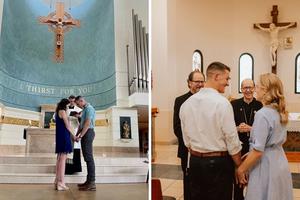
Another practice of sanctifying engagement is the betrothal rite.
Father Joseph Murphy, director of the Office of Worship for the Archdiocese of Washington, D.C., places the modern-day Order of Blessing an Engaged Couple (more commonly known as betrothal) in context.
“The rite recognizes that engagement is a family affair beyond just the bride and groom. There are separate options for introducing the betrothal rite suited to a cleric and a parent or layperson. The commonality between them are the words, ‘our Lord Jesus Christ who loved us and gave himself for us,’” said Father Murphy in an interview with the Register.
He explained that these words “tie engagement to its end — Christ’s love for his bride, the Church, to the point of death to raise her up in his own body.”
The rite emphasizes the special grace sought by the engaged couple to “grow in mutual respect, love each other more truly, and approach the celebration of holy matrimony chastely through appropriate companionship and prayer together.”
Father Murphy also explained that the rite directly connects the three graces sought with the core of the faith: love of neighbor (appropriate companionship) and love of God (prayer together).
He noted that the rite of betrothal did not appear in the Rituale Romanum but is common in most English translations of the book, showing its adaptation to a variety of cultural circumstances.
The betrothal rite ends with a reflection on the couple’s past preparation with a look to the future graces of matrimony.
“May the God of love and peace abide in you, guide your steps, and confirm your hearts in his love, now and for ever.”
Alex McKenna writes from Washington, D.C.