Why the Christian Vision of Men and Women, Led by Female Witness, Will Help Society Flourish
A look at ‘women at the heart of history’— through the contributions of the saints and Mother Angelica and beyond — and how feminine contributions have long aided the world.
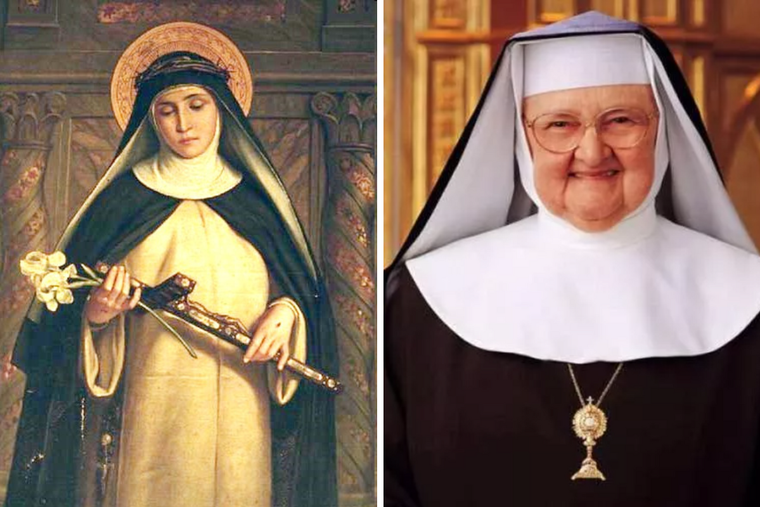
Editor’s note: Register Europe correspondent Solène Tadié gave the following speech at the annual Vanenburg meeting, organized by the Center for European Renewal for the discussion of ideas and study of important current topics, on July 10 in Berlin.
Good afternoon, we’re here to discuss a question that, in many ways, seems evidently absurd — but that is at the core of many of the debates that have come to define our time: “Do women exist?”
I assume that we’ve all caught the humoristic nod to Matt Walsh’s documentary What Is a Woman? — which reaffirms basic principles of biology and whose unexpected success has also demonstrated the extent of the Western world’s decadence.
Now, in the spirit of a classic Marxist tradition, especially dear to us French, of disclosing “from where we speak,” I’d like to clarify that I’m approaching this question from a particular vantage point: as a woman, a Catholic, and a journalist who could be considered by feminists as an “emancipated woman.”
I understand that my Catholic perspective may not resonate with everyone here, but I believe it to be crucial, as it offers very timely and constructive reflections on a topic that could determine the future of our civilization as we are facing an unprecedented demography crisis.
Most encyclopedias define “feminism” as a doctrine, a set of movements advocating equality between men and women in all spheres and the extension of women’s role within society. Thus, on the surface, feminism has all the makings of a praiseworthy project, dedicated to the common good. But if you judge a tree by its fruit, it becomes a different story.
In my view, feminism, especially modern feminism, is a fundamental anthropological error. While it can be argued that early feminism emerged in response to the misogyny exclusion of women from the Enlightenment ranks — especially because of their closeness to the clergy — today’s feminism has become a constructivist ideology that disregards biology, positing that gender is a social construct, malleable like clay.
Feminism Against Science
This ideological framework, championed by figures like Simone de Beauvoir, asserts that “one is not born, but rather becomes, a woman.” What does this really mean? It is not some romantic or personal development notion, but an assertion that the concept of women is nothing more than the fruit of a social construction, primarily invented by men. It’s really worth reading her book The Second Sex to understand her contempt for what constitutes a woman’s nature, especially motherhood, which she sees as a woman’s ultimate enslavement.
To give you an idea, for her, nausea and vomiting during pregnancy “manifest the body’s revolt against the species that takes possession of it,” and it’s not until menopause that women finally “coincide with themselves.” For her, it’s enough to get rid of our biological determinism. She is delighted that technology will eventually be able to cancel out the physical differences between men and women, a necessary condition for achieving perfect equality between sexes, which is the goal of the feminist quest.
The problem here, as I see it, is that when you deny biological truths, you lose the very essence of what it means to be human.
This ideology has permeated our culture for decades, leading to the current woke ideology and transgenderism, a profoundly anti-women ideology that is fostering unexpected alliances between the so-called traditional feminists and the Christian or conservative world. But it is contradicted in every way possible by science, history and sociology.
Take, for example, the studies by Cambridge professor Simon Baron-Cohen, a renowned neuroscientist, who showed that boys and girls develop different neurological tendencies from a very early age. From the age of 6, girls tend to be more empathetic, while boys lean toward more systemizing behaviors. These differences are not just cultural or social; they are biologically driven. This scientific evidence is a challenge to the feminist claim that gender differences are simply the result of a social construct.
Let’s consider another example: Sweden, often held up as a paragon of gender equality, offers an interesting case study. Statistics published in 2022 showed that in the country where women have the best job opportunities in Europe, they still overwhelmingly gravitate toward careers in personal care, teaching and direct sales, while few enter management or finance. If women were truly marginalized into these roles, as feminism often claims, why would this pattern persist even in the most gender-equal society?
This brings me to the heart of the issue: By denying biology, feminism locks women into a phantom vision of their role in society, one that ignores their natural inclinations. Instead of liberating women, it traps them in an ideological box.
Christianity, Main Driving Force for Women’s Liberation
This false anthropology is further compounded by a false history, one I’ve tirelessly highlighted in my work, as I believe the myth of Christianity as a historical oppressor for women is having heavy consequences on Western societies.
Indeed, as many of them are experiencing an unexpected Christian renewal, it is attracting mostly young men, while women are still largely absent from the phenomenon.
If Christians and defenders of Western civilization don’t reaffirm Christianity as the ultimate liberating force for women, they may lose an entire generation to the impasse of feminism and woke ideologies. They should reclaim this narrative, not only to clarify history but to help guide the future.
To understand Christianity’s true liberating force, let’s just mention briefly the Church of the first centuries, where Christianity offered women something unparalleled in the ancient world: a legal status. They were often considered property. This was a world where fathers held the power of life and death over their daughters.
The Gospel changed this. Women became active participants in evangelizing the world, even at great personal risk. From the earliest days, women were empowered to choose their spouses or remain celibate, and many of them chose martyrdom over renouncing their faith. Most of the saints of the first centuries of the Christian era are women, and this is no coincidence.
These early Christian women were not waiting for permission from any secular authority — they were affirming their identity and power through their faith, which was revolutionary for their time.
Contrary to modern myths about the “Dark Ages,” the Middle Ages were a time of unprecedented opportunity for women, largely due to the influence of Christianity. The historian Régine Pernoud famously demonstrated that women reached their peak in this era, holding power as queens, abbesses, theologians, landowners, and even warriors in the Crusades.
Unlike earlier patriarchal systems, the feudal society of the time allowed women autonomy. They reached adulthood at 12, two years before boys. Many women owned lands, managed estates, and were key decision-makers in the political and intellectual spheres of the time. Figures like Eleanor of Aquitaine and Blanche of Castile had significant political power, while others, like St. Hildegard of Bingen, made monumental contributions to theology, science and the arts, drawing deep admiration from high-ranking clergymen of the time.
The Church didn’t just elevate women spiritually but created a framework where they could thrive as leaders. St. Catherine of Siena, for example, had enormous influence during the Great Western Schism, bringing back the Pope from Avignon to Rome, without ever having to forsake her femininity. Women flourished in this system, not by imitating men but by embracing their distinct roles — proving that Christianity offered them far more freedom and empowerment than any secular ideology could.
Mother Angelica and Christian Empowerment
Today, the same Christian principles enable women to reach extraordinary heights with the strength of their character only. A modern and personal example that I hold dear is Mother Angelica, founder of EWTN in the 1980s, who faced skepticism and resistance from both secular forces and male-dominated clergy. Yet she built the largest Catholic television network in the world through sheer faith, grit and determination.
Her story underscores the broader point: Women don’t need to reject their femininity or conform to secular ideologies in order to lead. Mother Angelica’s leadership was propelled by her deep faith and unshakable will.
EWTN News’ current president and COO, Montse Alvarado, exemplifies such Christian empowerment. She brings a unique strength rooted in intuition, empathy, and a deep sense of purpose. Her leadership is not shaped by the need to imitate men but by the strength of her feminine gifts. She has thrived not by conforming but by embracing her distinct role, one deeply grounded in faith.
Demographic Collapse and the Christian Solution
This brings us to a more concrete political dimension, as we are now faced with an unprecedented demographic crisis. I recently interviewed Mads Larsen, a Norwegian professor and author of a great book called Stories of Love From Vikings to Tinder: The Evolution of Modern Mating Ideologies, Dating Dysfunction, and Demographic Collapse. He pointed out that this demographic winter unfolding right now is more threatening to the west than the Black Death.
The epidemic of loneliness, the collapse of family structures, and the decline of birth rates — these are all symptoms of a deeper issue.
Larsen provocatively argued that Christianity’s contribution to the liberation of women has also created unintended consequences. By granting women legal status and autonomy, Christianity set the stage for the demographic crisis we face today, one exacerbated by the widespread use of birth control. The rise of individual freedom was not matched with a societal framework that could support sustainable population growth.
That calls to mind the work of Catholic philosopher Chantal Delsol, La haine du monde (“The Hatred of the World”), in which she suggested that, for the West, Christianity is both the poison and the antidote. The very same Christian emphasis on the human person and individual freedom that helped women gain autonomy is now also leading us into a demographic collapse.
But Christianity is also the only sustainable antidote to the current crisis — if our societies are committed to using it to reconcile the sexes in a way that respects both men and women’s roles in society.
The time for ideological warfare is over. The answer is not to fight between the sexes but to reconcile them in a way that acknowledges their complementarity. Christianity offers a framework for doing just that. If we return to a Christian vision of gender — rooted in mutual understanding and responsibility — we can begin to rebuild a society where both men and women flourish and where demographic collapse is averted.
As we consider the role of women today, it’s essential to reject the false dichotomy that has been promoted by modern ideologies. There is no such thing as good and bad feminism. The very idea of feminism assumes that society is divided into categories of eternal victims and oppressors. It’s a vision that places women in a position of weakness.
Let’s remember the brilliant examples of women throughout history who did not bend to the limitations of modern feminist ideologies. They never tried — or needed — to imitate men. They simply lived their truth, guided by faith, and shaped the world in ways that no amount of political ideology could ever achieve.
Women reveal themselves above all in times of crisis. The geopolitical and ethical challenges posed in particular by the rise of AI will open a path for them to contribute, aided by their own feminine genius — not through class warfare rhetoric, but by recovering the strength of character and virtues that have placed women at the heart of history for centuries. Christianity must continue to do what it does best: promote the uniqueness of the human person and lead him or her toward excellence, toward holiness.
The task now is clear: to reconcile the sexes, to reaffirm the truth of our biology and complementarity, and to use Christianity, as it has always done, as the framework for building a harmonious society. This is not just a moral imperative — it’s a political necessity for the survival of our civilization.
- Keywords:
- complementarity of genders
- feminism
- feminine genius
- catholic women
- christian women and girls