Gardening With a Saint: Healing and Health, Hildegard of Bingen-Style
TO READ: ‘St. Hildegard’s Garden’
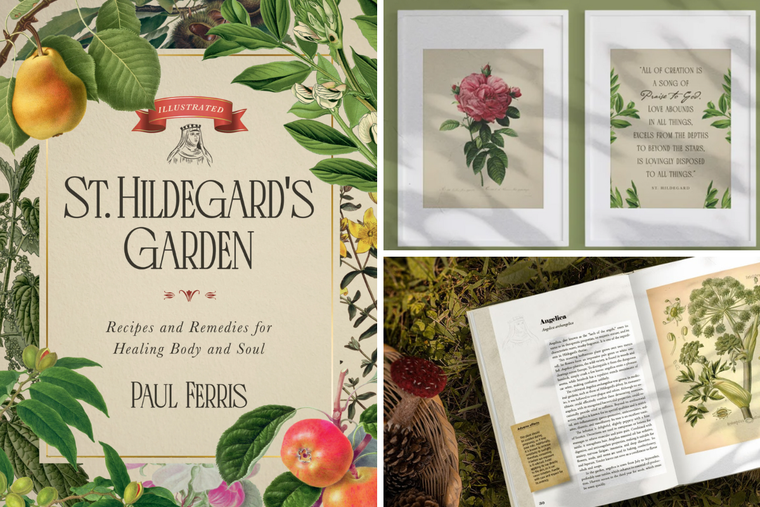
St. Hildegard’s Garden
Recipes and Remedies for Healing Body and Soul
By Paul Ferris
Sophia Institute Press, 2025
240 pages; $29.95
To order: SophiaInstitute.com or call (800) 888-9344
While natural and herbal remedies for cures and relief of common ailments and health conditions have become all the rage in recent years, a thousand years ago, St. Hildegard of Bingen beat today’s purveyors to scores of them. This timely reminder comes in the book St. Hildegard’s Garden: Recipes and Remedies for Healing Body and Soul by Paul Ferris.
When Benedict XVI proclaimed Hildegard a doctor of the universal Church in 2012, he wrote, “This great woman truly stands out crystal clear against the horizon of history for her wholeness of life and the originality of her teaching. And, as with every authentic human and theological experience, her authority reaches far beyond the confines of a single epoch or society; despite the distance of time and culture, her thought has proven to be of lasting relevance.”
For one, this German Benedictine nun had profound insights into plants, their properties and how they could be used for cures, relief from illnesses, and promotion of good health. She put her knowledge to use as a one-woman pharmacy and doctor in her The Book of Divine Works, Causes and Cures. Many of her recipes for remedies and relief have been scientifically proven valid, according to the author. “She understood ailments of all kinds and knew, and recorded, remedies for them. She was a healer and also a philosopher-theologian,” writes Ferris. “The majority of her advice remains relevant.”
Recognizable Plants
Naturally, St. Hildegard’s Garden cannot treat every single plant she wrote about. But it concentrates on several of her favorites, and many of those names are recognizable: almond, aloe, sage, basil, beans, beans, dill, dandelion, iris, lavender, marigold, nutmeg, oats and rosemary.
To add perspective, the author describes a little of Hildegrd’s life, from when she was born in 1098, to her mystical visions, even in childhood, to her many interests as a Benedictine nun, including medicine and healing.
“[S]he utilized everything in nature, everything nature offered for treating illnesses — plants, minerals, and animals.”
In her voluminous writing, she described in detail each plant, mineral, or object of her studies and categorized them within her methodical system. Furthermore, she believed that disease prevention hinged on proper nutrition.
Naturally, all this comes into play in St. Hildegard’s Garden, as readers learn of various plants, vegetables and fruits and their beneficial and healing properties. Take simple garlic, whose benefits, such as promoting circulation and helping prevent hypertension and respiratory infections, are now known. Hildegard figured that out 10 centuries ago. Ditto various nuts like almonds, plus beans, cabbages of which she has much to say, and herbs like sage and angelica (from the carrot family), plus different grains such as spelt: “warm, rich, and full of qualities. Spelt provides vigor and strength to the human body, brings a vital grace to the spirit.”
Hildegard speaks highly of the apple tree, which leads her section on trees in her Book of Divine Works. She learned of all its beneficial qualities centuries ago. “Modern science has proven that this fruit possesses remarkable circulatory, digestive, laxative, anti-cancer and anti-inflammatory properties,” writes Ferris.
The book treats all these, including spices like ginger and cinnamon that Hildegard especially appreciated. “Indeed, cinnamon boasts exceptional bacterial, antiviral and anti-inflammatory properties,” notes the author.
Lavender, violets, parsley, rosemary, different kinds of mint, thyme, and common barley all get their place in the spotlight. So does the iris, according to Hildegard, because it holds religious significance — its color symbolizing the Virgin Mary and shape resembling the lance that pierced Christ’s heart.
A Saint’s Instructions
Page after page, readers will find that “many phytotherapeutic properties described by Hildegard have been scientifically confirmed”; for example: “Calendula, widely used in dermatological creams today, is the same marigold that Hildegard recommended for scalp and skin conditions.” Indeed, this saint was far ahead in many respects, since phytotherapy — using medicines derived from plants or herbs to treat or prevent health conditions — did not get formal attention until the early 1900s.
Making for added interest is the way each new herb, fruit, flower or plant is described according to its properties, how it grows, and how it is used, as well as how it can be grown. Then partnered on the facing page is a picture of the plant — in colorful drawings in the style found in a botanical garden book.
Throughout are Hildegard’s own words, amplifying the author’s own rephrasing of the great doctor while being as true to her writing as possible to deem the book “practical for everyday use.” A few sections do not fit that bill, but remain fascinating nevertheless. For instance, Ferris includes a tiny handful of plants that are known to be toxic, such as boxwood, which today is used as a shrub and not eaten. Missing, too, are tomatoes, potatoes, avocados and pumpkins that were unknown in Europe until after Columbus. If they were known, Hildegard would surely have included them.
St. Hildegard’s Garden includes fascinating companion sections. The first is “Grow, Multiply and Harvest,” which is self-explanatory. The author focuses on medicinal plants. Fascinating as well as informative are the instructions on how the garden should be planted — as was planted — in usually four thematic and geometric sections to correspond to the Four Evangelists, Sts. Matthew, Mark, Luke and John. Often a central fifth bed was added in honor of the Holy Spirit, the Blessed Mother, or St. Paul.
A detailed drawing not only shows the layout of this herb garden but includes where and how each plant should be placed. The reasons come to light in explanations of how the pairing and placement of the plants affect each other. Some plants help one another; some do the opposite. This fascinating treasure trove of information includes a preservation how-to.
Another section with Hildegard-recommended or advised ingredients brings more surprises, while the section on “Health Remedies” includes recipes and uses for medicinal wines, syrups and herbal teas. One of the recipes uses a little-known plant called agrimony for treating nervous disorders. Other recipes are for poultices and ointments.
There is a bonus: a short section with kitchen recipes. The author admits difficulty with them because some of Hildegard’s recipes are highly complex to prepare or involve ingredients now unavailable, and she rarely listed quantities, even for the simplest recipes. Still, it was “essential to remain as faithful as possible to Hildegard's writings,” explains the author, who diligently includes ingredients’ measurements for these recipes, such as nutmeg and gladiolus porridge, pear compote with chervil, green soup, oatcakes, and laurel and almond cookies.
Whether or not you plant the garden or try the recipes, St. Hildegard’s Garden offers a fascinating look into this scientific- and garden-minded saint and her methods of making good use of natural resources and remedies.
- Keywords:
- st. hildegard
- gardening
- care of creation
- nutrition