3 Key Moments From Pope Leo’s Voyage to Madrid
COMMENTARY: A prayer vigil, Corpus Christi procession and a meeting with the Spanish parliament punctuated a memorable trip to Spain’s capital city.
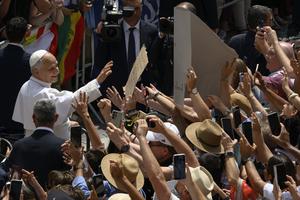
In visiting the capital of Spain, Pope Leo XIV returned the papacy to one of the historic centers of Catholic Europe — and he received a rapturous response.
Speaking to journalists en route to Madrid, the Holy Father acknowledged, in an understated way, that it had been “quite some time” since there had been a papal visit to Spain. Pope Francis did not visit the historic Catholic cities of Europe — Madrid and Paris, most notably — except for World Youth Day, visiting Kraków (2016) and Lisbon (2023). Unlike his predecessor, Leo began his apostolic journey to Spain with a stop in the capital, before visiting Barcelona, Montserrat and the Canary Islands.
Plans have already been announced for a visit to Paris in September.
Spain is a typical European country, largely secular but with a long Catholic history, and currently led by a socialist prime minister advancing a socially liberal agenda. Yet Leo’s days in Madrid seemed to indicate that the capital was eager to celebrate its Catholic culture and history.
Three moments from the days in Madrid stood out, which began with the kind of pageantry that only a Catholic crown can provide — mounted horses in procession, grand palaces, the nation’s queens dressed in white. Spain’s royal family is the most prominent Catholic monarchy left in the world.
Prayer Vigil
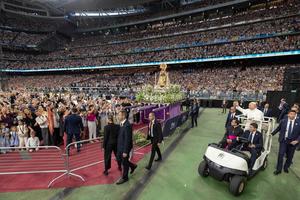
On June 6, his first night in Madrid, Pope Leo led a prayer vigil for young people, culminating in Eucharistic adoration. The evening drew some 500,000 pilgrims. Earlier in the day, aboard the papal flight, Leo casually mentioned that the reggaeton sensation from Puerto Rico, Bad Bunny, would be on tour in Spain during his visit. Between Bad Bunny and the Pope, some would choose the former and some the latter, Leo observed, and the contrast would be interesting. Leo got more than his share with a half million strong (Bad Bunny’s June 6 concert was reportedly attended by around 60,000), for an evening of shared witness, silence and prayer.
The prayer vigil had been highly anticipated due to the most memorable moment of the last papal visit to Spain, in 2011 for World Youth Day. At the prayer vigil a fierce tempest swept over the 2 million present, with Pope Benedict XVI being shielded by multiple umbrellas. He refused to leave, continuing with his vestments dishevelled and his hair windswept. Calm returned, and a great silence descended as Benedict led the drenched young people in adoration of the Blessed Sacrament. The silence after the storm was a signature moment of his pontificate.
Leo’s structured conversation with the young people included him speaking about his favorite saints — “apart from St. Augustine.” He chose saints from history who are less well-known today: St. John Chrysostom and two Spaniards, St. Thomas of Villanueva and St. Turibius de Mogrovejo, a missionary in Peru.
“Reflecting on the lives of these saints, I said to myself, as did St. Augustine: If they were able to do it, why not me? (cf. Confessions, VIII, 27),” the Holy Father said. “It is a question I am pleased to share with you too, as I invite you to choose examples of a good life that are inspiring both to you and to others.”
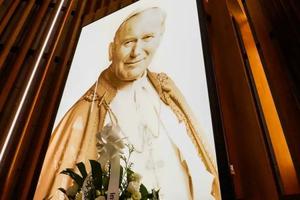
The meeting in Madrid also echoed one of the first such papal encounters, in 1987 in Chile. There, St. John Paul II repeatedly encouraged the young people, in an impassioned address, to seek Christ above all else, as more than a wise man, more than a prophet, more than a social reformer — “mucho mas (much more), mucho mas, mucho mas!”
Leo, for his part, spontaneously added several times, “seek truth,” a truth that would lead, as it did for St. Augustine, to Christ. On Saturday evening in Madrid, the threads of papal vigils with young people over 40 years were woven together.
Corpus Christi Procession
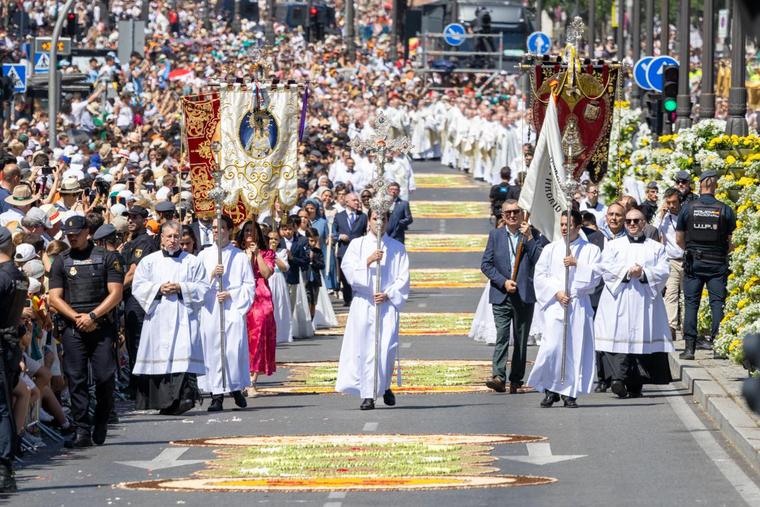
The second great moment in Madrid was the Corpus Christi procession on Sunday morning. Only a great Catholic capital can operate on that scale, with a million and half people taking part.
Spain is a land of processions — the famous Semana Santa in Seville for Holy Week, and the most elaborate Corpus Christi procession on the planet, in Toledo. For the Holy Father to lead the procession in Madrid was a high moment for Spain’s Catholic culture. Leo warned that it ought not be only about the past but to inform the present, too:
“The historical memory of the Corpus Christi processions is not confined to wistful nostalgia. Instead, it stands as an invitation in the present moment, in our daily lives, in our relationships, in society, and in the building of the future. … Herein lies the task of Spain today and in the future: to ensure that the religiosity which has shaped and defined this country for centuries is not a museum of the past to be visited, but a school of faith from which to draw even today.”
Spanish Parliament Address
On Monday morning, Leo became the first pope to address the Spanish parliament. His address was what one might expect from an address to legislators — he quoted Benedict’s address to the German federal parliament in 2011. The Holy Father exhorted them to protect the right to life, promote the family, to care for the vulnerable. Leo framed his remarks in the context of Spain’s “Salamanca” school, in which Catholic theologians — he named Francisco de Vitoria — laid the foundation for the recognition of universal human rights.
He concluded with a lyrical reflection on the beauty of the parliamentary chamber itself.
“In this Chamber, natural light streams in through the skylight that crowns the room. That light coming from above may remind us that politics, too, must acknowledge a force that precedes and transcends it,” he said. “Likewise, the paintings on the upper part of the main wall, depicting the reception of the Gospel and the Decalogue, remind us of something essential. Without confusing the political order with the religious one, these symbols invite us to recognize that modern freedom has also been shaped by a long education of conscience, deeply marked by the Christian tradition.”
The Holy Father added, “In that inner school, people learned that law must serve the good, that justice sets limits on force, that power requires legitimacy, that the poor belong fully to the community, that the foreigner must be welcomed in accordance with his dignity, and that human life can never be treated as a commodity.”
He then concluded with a bold exhortation:
“I invite you, then, to lift your gaze to the world around you, not to turn away from reality, but to remember that every decision by public authorities affects real people, especially those who have less power to make their voices heard.”
The response was intense and emotional — even though many in the chamber favor policies that Leo opposes. The deputies rose in an ovation that went on and on … and on, punctuated by cries of “Viva el Papa!"
They simply would not stop, even as the Holy Father stood silently, a bit overwhelmed. Finally, after about seven minutes, the speaker of the parliament suggested that the papal party take its leave. Only after Leo left the chamber did the ovation cease.
There were other notable moments in Madrid, including at Santiago Bernabéu Stadium, Spain’s most famous football (soccer) stadium — often called the “cathedral” of football.
“I suppose that, for a football player, scoring a goal in this stadium is something that leaves a lasting impression for life,” Leo spontaneously began. “Cardinal José: today the Church of Madrid scored a spectacular goal that will go down in history!”
The same could be said about Leo’s three days in Madrid.
- Keywords:
- madrid, spain
- 'pope leo xiv'