6 Lessons From St. Thérèse’s ‘Little Way’
New book explores the spirituality of the Little Flower.
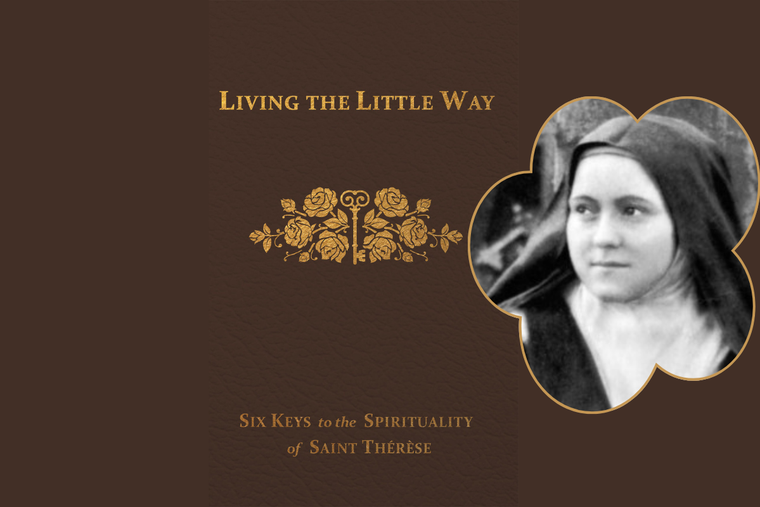
St. Thérèse of Lisieux is a beloved saint for many Catholics, especially those who follow the principles of her “Little Way” to holiness, a practice characterized by loving God in small ways and having childlike trust. plus, her “shower of roses.”
Now, this spirituality is explored in a new book, Living the Little Way (TAN Books), by Franciscan Father Joseph Spence, a professor at the Pontifical Teresianum University in Rome where he teaches courses on the French saint’s spirituality. In the book, readers can delve into the “Six Keys to the Spirituality of St. Thérèse.”
1. Holy Scripture and St. Thérèse's ‘Little Way’
Scripture was the crux of her “Little Way” of spirituality, as Father Spence explains: “ … it is most importantly the Holy Scriptures that inspired Thérèse in her ‘Little Way.’ Since 1892 — that is, since Thérèse turned nineteen years of age — she preferred the Gospels as her main source of spiritual nourishment. It was the Holy Spirit Himself, then, and Jesus, Thérèse’s ‘spiritual director,’ who instructed Thérèse in the depths of her heart, soul, and mind — through the Holy Scriptures, first and foremost, and through various other sources — forging in her a beautifully correct image of God. … The Holy Spirit was teaching her the confidence — the confiance — and the trusting abandonment and self-surrender, to God, that true children of God the Father must have.”
2. Devotion to the Child Jesus and the Holy Face
As reflected in her religious name — Sister Thérèse of the Child Jesus and the Holy Face — this aspect of her spirituality stemmed from family life.
“Thérèse’s sisters, and relatives, and friends would tendentially use the image of the Child Jesus when speaking to Thérèse about God,” Father Spence writes.
“Thérèse’s devotion to the Child Jesus would never fade with the passage of time, because her devotion was not a ‘childish’ one. Rather, it was a devotion to Christ as seen in one of His most fundamental mysteries and characteristics: His Incarnation.”
The book further explains:
“On April 26, 1885, Louis Martin and four of his daughters — Thérèse included — enrolled in the Confraternity of the Holy Face. Thérèse was twelve years old. Thérèse was, then, devoted to the Holy Face from at least the age of twelve. In fact, she also painted a copy of the Veil of Veronica and had it placed in the arbor or gazebo in the backyard of Les Buissonnets, the Martins’ home in Lisieux. In December of 1889, once Les Buissonnets had been sold, the painting was taken to the Lisieux Carmel and placed into another gazebo, called the ‘Hermitage of the Holy Face.’”
But it was her father’s long illness that cemented the Little Flower’s closeness to the Holy Face.
“Thérèse’s personal ‘encounter’ with the Holy Face came about,” Father Spence writes, “because of another series of events: her father’s illness. Louis Martin had been showing worrisome signs in regard to his mental health. On June 23, 1888, Louis Martin suddenly disappeared and was found four days later in another town, Le Havre. On February 12, 1889, the unthinkable occurred: hallucinating and convinced that a battle was raging in Lisieux, Mr. Martin took out his revolver in an attempt to defend his two daughters, Céline and Léonie, and the servant Marie Cosseron. They quickly sought help from their Uncle Isidore Guérin, who then fetched a strong, tall friend to come and calm Louis Martin. They took him on ‘a walk’ to the Lisieux Carmel to say goodbye.”
Father Spence continues, “He brought a few small fish in a handkerchief and gave them to Pauline. They then took him immediately to the psychiatric ward in the Bon Sauveur Hospital in Caen. He was to remain there for thirty-nine long months. Mr. Martin suffered from cerebral arteriosclerosis; he would later be confined to a wheelchair. Thérèse later wrote, in her Manuscript A: ‘Ah! that day, I didn’t say I was able to suffer more! Words cannot express our anguish, and I’m not going to attempt to describe it.’ Thérèse, instructed by Pauline (Sr. Agnes of Jesus) in the devotion to the Holy Face as a novice, had thus chosen this mystery as a complementary addition to her religious name on the day of her Vestition (January 10, 1889); the mystery of Christ’s suffering had been a refuge for her in the humiliating and anguishing months of their dear father Louis’ downturn in his mental health. Only a month after her Clothing Ceremony, Louis was interned in the Bon Sauveur Hospital.”
“In the following months and years, the Holy Face of Jesus would be the source of a constant spiritual strength and comfort for Thérèse,” the priest writes. “And an explanation, on a spiritual level, of her father’s humiliation and sufferings: Jesus was associating him and their whole family to His own humiliation and sufferings, as contemplated in His Holy Face. On Louis Martin’s funeral holy card, in fact, his daughters chose the image of the Holy Face.”
3. Love of Christ
“Jesus is my only love!” (“Jésus est mon unique Amour!”): Agape love of Christ is also key to the Little Flower’s faith life, before and after her religious profession.
“Thérèse had a living and extraordinary example, in her holy parents, of what it means as a couple to live one’s spousal love in everyday life,” Father Spence writes. “Most certainly, this family environment helped Thérèse, consciously or unconsciously, to live a balanced and passionate love for Jesus.”
After her first Communion, for example, Thérèse wrote, “I felt that I was loved.”
This depth of love extended to her vocation.
“For Thérèse … the day of her Profession was truly her wedding day with Jesus. ... In her Profession Note, she wrote: ‘O Jesus, my divine spouse!’”
4. Marian Devotion
As Little Flower devotees well know, it was at its height of Thérèse's healing from a mysterious illness at age 10 that she developed a deep devotion to Mary. She would later write: “All of a sudden the Blessed Virgin appeared beautiful to me, so beautiful that never had I seen anything so attractive; her face was suffused with an ineffable benevolence and tenderness, but what penetrated to the very depths of my soul was the ‘ravishing smile of the Blessed Virgin.’ At that instant, all my pain disappeared, and two large tears glistened on my eyelashes, and flowed down my cheeks silently, but they were tears of unmixed joy.”
That healing was a beautiful moment, but Mary was always a mother to her, especially after her own mother Zélie’s death at age 45 when her youngest surviving daughter was just 4 years old.
In her own words: “Father encouraged me to be devout to the Blessed Virgin and I promised myself to redouble my tenderness for her.” That included “my little May altar.”
5. Fraternal Charity
St. Thérèse's love for others, learned first in the Martin home and extended to Carmel (amid unkind treatments from fellow nuns), was demonstrated even in her prayers for priests and sinners, including a condemned murderer.
“Thérèse had understood … that ‘charity must not remain hidden in the bottom of the heart’ and that, as she wrote, ‘my love was not to be expressed only in words, for It is not those who say: ‘Lord, Lord!’ who will enter the kingdom of heaven, but those who do the will of my Father in heaven’ (cf. Ms C, 11vo.12ro). So Thérèse made sure to overcome her natural feelings and to demonstrate explicitly and in concrete ways — for example, with her best smile — her love for Jesus through her charity toward her nun-sisters,” the book explains.
Her vocation, of course, encompassed love. Among the Little Flower’s most famous quotes is her declaration: “O Jesus, my Love ... my vocation, at last I have found it ... MY VOCATION IS LOVE!”
6. Holiness in Suffering
Lastly, Thérèse’s immense suffering — from tuberculosis and especially spiritually as death at age 24 neared — offers a profound lesson.
“He [Jesus] permitted my soul to be invaded by the thickest darkness,” she herself wrote, yet, as the book recalls, “in all of this — in her martyrdom, in her Via Crucis — Thérèse was full of joy. Full of humor. Full of love. There is only one way to truly understand the purity, the candor, the simplicity, the heroism, the love, which had imbibed Thérèse’s soul —through the action of the Holy Spirit —” her “death of love.”
Her death — and holy life — attests to Love. Her sister Pauline recounted her final, literally lovely words:
“Oh! I love Him. ... My God ... I ... love you!”
- Keywords:
- little way
- saint therese of lisieux

Amy Smith Amy Smith is a Register senior editor who edits devotions and features for print and online. Fueled by prayer and coffee, she enjoys writing about everything from Jane Austen to saints for the Register. She is the author of The Plans God Has for You: Hopeful Lessons for Young Women (Emmaus Road Publishing). Her writing has also appeared in various other Catholic publications. She has a master’s degree in journalism and a B.A. in English.