How Can I Forgive… God?
COMMENTARY: An exchange between a young woman and Pope Leo in Spain invites us to consider: Where do we find God in our suffering?
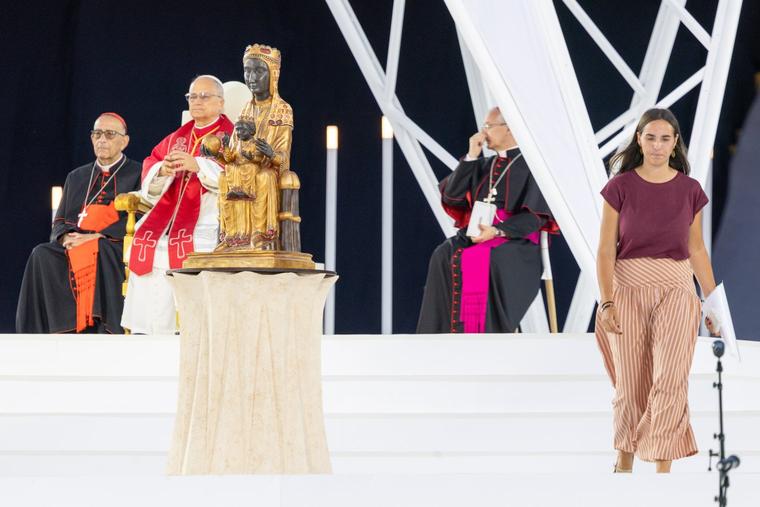
At a question-and-answer session during Pope Leo XIV’s visit to Spain, a young woman named Desirée shared a heartbreaking story.
When she was little, her father tried to kill her mother. A young man stepped in to protect her and was killed instead. Her father went to prison, and her mother became addicted to drugs.
When she was 10, social services intervened. After some time in a children's home, Desirée was placed in a loving family and eventually baptized. But as she grew in her faith, she found herself asking God a question many of us have whispered in the dark: “Where were you?”
She put two questions to the Pope. How can I forgive my father? And how can I truly reconcile with God?
Pope Leo told her, “We cannot attribute to God what has been entrusted to our responsibility.” If violence happens, if love among family members curdles into hatred, the honest question isn’t “Where was God?” but a question about us, about a humanity that sometimes becomes a prisoner of its own evil. And forgiveness, he reminded her, is a journey rather than a single act, one that never requires returning to a dangerous relationship or pretending the wound never happened.
In my work with CatholicCounselors.com I often accompany people who have similar questions: How do I forgive the people who hurt me? And how can I forgive God for letting it happen?
Let’s look at how we can begin to answer both of these questions in the face of our own pain.
Forgiving Others
Pope Leo’s response to Desirée’s question about forgiving her father reminded me of what both St. Augustine and Pope St. John Paul II said about forgiveness. Namely, that forgiveness is simply the decision to surrender our desire for revenge. Forgiveness doesn’t require us to pretend the offense never happened, or put ourselves in harm’s way again, or refuse to hold the person accountable. It simply means, as the Catechism teaches, that I am committed to giving up my desire to hurt someone for having hurt me (2843).
Likewise, it’s possible for a Christian to forgive someone but not be reconciled to them, especially when the other person remains unrepentant or unsafe. As the Pope told Desirée, we can work to reject hatred in our hearts, repair what can be repaired, and pray for the person, all without putting ourselves in harm’s way.
Forgiveness is something we can do on our own power, but reconciliation requires that everyone involved is willing and able to do the work required to heal the relationship.
Forgiving God
But how can I reconcile with God when the things I have suffered cause me to feel that he abandoned me — or worse.
Most of us believe that if God really loved us, he would spare us from suffering. Suffering feels like a divine betrayal. How can we trust God if he doesn’t prevent bad things from happening to us?
As natural as it is to ask this question, it’s based on a misunderstanding of God’s original plan for us, how that plan was destroyed, and what God is doing — even now — to make that plan a reality.
In the Beginning
In Genesis, we see that God first created a world without suffering. His original plan for us was a life without pain, toil, or hardship. In fact, St John Paul’s Theology of the Body suggests that our unconscious expectation of a life without suffering isn’t folly. It’s an ancient, collectively unconscious memory of the world for which we were originally created.
But when our First Parents rejected God’s plan, they also rejected the pain-free life that God offered them. In fact, despite the presence of every good thing around them, Adam and Eve demanded the right to experience good and evil (Genesis 3:5).
As a result, the delicate balance that prevented suffering was shattered. The earth stopped being God’s Kingdom and became enemy territory (John 18:36). Ever since, human beings have lived behind enemy lines, suffering all the things that image entails.
That’s why Catholics call the Church on earth, “The Church Militant.” All humans are under constant attack by suffering and evil.
Although Christians are not immune from suffering, God has placed us in a privileged position. Rather than leaving us powerless, Christ shows us how to conquer evil and the effects of evil. He gives us powerful weapons (faith, hope, love, truth, goodness, beauty, and all the virtues) that enable us to bring goodness, healing, peace, and blessings out of even the greatest evils.
Although we still live behind enemy lines and suffer the evil slings and arrows of the Enemy, God is constantly subverting and conquering evil — and showing us how to use the power of good to fight alongside him.
Unleashing The Power of Good
Christians don’t believe that good ever “just happens.” No blessing is an accident or coincidence. Every good thing that happens — especially in the wake of tragedy — is evidence of God actively working (both directly and through the people who follow him) to save us from suffering and help us overcome the effects of evil in all its forms.
Since the first moments after the mankind’s fall, God has been unceasingly working to bring order out of chaos, peace out of conflict, healing out of pain, life out of death. God promises, “Behold, I make all things new.” (Revelation 21:5).
The existence of good (good deeds, good things, good outcomes, etc.) —particularly in a fallen world overseen by the forces of evil — is a sign of God’s constant, loving efforts to save and heal his children. Moreover, it is a testament to his desire to teach us how to join him in this noble fight.
Which brings us back to our question: Where do we find God in our suffering? Right in the middle of our pain. We encounter him in the tiny voice in our heart that says, “This is unjust. There should be more to life than this. Healing must be possible. Somehow, I can make something good come out of this.”
That isn’t our voice (even if it sounds like us). It’s the voice of the Holy Spirit calling us out of despair and promising healing. Even in our darkest moments, if we listen, we can hear God saying, “Do not fear: I am with you. … I will uphold you with my victorious right hand” (Isaia 41:10).
The natural human response to suffering is to simply give up and let it win. If you have ever come through difficult times of any sort, you did it because the Holy Spirit was moving inside of you, showing how to keep getting up, how to cling to the gifts and strengths he has given you, and find the people who could help you persevere toward a place of healing, strength, wholeness in spite of everything.
And if you have not yet found that healing, strength, and wholeness, it is only because God is not finished writing the story of your victory. “For in all these things we are more than conquerors through him who loved us” (Romans 8:38).
Forgiving Others. Reconciling with God
Which brings us back to Desirée’s two, intimately connected, questions. What does it mean to forgive the people who hurt us?
It means refusing to hurt them for having hurt us, holding them accountable for their actions so that they can learn from and repent of their offenses, and being willing to reconcile if it ever becomes safe and appropriate to do so — but not before.
And how can we overcome the sense of hurt and betrayal we feel toward God for our suffering? As Pope Leo reminded us in Spain:
“God does not desire suffering; he bears it with us and invites us to trust in him perseveringly.”
We must open our eyes to see that not only did God never want us to suffer, but from the very first moment that the Enemy was inflicting pain on us, God was already setting a table of victory before us in the presence of our Enemy, showing us how to heal — and even thrive — despite what we’ve experienced, and revealing that with him at our side, we have nothing to fear.
Greg Popcak, Ph.D, is the author of more than 20 books and conducts an active Catholic telephone counseling practice through the Pastoral Solutions Institute. An adjunct professor of psychology and theology at Franciscan University, he and his wife, Lisa, host More2Life Radio and were featured speakers at the 2015 World Meeting of Families. Learn more at www.CatholicCounselors.com.
- Keywords:
- forgiveness
- 'pope leo xiv'
- church in spain