‘They Beat as One’: Why the Sacred and Immaculate Hearts Are Celebrated Side-by-Side
Contemplating the union of the two hearts.
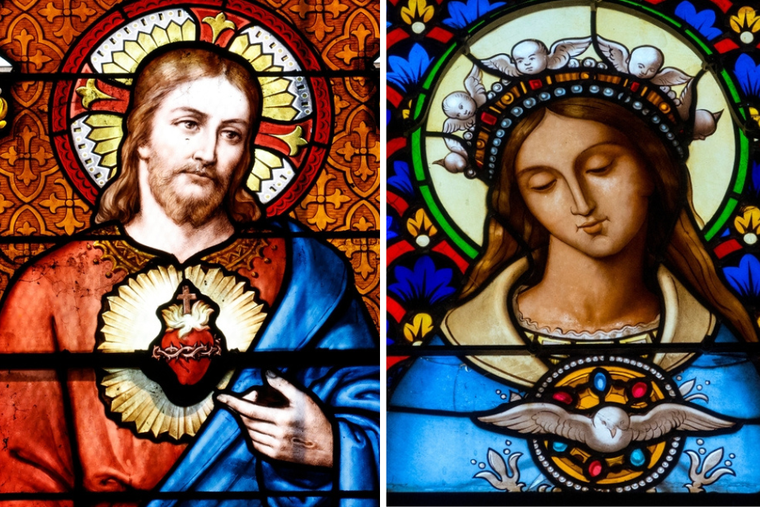
June, the month of the Sacred Heart, also highlights the Immaculate Heart of Mary with a major side-by-side celebration. The Solemnity of the Most Sacred Heart of Jesus, celebrated this year on June 12, is followed next day by the Memorial of the Immaculate Heart of the Blessed Virgin Mary.
“Liturgically, the reason that they're back-to-back and not in different months is to show the union, the closeness of those hearts,” explains Marian Father Donald Calloway of the Marians of the Immaculate Conception. Author of several books including Champions of the Rosary, he explains, “[T]he whole intention of the Church in making the feast back-to-back is to show that union, to show the closeness because if one was in May and another was in September, you might lose the connection. But back-to-back, we have a double header. It’s a whole celebration that lasts for two days.”
The Holy See’s Directory on Popular Piety and the Liturgy affirms, “The contiguity of both celebrations is in itself a liturgical sign of their close connection: the mysterium of the Heart of Jesus is projected onto and reverberates in the Heart of His Mother, who is also one of his followers and a disciple.”
That closeness began in her womb. Father Calloway finds it amazing to think that “Mary literally made the physical heart of God…We're not talking about God, we're talking about his human heart and the person of Jesus…the Immaculate Heart formed the Sacred Heart. That union is so intense because literally her bodily tissue and her blood went into shaping the heart of Jesus, the Sacred Heart. So there's a bond there that's so deep and so profound. And there's that union of the two hearts. It's almost like they beat as one.”
The New Testament makes and expands on these connections. Luke tells us that after the birth of Jesus and visit of the shepherds, “Mary treasured all these words and pondered them in her heart” (Luke 2:19). And after finding Jesus in the temple, “His mother treasured all these things in her heart.” (Luke 2:51).
Later, John tells us about the spear of Longinus piercing Jesus’s heart. "One of the soldiers opened His side with a lance, and immediately there came out blood and water” (John 19:34). At the same time Mary was pierced in spirit to fulfill Simeon’s prophecy.
Father Calloway added, “Their hearts are one really. They have the same desire, the same intention. So even though she wasn't crucified like our Lord, spiritually she underwent a certain martyrdom of the heart.”
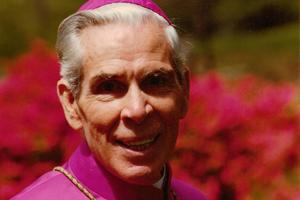
Venerable Fulton Sheen picked up this theme in what he called his favorite book, The World’s First Love. In it he explained, “Simeon had foretold that a sword her own soul would pierce; this time it came through the riven side of Her Son. Literally in His case, metaphorically in hers, it was a piercing of two hearts with one sword. It is this simultaneity of thrusts, this transfixion of His Heart and her own soul, which unites us in adoration of the Sacred Heart of Jesus and in veneration of the Immaculate Heart of Mary.”
At the same time, Father Calloway shares how this leads to her being our spiritual mother. “God used her heart like a womb. It was pierced. It was opened so that we could be born. We're born of her Immaculate Heart,” he told the Register. “Again, there's that union of hearts; that if we're her spiritual children, then we have to be in union with her and have the same intentions as her Immaculate Heart, because that's where we were born.”
The Feasts Foreshadowed
In the 17th century, St. John Eudes saw the two-hearts connection. In his book The Admirable Heart of Mary, the first book written on the devotion to both hearts, he explained, “The Admirable Heart of Mary is the perfect image of the most divine Heart of Jesus.”
Then establishing the feasts had its beginnings in June 1675 when Jesus appeared to St. Margaret Mary Alacoque and told her that he wanted her to establish devotion to his Sacred Heart. He also asked for the establishment of the Nine First Fridays with the reception of Holy Communion for reparation for offences against His Sacred Heart.
Then in 1917 at Fatima during the June apparition, Our Lady told Lucia, Jacinta and Francisco, “He [Jesus] wishes also for you to establish devotion in the world to my Immaculate Heart.” Similarly, our Lady of Fatima asked for the Five First Saturdays devotion, also receiving Communion, for reparation for the blasphemies committed against Mary’s Immaculate Heart.
Before Our Lady began appearing, the Angel of Peace told the children “The hearts of Jesus and Mary have merciful designs for you.”
Still, it took more years before the two feasts were placed side-by-side. In 1944 on the 25th anniversary of Fatima, Venerable Pius XII set the feast of the Immaculate Heart to be the traditional octave day of the Assumption on Aug. 22. The final step came in 1969 when St. Paul VI moved the celebration to the Saturday following the Solemnity of the Sacred Heart of Jesus, placing the Two Hearts liturgically side-by-side, just as Jesus desired at Fatima.
Popular Piety
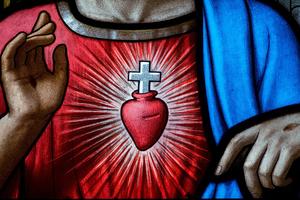
Most Catholics are very familiar with the images of the Sacred Heart and the Immaculate Heart in paintings and statues. Many Catholic homes display these two Hearts pictures.
As the Directory of Popular Piety observes: “In popular piety devotions to the Immaculate Heart of Mary resemble those of the Sacred Heart of Jesus, while bearing in mind the distance between Jesus and his Mother: consecration of individuals and families, of religious communities and nations; reparation for sins through prayer, mortification and alms deeds; the practice of the First Five Saturdays.”
Devotion to both Hearts plays an important part with the Spencer family — Susanna, the theological and associate editor for Blessed is She, and husband Mark. They have five children and co-write Living with Lady Philosophy.
“My husband and I consecrated our family to the Sacred Heart during our first year of marriage and have always had an image in the center of our family prayer space,” Susanna told the Register. “Our Lady’s Immaculate Heart is united so closely to her Son’s that devotion to her heart flows easily from devotion to her Son’s. As a mother, I rely on her heart to entrust my children to God’s call for them and in the suffering they encounter in life.”
The Spencers find many ways to celebrate. Susanna shared, “We learned of the existence of our three-month-old baby girl on the Feast of the Sacred Heart last year. We always celebrate the two feasts with a fun dessert. Sometimes we make a cake with an image of the two hearts frosted on top. We also like to pray a renewal prayer of our family consecration.”
Essential Devotion
Instructing his flock in 2023, Pittsburgh Auxiliary Bishop William Waltersheid wrote, “We know that in our spirituality and theology, the ‘“heart,’ as in the Sacred Heart of Jesus and the Immaculate Heart of Mary, means the entire person. So, when we hear that the Hearts of Jesus and Mary are attentive to our prayers, we realize that these persons so important in our life of faith are listening to us and are very willing to come to our aid…What a consolation it is to know that the Sacred Heart of Jesus and the Immaculate Heart of Mary are attentive to our prayers and supplications!”
Bishop Waltersheid sees the image of the ‘heart’ as the sign of love. “The Sacred Heart speaks to us of the love of God. The Immaculate Heart of Mary demonstrates for us the tenderness of the maternal love of the woman chosen to be the Mother of God Himself, the Mother of the Incarnate Word, and our Mother. We see in the Immaculate Heart an intercessor who, as our Mother, protects us and draws us to the Heart of Jesus.”
He added that we are invited to turn to the Hearts of Jesus and Mary very confidently in prayer and then share our love for the Hearts of Jesus and Mary with others. As we persevere in “prayer to the Sacred Heart of Jesus and the Immaculate Heart of Mary,” he reminded, “we are able in union with them to transform a culture of death into a culture of life and a world of violence and hatred into a civilization of love.”